
|
| Click on any image to see full size version |
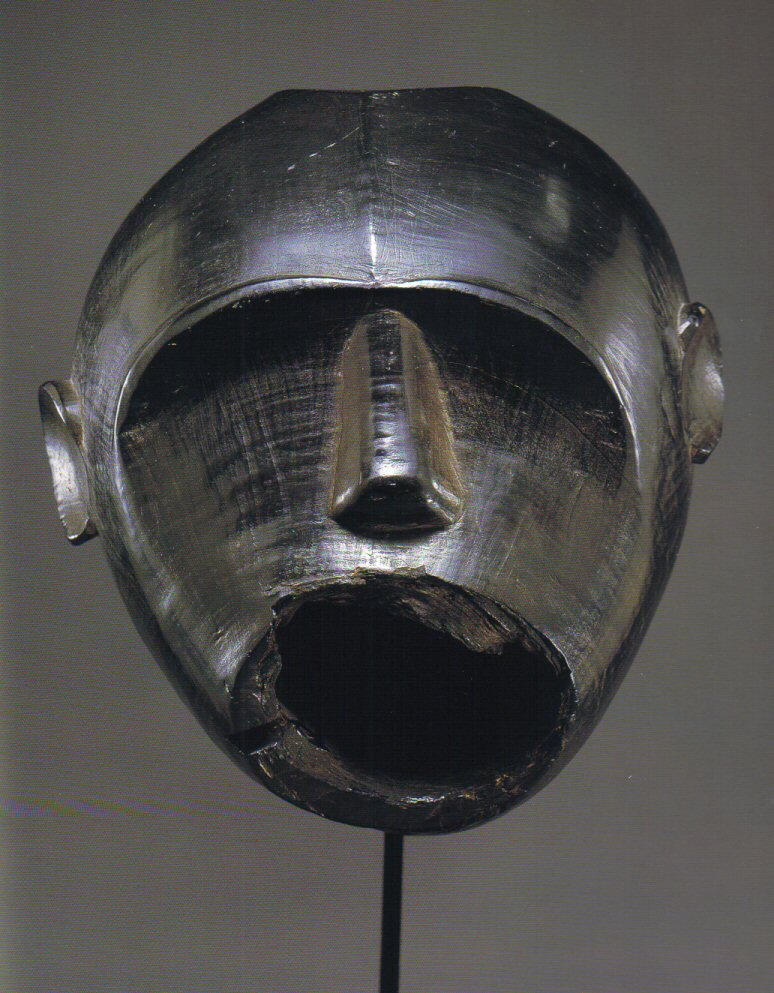
| Lot 229 A magnificent and rare Central African monkey head height 7 1/4 in; diameter 6 1/4in. (18.4cm.; 16.5cm.) estimate $150,000-250,000 SOLD for $310,500 USD of extremely dense wood, the hollowed head carved in the form of a rounded skull, with a flat triangular plane at the crown joining the medial ridge above the prominent asymmetrical brow, with a convex facial plane with raised rounded triangular nose and a large open circular cavity for the mouth, asymmetrical crescent ears held high on the head; exceptionally fine dark brown patina. Provenance: Rene Lalique, Paris Fr. Haviland, Paris Charles Ratton, Paris Morris Pinto, Paris Jay C. Leff, Uniontown Published: Einstein, Negerplastik, 1915:plates 14-15 Basler, Art Chez les Peuples Primitifs, 1929:number 39 Fry, Last Lectures, 1935: number 95 Carnegie Institute, Exotic Art: From Ancient and Primitive Civilizations: Collection of Jay C. Leff, 1959: number 245 The Museum of Primitive Art, African Sculpture from the Collection of Jay C. Leff, 1964: number 1 Carnegie, The Art of Black Africa: The Collection of Jay C. Leff, 1969: number 298 Wilkinson in Rubin (ed.), "Henry Moore" in Primitivism in Twentieth Century Art, 1984:599 Exhibited: Pittsburgh, Exotic Art: From Ancient and Primitive Civilizations: Collection of Jay C. Leff, The Carnegie Institute, 15 October 1959-3 January 1960 New York, African Sculpture from the Collection of Jay C. Leff, The Museum of Primitive Art, 25 November 1964-7 February 1965 Morgantown, University of West Virginia, Creative Arts Center, March 1969 Pittsburgh, The Art of Black Africa: Collection of Jay C. Leff, Carnegie Institute, 24 October 1969-18 January, 1970 This powerful monkey head has a long and prestigious provenance. As far as we know, it is the only known example of this type of head. A survey of its publication history reveals a number of previous stylistic attributions including Gbekre(?) of the Ivory Coast as well as Central Africa. It was William Fagg who in the early 1980's firmly attributed the work to Central Africa for the publication of the Primitivism in the Twentieth Century catalogue. It is interesting to note that this head, with its highly abstract lines and evident power, was amongst the works of African art which influenced the British sculptor Henry Moore (1984: 559-560). Moore's notebooks from 1922-24 reveal a sketch of this distinct head (ibid 559) as part of a comprehensive study of the art of Africa, Oceania and the Americas by Moore in the 1920's. His sketches from this period include studies of works in the British Museum as well as those in early publications of African Art. Undoubtedly Moore saw this work published in Einstein's Negerplastik (1915) as his drawing of the work is shown on page 120 from No. 3 Notebook (Wilkinson, ibid: 599). Of the impact of African art on his own work, Moore stated, 'to discover, as a young student that the African carvers could interpret the figure to this degree but still keep and intensify the expression, encourages me to be more adventurous and experimental' (ibid: 597). |


| Lot 227 An important and rare Fang female reliquary guardian torso height 111/2 in. (29.2cm.) estimate $500,000-700,000 SOLD for $1,542,500 USD the torso pierced through transversely beneath the tapering torso with incised scarification in arching forms on the front and rows of repeating diamonds on the reverse, the rounded shoulders hunched forward and leading to the curving arms held forward and framing the dramatic pendant conical breasts, a finely carved notched spine on the back, beneath a flat round face decorated with three lines of raised scarification inset and radiating from the downturned mouth, a similar single line across the domed forehead, with a raised nose and asymmetrical attached circular discs for the eyes, and framed by raised pierced circles for the ears, wearing a wig-like coiffure descending from the crown with elegant long crosshatched tresses and a smooth medial ridge; shiny black patina, Inagaki base. Provenance: Docteur Paul Chadourne, Paris Morris Pinto, Paris Published: Sweeney, African Negro Art, 1935: figure 350 Radin and Sweeney, African Folklore and Sculpture, 1952: figure 72 Elisofon and Fagg, The Sculpture of Africa, 1958: 258 Perrois, La Statuaire Fang Gabon, 1972:369 Laburthe-Tolra and Falgayrettes-Leveau, Fang, 1991: 104-105 De Grunne, "Fang Statuary: A Classical Art Form", in The World of Tribal Arts, June 1994, issue 2, cover and page 51, figure 3 Phillips, Africa: the Art of a Continent, 1995:323, catalog 4.95 Exhibited: New York, African Negro Art, The Museum of Modern Art, 18 March-19 May, 1935 Paris, Fang, Musee Dapper, 21 November 1991-15 April 1992 London, Africa: The Art of a Continent, The Royal Academy of Arts, 5 October 1995-28 January 1996 New York, The Solomon R. Guggenheim Museum, 5 June-29 September 1996 This extraordinary female torso was exhibited at the Museum of Modern Art in New York in 1935 in the first comprehensive exhibition on African Art in the United States. This seminal exhibition included more than 600 pieces from across the continent of Africa. All the pieces were photographed by Walker Evans, although a much smaller number, including this figure, are pictured in the catalogue. This figure was only one of a number of works lent to the exhibition by Dr. Paul Chadourne, a trench collector of African and Oceanic works of art whose objects were exhibited as early as 1930 at the Galerie Pigalle, Paris. Based on interviews with Fang people around the turn of the century Tessman (1913) wrote that Fang heads and torsos generally were earlier in carving date than the full figures, and they were thus subsequently much more rare. This expressive torso most closely resembles the famous Epstein figure, formerly in the Monzino collection (Vogel 1986: figure 99), and both are highly unusual within the corpus of Fang art. Tessman (ibid.) attributed the row of scarification marks, found on both figures, across the forehead to the Rio Muni Fang. In the case of these sculptures, the row on the forehead as well as the three rows on the chin are inset. This can also be compared with a large head of a closely related style, formerly in the Helena Rubinstein collection (Laburthe-Tolra and Falgayrettes-Leveau, 1991:106). The similar scarification markings have been incised and reach across only half of the domed brow. In addition, a number of formal qualities link this female torso and the Monzino male full standing figure, suggesting that they were more than likely carved by the same hand. The proportions of the large disc eyes to the face, the treatment of the ears carved as a circular discs in front of the coiffure, and the undercut coiffure carved as a single overall element show a strong cohesion of style. However, it is the plastic form of the body and the expressive nature of the faces in both figures which make them unlike any other known Fang figures and elevate them to the highest level of sculptural works of art. |


| 228 A fine Fang reliquary guardian head height I7 3/4 in. (45.1cm.) estimate $150,000-250,000 SOLD for $332,500 USD rising from a tapering rectangular plinth showing thick adze marks, and supporting an oval neck with adzed undercut section at the back beneath the large head with concave heart-shaped facial plane, flat chin with a slit incised mouth beneath the raised triangular nose framed by large circular copper plates affixed to the surface beneath the domed brow decorated with a rectangular panel of incised geometric motif at the forehead, and wearing a backswept coiffure with five raised transverse sections intersected by a single raised crest pierced twice for the attachment of numerous ornaments; exceptionally fine encrusted patina over a blackened surface. Provenance: Merton D. Simpson, New York Fang reliquary guardian heads are believed to pre-date the more widely known figurative sculptures (Tessman, 1913) Both were used as guardians to protect the baskets containing the bones and skull of a venerated ancestor and both are highly abstract. Stylistically, a number of features link this head with the great head, originally one of several superb heads, in the Helena Rubinstein collection (Sotheby's New York, May 8, 1996, lot 114)—the heart-shaped facial plane, the concave inset copper circular discs for eyes the slightly asymmetrical inset scarification markings on the brow and the fine rounded domed brow leading back into a raised and heavily abraded coiffure of numerous transverse ridges. This close stylistic cohesion suggests they may have been carved in the same atelier. In addition to the great expressiveness evident in this head, it shows extreme age, evident in the fine encrustation on the face and coiffure. The date of carving must therefore be placed well back into the nineteenth century, if not earlier. |
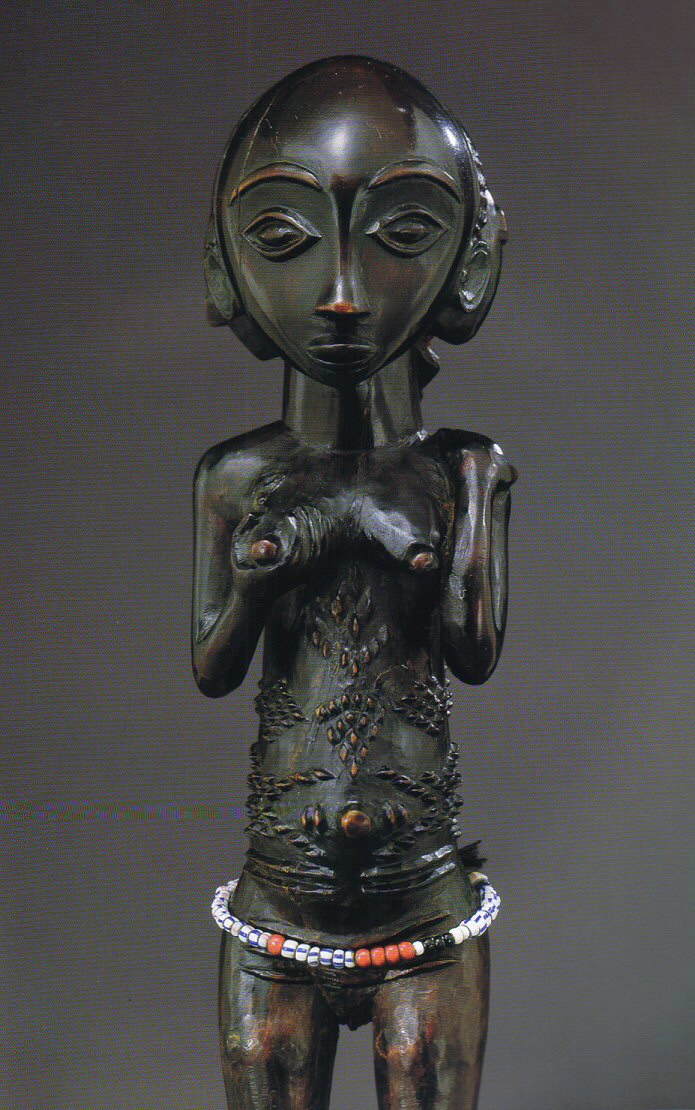
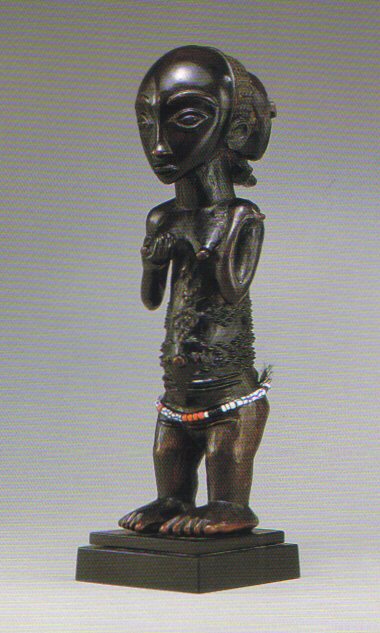
| Lot 231 - A superb Luba female figure Estimate $100,000 - $150,000 SOLD for 222,500 USD Standing, and leaning slightly forward, with wedge-shaped feet and finely articulated toes beneath bent legs and a protruding abdomen, with a deeply grooved spinal column, the torso tapering beneath conical protruding breasts and rounded shoulders with raised articulated shoulder blades, her right hand holding her breast and her left resting on her shoulder, beneath a cylindrical neck and large spherical head with exceptionally fine facial features including open almond-shaped eyes and a domed forehead, and wearing a coiffure of multiple braided rows and a backswept cruciform circular section, fine raised scarification on the torso; exceptionally fine and varied dark brown patina. Provenance: Merton Simpson, New York Nancy and Richard Bloch, California Morris Pinto, Paris This superb free-standing Luba female is so distinct stylistically that the hand can be clearly identified—the extraordinary domed forehead, the raised open oval eyes, the elaborate scarification patterning and the treatment of the coiffure form a cohesive style. Neyt (1994: 126) places other published works by the same hand within the 'Atelier of the master of Mulongo'—which was active not far from the confluence of the Lovoi and Lufira Rivers. The clarity and sensitivity of the work on this figure and the other known examples clearly show the hand of a master carver. For related examples by the same hand see Neyt (ibid:l26-l27) for a staff of authority by the same hand and (188) for two double figure neckrests, one in the National Museum of African Art (inv. 86-12-14) and another in the Museum of Mankind, London (inv. 1956 AF 27-270). See also Roberts and Roberts (1996: 197) for a bowl figure in the Museo Carlos Machado, Ponta Delgada (inv. no. 256) as well as another in the Museum of Natural History New York (inv. no. 2432B) (Neyt: ibid: 28). The elaborate and finely-carved scarification patterns place this figure firmly in the eastern Luba tradition. This type of patterning is a particular design that one sees again and again in Luba art. Roberts and Roberts (1996: 98-112) discuss in great detail the meaning of these elaborate markings including the names and forms of specific patterns and how they constitute a vocabulary. The gesture of the arms is highly inventive. The cupping of the breast probably relates to the meaning of other Luba objects in which a female figure gestures to her breasts—a reference to the role women play as keepers of the secrets of Luba royalty. However, the left hand resting on the shoulder is highly unusual—and its meaning has yet to be decoded. Both gestures, as well as the inventive iconography on the bowl figure in the Museo Carlos Machado suggest this carver was not only highly skilled, but extremely creative. |
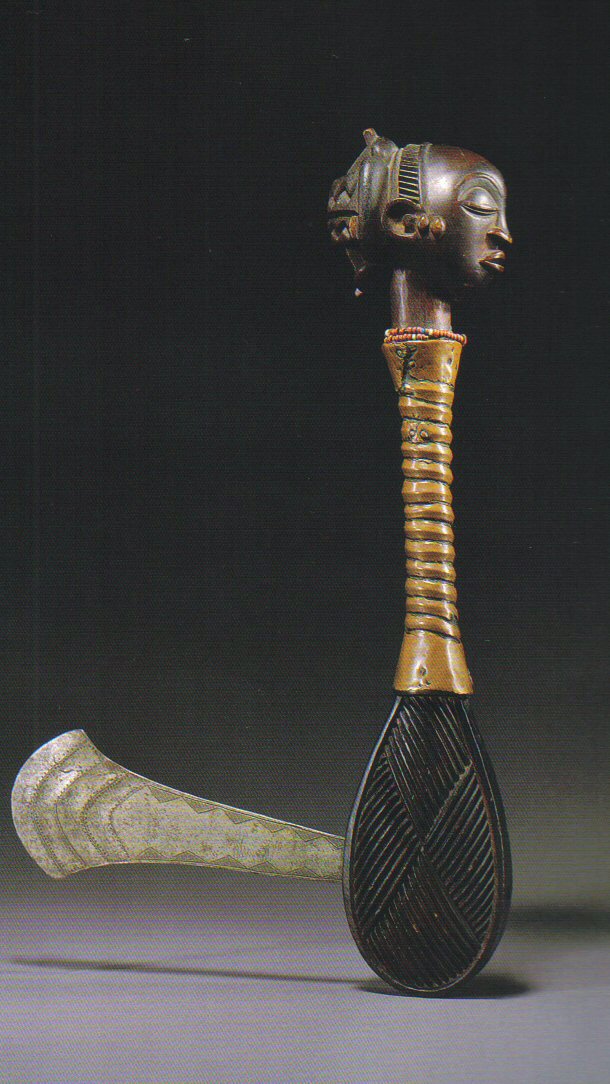
| Lot 53- A superb Luba ceremonial adze the handle in the form of a delicately carved human head with beads encircling the neck, and wearing an elaborately carved typical backswept cruciform coiffure, supported by a handle encircled by a flattened strip of copper affixed with metal staples, and flaring to a wooden oval-shaped head of the adze deeply incised with crosshatch motif terminating in an flat iron blade decorated with lightly incised geometric motif; fine reddish brown patina. height 16 1/4in. (41cm.) Provenance: Collected before the first World War by Heinrich Brand, an officer in the German Colonial Army. By descent through the family. Published: Schadler, 1994: 27 Schadler, 1997b: 342 Exhibited: Vienna, 1994 Munich, 1997 Burgrieden-Rot, 1998 Cf. Roberts and Roberts, 1996: catalogue 12 for a related example. See also Nooter-Roberts in Tervuren (1995:figure 165) for a ceremonial staff, probably by the same hand or same atelier, registered at the museum in 1932. As Roberts and Roberts note, these ceremonial axes belonged to the most important members of society, from royalty and titleholders to female spirit mediums and diviners. They might be worn over the shoulder or wielded in dance to signify rank and power of an individual. Used in initiation ceremonies, the axe symbolically clear(s) the path leading to civilization.' Estimate $20,000-25,000 SOLD for $156,500 USD |


| 206 A rare and important Fang male reliquary guardian figure Estimate Upon Request SOLD for $409,500 of elongated attenuated form, and rising from a roughly adzed cylindrical shaft with remains of an old label on the reverse reading '...Paris', the figure with splayed bent legs, wedge-shaped feet and pendant phallus beneath the extremely attenuated torso with flat strip incised with parallel rows defining the back, and broadening at the waist, tapering again near the underarms beneath rounded shoulders and muscular cutaway arms, with prominent cylindrical navel, all supporting the lengthy cylindrical neck and forward-protruding concave heart-shaped facial plane with flat chin, raised triangular nose and a number of vertical striations at the eyes, framed by incised crescent ears, and wearing an elaborate tripartite backswept coiffure pierced through for the attachment of ornaments; fine and varied dark brown patina with resinous areas; Inagaki base. height 25 1/4 in. (64.1cm.) Provenance: John D. Graham, New York Frank Crowninshield, New York Julius Carlebach, New York Jack Passer, New York Published: Graham, Exhibition of Sculptures of Old African Civilizations, 1936: page 5 The Brooklyn Museum of Art, African Negro Art: The Collection of Frank Crowninshield, 1937 Segy, African Sculpture Speaks, 1970: 217 and 280 Museum for African Art, The Language of African Art, 1970: number 341 Perrois, La Statuaire Fang du Gabon, 1972: 192 number 8 Robbins and Nooter, African Art in American Collection, 1989: figure 863 Exhibited: New York, Jacques Seligmann Gallery, Exhibition of Sculptures of Old African Civilizations, January 4-January 22, 1936 Brooklyn, The Brooklyn Museum of Art, African Negro Art: The Collection of Frank Crowninshield, May 1937 Washington, D. C, The Museum for African Art, The Language of African Art, guest exhibition at the Smithsonian Institution, 24 May-7 September 1970 In her article, 'John Graham and the Crowninshield Collection of African Art', Clarke (1995) offers a pointed discussion of Graham as an African art connoisseur, and artistic counsel to Crowninshield. John Graham was a New York artist who began collecting African art in the 1920's. His interest in this collecting field was fostered by his burgeoning relationships with members of the Parisian avant-garde. He was acquainted with many dealers and advocates of African art, including Charles Ratton, Louis Carre, Felix Feneon, and Cahiers d'Art editor, Christian Zevros. By the end of the 1920's Graham was a well-known connoisseur of African art, who developed his own criteria for collecting African works of art. This philosophy was published in his book, System and Dialectics of Art (1937). Fang reliquary figures were of particular interest to him, as they captured the most elegant and 'classical' form of African sculptures. In the late 1920's, Graham consulted Frank Crowninshield on the purchases for the latter's collection. A purveyor of taste in the years before World War II, Crowninshield was the editor of Vanity Fair from 1914 to 1936 and one of the seven founders of the Museum for Modern Art in New York. Works from his African art collection were prominently exhibited in important shows such as African Negro Art, organized by James Johnson Sweeney in 1935. By the late 1930's and early 1940's both Graham's and Crowninshield's collections were dispersed. Graham's collection was sold at Rains Gallery in New York, 1937, and Crowninshield's in two Parke-Bernet sales in 1941 and 1943. Much of the rest of Crowninshield's African collection was acquired by the artist Chaim Gross. Even in Graham's early notes on his collection, it is clear that he held this figure in high esteem calling it the 'dancing pahouin' (Fang). Fewer than five of these 'dancing' figures exist. The form—with its great attention to elongation and abstraction—is striking within the genre of Fang sculpture. For another dancing Fang compare with the figure in The New Orleans Museum of Art, bequest of Victor Kiam. |
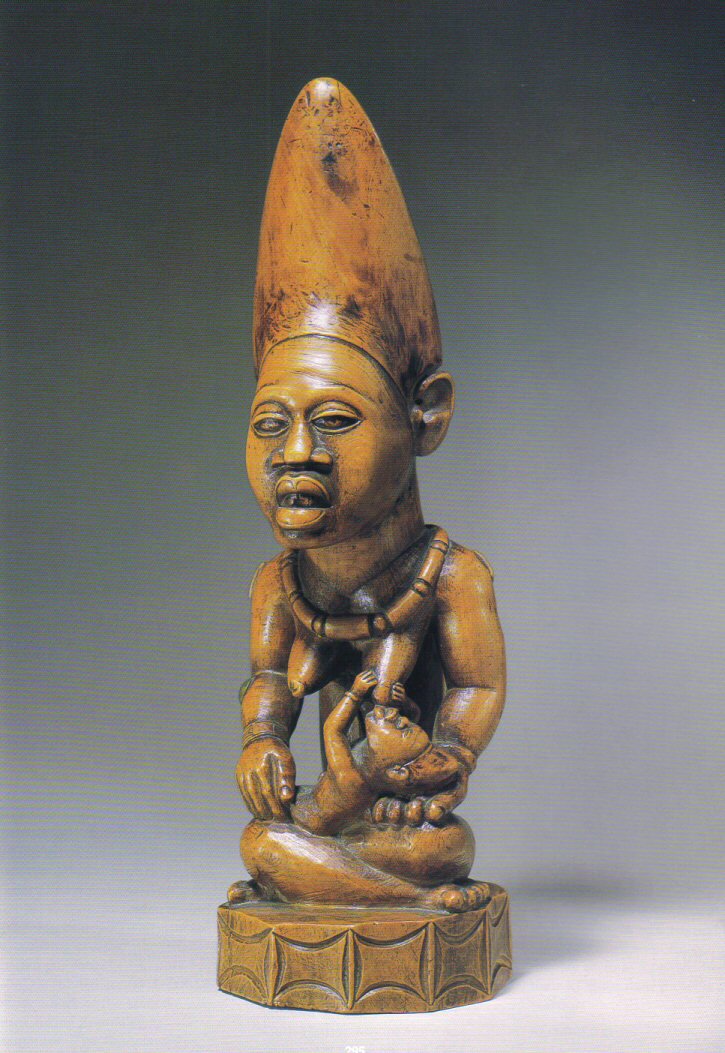
| Property from a West Coast Collector Lot 295 A superb Kongo maternity figure in the form of a female figure seated crosslegged on a faceted base incised with a geometric pattern encircling the rim, and cradling a child suckling her breast, the thick neck supporting the delicately carved head with full naturalistic lips, broad flattened nose and heavy lidded eyes, back-set ears, and wearing a high peaked coiffure, carved bracelets, necklace and waist band, raised scarifications on the back, a brass tack on the lower part of the right arm; fine, honey brown patina. height 11 3/8 in. (28.9cm.) Published: Lehuard, Art Bakongo, 1989: 580, figure K-6-1-2 Exhibited: Los Angeles, California, Mother and Child in African Art, Los Angeles County Museum of Art, May 12, 1985-June 7, 1986. New York, Mother and Child in African Sculpture, The African-American Institute, October 21, 1986-February 28,1987. Estimate $25,000-35,000 SOLD for $51,750 USD |
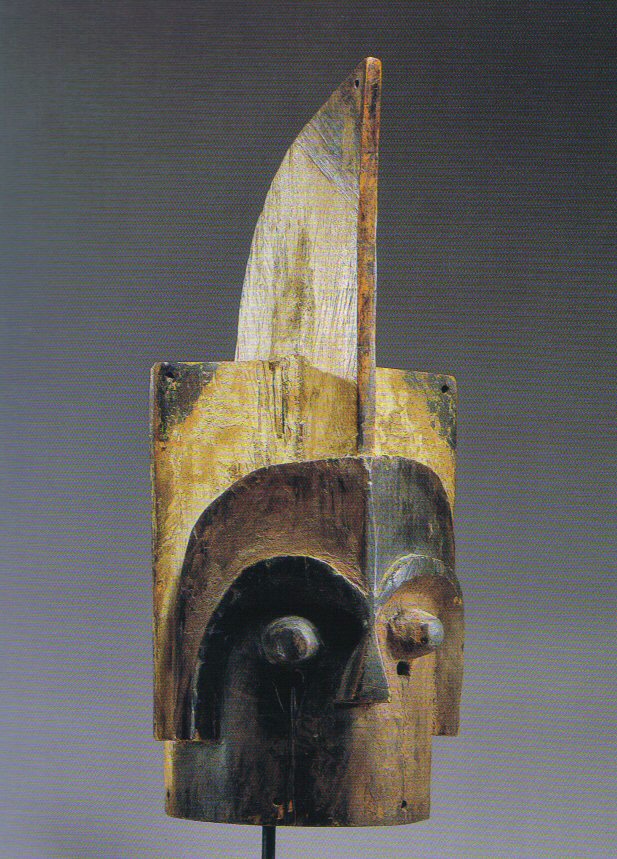
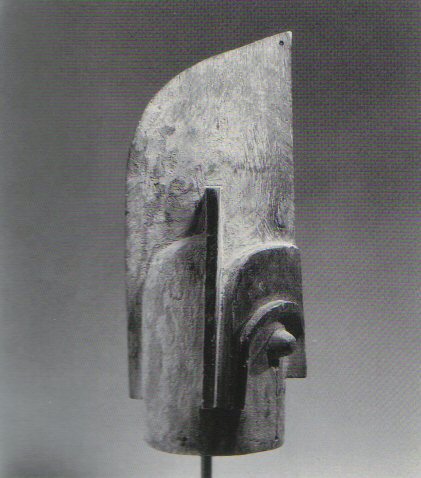
| Property from the Collection of Joseph and Doris Gerofsky 309 A rare Bakota helmet mask (Mbuto) emboli, of immense hollowed cylindrical form, and pierced around the lower rim for the attachment of fiber, with a raised triangular nose leading into a single dramatic undulating brow forming the conical protruding eyes above pierced vis ion holes, the angular head with large flange emanating from the crown, and intersected by a transverse squared flange above, a hole at each corner for attachments, fine geometric incisions under the eyeholes; exceptionally fine layered red ochre and black pigments on the face and kaolin on the flange. height 27in. (68.6cm.) Provenance: Acquired from Raymond Kerr, New York Bakota helmet masks are exceptionally rare. See Leuzinger (1971:number R14) for another of extremely similar form and structure, possibly by the same hand. See also Sotheby's London, December 7, 1971, lot 191 for a related mask with a nearly identical treatment to the nose and brow, but exhibiting a slightly different treatment to the coloration. Leon Siroto wrote the following comments about this mask, This mask very well exemplifies the style followed by the BaKota (in the strict sense) of the region of Makokou in northeast Gabon. As an example of its type, this mask is quintessential both in form and decoration. A slightly more detailed version of this mask, possible by the same hand, can be seen in E. Leuzinger, Afrikanische Kunstzverke, Essen 1971, no. R14.' Estimate $25,000-35,000 Didn't sell |
| Rand African Art home page Fang style comparison page Sotheby's auction recaps from The City Review Educational Resources page |