
| A wonderful headrest from the Tsonga people South Africa, Zimbabwe or Mozambique Believed to be late 19th or early 20th century Measurements: 6 1/2" long x 4 1/4" tall x 3" wide Provenance: Ex. Dan Jordan collection, USA - Originally acquired by D. Jordan in 1973 in Toronto, Canada Toronto was home to a lot of missionaries who were in Africa in the early part of the 20th century. This headrest is believed to have come from the family of a missionary, but there is no information on the original collection date or place. A TRULY fantastic headrest in my opinion! Wonderful patina, fine adze marks, beautiful form and carving. Tsonga carvers are wonderfully creative with the carving of the supports of their headrests and each one you see documented or published is a unique and inventive form. I think that is what draws me so strongly to their headrests and I really love how the curved supports intersect on my headrest. I've enjoyed the feedback I've received when I have shown it to several other headrest collectors. I think my favorite feedback has been from Willy who owns the Calverton Collection of African headrests: "Let me just say that your Tsonga headrest is an absolute killer, well done!" -Willy W. Click on any photo to see high resolution version (1128 x 848 / aprox 314kb in size) |
|

| Tsonga headrest in the collection of the Metropolitan Museum of Art, NY Headrest, 19th–20th century South Africa or Mozambique; Tsonga people Wood; H. 4 13/16 in. (12.4 cm) Bequest of John B. Elliot, 1998 (1999.47.101) Carved wooden headrests have a long history in Africa. This Tsonga headrest from southern Africa represents a specific stylistic interpretation of the form that Tsonga carvers have developed. Headrests were made to sleep on while at the same time protecting the elaborate coiffure of the sleeper. Headrests are small, their height being the average distance from ear to shoulder. The origins of this tradition are unknown, but the oldest extant examples date back to ancient Egypt. This headrest, like most others, consists of three basic elements: two horizontal planes joined by a vertical post. Tsonga artists have invested a great deal of creative ingenuity in designing the composition and structure of the supporting vertical post. This headrest's support is composed of a V-shaped bracket resting on a downward U-shaped form. The horizontal plane on top takes a slightly concaved, rectangular form and features incised geometric patterns along the surface edges. Included on the underside of the upper ledge are small pendant pieces known as ears or lugs. Lugs can take a number of different forms; in this case, they are square tabs positioned parallel to the main axis of the headrest. Nearly all Tsonga headrests have lugs, but not all headrests that have lugs are necessarily Tsonga. The base of this headrest is formed from two conjoined circular forms. The symbolism of the form and composition of Tsonga headrests remains a point of debate. One interpretation draws upon a popular theory regarding the headrests of the nearby Shona peoples. Among the Shona, headrests are believed to be metaphors for women. There are clues for interpreting some Tsonga forms as female, for example, it has been suggested that the lugs of Tsonga headrests can be decorated with beaded earrings like a young girl. In Tsonga society, however, headrests are not limited to male-only use as they are in Shona society. So it seems unlikely that women slept on "female" headrests, either metaphorical or representational. Meaning may not necessarily lie with the formal appearance and structure of the headrest, but in its use and history. A headrest that has been owned and used by a particular ancestor has a value beyond anything indicated by its physical appearance. In other cases, as the headrest was consistently used and handled, it would become personalized to such a degree that upon the owner's death, he would be buried along with the headrest and other personal items. Headrests have also been described as mhamba, a Tsonga term used to describe any object, act, or even person that is used to establish a bond between the gods and people. For example, the headrest is conceived to serve as a communicating vehicle through which to contact ancestors and spirits in dreams. From: Metropolitan Museum website |
| The 2 headrests directly below are from the Sotheby's auction of the Egon Guenther Collection. The high prices are most likely due to provenance even though the headrests are both exceptional. |

| Sotheby's New York - African Art from the Egon Guenther Family Collection SALE NY7557 AUCTION DATE 18 Nov 00 LOT 169 A superb Tsonga/Shangaan neckrest Estimate 8,000—12,000 USD Lot Sold. Hammer Price with Buyer's Premium: 41,000 USD (The highest price at that time for a headrest from this culture) DESCRIPTION A superb Tsonga/Shangaan neckrest the base in the form of two flat discs connected by a central section, beneath the support structure of two cylindrical sections rising from the base a rectangular section running diagonally and decorated with two raised linear bands on either side, and supporting two parallel cylindrical sections, all beneath the upturned pillow with looping pendant lugs and a repeating zigzag motif on either end; exceptionally fine medium brown patina, signed 'A.A. Jacques' and 'EG'as well as the number '50/968' in pigment on the underside. height 5 1/2 in. (14 cm.) Provenance: Collected by A.A. Jacques in the late 1920s or early 1930s, number 50/968 The Jacques Collection, now in the Johannesburg Art Gallery, comprises the largest collection of headrests by the Tsonga-related peoples. The 111 headrests in the Art Gallery (as well as this lot) were collected by Reverend A. A. Jacques of the Swiss Mission during a fifteen year period beginning in the mid-1920s. Most of the pieces were found in the Pilgrim's Rest (Bushbuckridge) area in the eastern Transvaal and were documented as Shangaan (Tsonga) (Becker 1995:59). It was Reverend Jacques who, in the late 1940s, created the first formal classification system for southern African neckrests. |

| Sotheby's New York - African Art from the Egon Guenther Family Collection SALE NY7557 AUCTION DATE 18 Nov 00 LOT 155 A superb Tsonga/Shangaan headrest Estimate 8,000—12,000 USD Lot Sold. Hammer Price with Buyer's Premium: 32,375 USD DESCRIPTION A superb Tsonga/Shangaan headrest height 6 1/2 in. (16.5 cm.) the bilobed base tapering to a quadriform base, and supporting a central columnar support flanked by two arching openwork forms, the left as viewed from either side decorated with a zigzag motif, and supporting an arching pillow with a square pendant lug at either end, signs of fine adze marks covering the surface; exceptionally fine and varied patina, 'EG' in pigment on the underside. Provenance: Acquired from Natalie Epstein, wife of pianist Isadore Epstein, 1953 As Becker (1991;1995) and others have noted, placing an exact attribution on southern African neckrests is very difficult. In general little information was recorded when the works were collected, and placing historical works into the context of modern groups is very difficult. The region where this headrest probably originated overruns modern political borders including south-eastern Zimbabwe, southern Mozambique and the northeastern Transvaal. Waves of migration during the nineteenth century make this a culturally complex area. (ibid:206) Headrests were utilitarian, protecting the hairstyle of the sleeper. Over extended periods of ownership and use they may have become invested with complex spiritual associations. It is known that headrests were often buried with their owners, but in some cases they were retained as vehicles through which the late owner might be contacted in the ancestral realm. (ibid). While this neckrest shows many of the classical elements of a Tsonga-peoples neckrest, including the pendant lugs on the side, the overall precision in the carving and the interplay of surface and form is highly unusual. The 4 examples below are also from past Sotheby's auctions |


| Rand African Art home page CLICK HERE to see a wonderful Tsonga headrest in the Calverton Collection African headrests main page |
| Tsonga headrest This headrest is no longer in my collection |

| Examples and information below for reference purposes the objects below are NOT in my collection The 4 wonderful headrests directly below are from the Daniel Rootenberg Collection Daniel has a passion for Tsonga headrests and sent me these images below to put on my website for reference purposes. (Thanks Daniel) |




| A group of headrests in the new Musée du quai Branly in Paris The 3 headrests on the right hand side are Tsonga headrests, the larger headrest in the back is a Shona headrest and the one in the back left I believe is Zulu and the one in the front left I didn't get notes on so I'm not sure at the moment. |

| Tsonga headrest in the Daniel Rootenberg Collection |
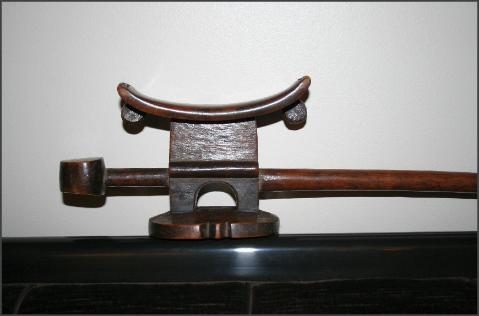

| A wonderful and no so common headrest in the Daniel Rootenberg Collection that is incorporated into a staff. There are a few examples of this in the book "Sleeping Beauties" as well. |
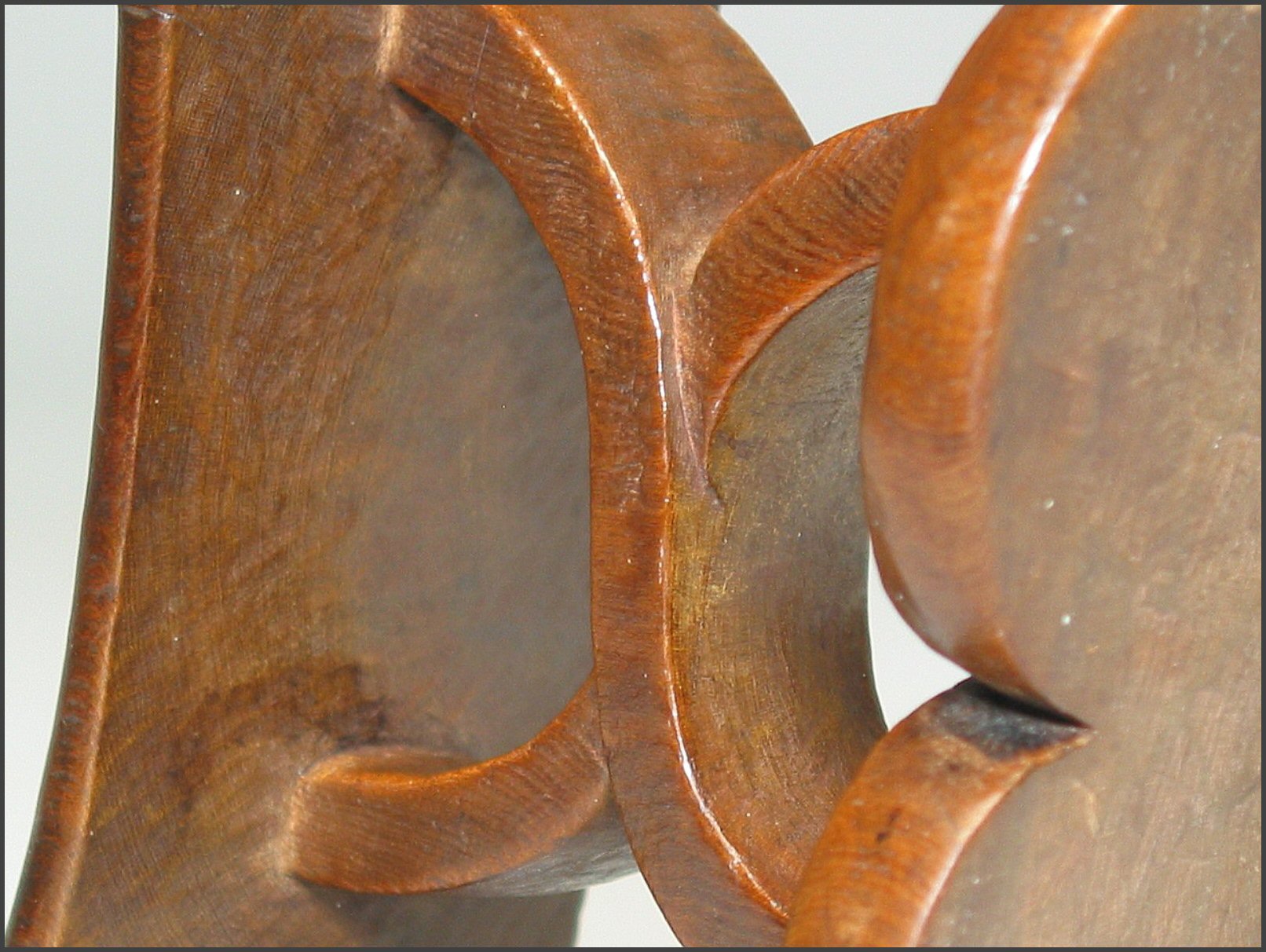
| Another wonderful and no so common headrest in the Daniel Rootenberg Collection Ex Sotheby's May 2004, Lot 84. Previously Ex Ella Winter, circa 1945 Sotheby's catalog note: "This neckrest is rare in its conception and demonstration of great skill and virtuosity by the carver. Carved as two independent, but interlocking, elements, the top portion swivels presumably to give more comfort to the owner. Carved in two parts, the gently tapered base with two crescent shapes on either side in relief, and supporting a complex column of two independent interlocking elements with points at either end for insertion into either end to pivot, the pillow with down turned flanges underneath and incised zigzag motif at the edges; fine slightly glossy reddish brown patina." The Joss Collection also consists of a headrest like this and can be seen below. |


| Tsonga headrest from the Jerome Joss Collection in the book "Speeping Beauties" with detachable upper and lower platforms. FMCH 86.2439 |

| This headrest at the Musee quai Branly also has a detachable upper and lower platform. |