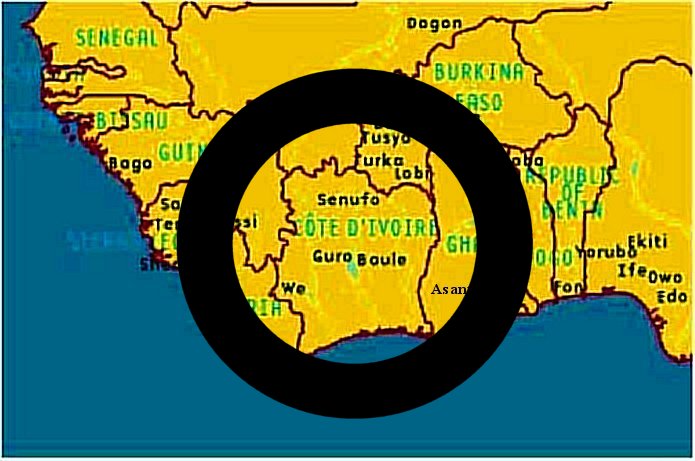
| SENUFO Burkina Faso, Côte d'Ivoire, Ghana and Mali |
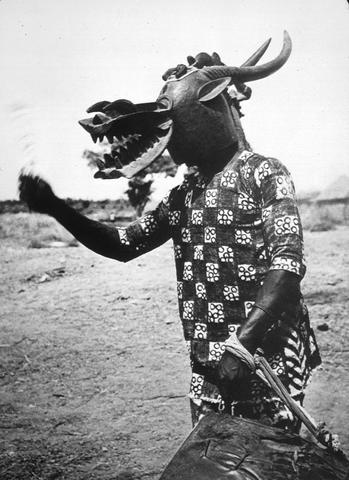
| Kponyungo Ethnic group: Kufulo Vernacular name and meaning: Kponyungo is the semi-public name (nyun-go means "head"; kpoo wii, high mid-tone, means "the dead one" or "corpse" and kpoo, high tone, means "to kill".) Thus, a broad translation of Kponyungo is "funeral head mask". Material components: Mask- carved, wooden, zoomorphic helmet mask; same dome shaped helmet and antelope horns as on the Gbon masks. The Senambele see the masks as basically an antelope head that is given additional selective features for both symbolic and decorative purposes. The antelope represent specific species, a fact that accounts for some important 'style' differences to be observed in collections. Kponyungo masks tend to be more elaborate then the austere forms of the Gbon and after 1950 were painted with lavish polychrome decorations. Whereas the Gbon usually has only the chameleon figure on the crest, the Kponyungo frequently has a group of figures, which may vary slightly from one mask to another. A Common grouping is a bird (fish eagle, long crested helmet shrike, or hornbill) biting a chameleon attached to a cup form, the latter a reference to a container for magical herbs and leaves. Another element can be a female figure added to the muzzle of the mask. Occasionally a magic bundle of porcupine quills and feathers is inserted into holes on the head and muzzle, but is not a consistant feature, as it is with the artisan helmet masks. The most critical features are the warthog tusks and the antelope horns. Costume: Jump suit with drawstring neck and straight-cut legs and sleeves (hands and feet allowed to show in contrast to the conservative Gbon raffia costume) painted in deep red dyes or sienna brown with geometric and figurative patterns. Each suit has a unique design. Other attributes: The masker carries a large, double-membrane, cylindrical drum beaten with a flexible, bludgeonlike stick. The Kponyungo is accompanied by an age mate playing the most sacred of the Kufulo Poro society drumbs, a long narrow cylindrical one played with a bent stick. Performance context(s): Ancestor rites in the commemorative funeral for graduates of the Poro society. The Kponyungo masks, one for each participating Popo orginazation, drum by the side of the carved wooden bed used in Central Senufo funeral ritual. This ritual always takes place by the small kpaala (a long wooden shelter with stacked layers of wood poles placed at alternating angles, serving both as domestic courtyard furniture and as a visual reference to the ancestral lineage of the katiolo chief) of the lineage group to which the dead man belonged. |

| A very nice older example (probably Gbon style) with signs of age and use. This example is surmounted by a chameleon. Aprox 29" in length This piece is no longer in my collection |


| Someday I hope to find, and own, a piece like the ones below. |

| SENUFO (SENOUFO, SIENA, SIENNA) Burkina Faso, Côte d'Ivoire, Ghana and Mali The Senufo number 1,000,000 to 1,500,000 and live in Côte d'Ivoire, Ghana, Burkina Faso, and the extreme south of Mali. They live principally off the fruits of agriculture and occasionally hunting. Senufo agriculture is typical of the region, including millet, sorghum, maize, rice, and yams. They also grow bananas, manioc, and a host of other crops that have been borrowed from cultures throughout the world. Small farm animals such as sheep, goats, chickens, guinea fowl, and dogs are raised. Minimal amounts of hunting and fishing also contribute to the local economy. Labor is divided between farmers and skilled artisans, and while it was once thought that these segments of society did not intermarry, In addition to a belief in a creator deity, ancestors and nature spirits, a central concept in Senufo religion is a female ancestral spirit called “ancient mother” or “ancient woman,” the sacred guiding spirit of each poro society. All adult men belong to the poro society, which maintains the continuity of religious and historical traditions, especially through the cult of the ancestors. The poro is the pillar of communal life. Responsible for initiation and training of the young boys, it is aimed at shaping an accomplished, social man who is integrated to the collective; it aids his entry into public responsibilities. A woman’s association, the sandogo, in charge of divination, is responsible for contact with the bush spirit who might be bothered by the activities of the hunt, farming, or of artisans. The Senufo produce a rich variety of sculptures, mainly associated with the poro society. The sculptors and metalsmiths, endogamous groups responsible for making the cult objects live on their own in a separate part of the village. The attitude shown toward them by other Senufo is a mixture of fear and respect, owing to their privileged relationship with the natural forces that they are capable of channeling in a sculpture. During initiations, headpieces are worn that have a flat, vertical, round or rectangular board on top decorated with paint or pierced work. Many wood carvings of male figures depict these headpieces, sometimes on rhythm pounders used by young initiates, who beat the earth to call upon the ancestors to take part in the ceremony and purify the earth. The carvers also produce ritual female statues, including mother-and-child figures, as well as statuettes depicting bush spirits and supernatural beings and equestrian figures. Large statues representing hornbills (often seen also on masks) and used in the lo society as symbols of fertility are the standing birds called porpianong. Figures of the hornbill are used in initiation, and groups of birds on a pole are trophies for the best farmer. Figures of male and female twins and of horsemen are used in divination. These represent the spirit familiars enabling the divination process. The diviners themselves are women, forming the sandogo society. Shrine doors and drums are carved in relief, and small figures and ritual rings are cast in bronze. Several types of mask are used depending upon the occasion. The kpelie, a human face with projections all around, is said to remind initiates of human imperfection. Danced by men, these masks perform as female characters. Animal-head masks usually combine characteristics of several creatures--hyena, warthog, and antelope. A type of animal mask called waniugo has a cup for a magical substance on top; these masks blow sparks from their muzzles in a nighttime ritual protecting the village from sorcerers. Among the Naffara group of the Senufo, masks of similar form but with an interior cavity too small for a human head are carried on the top corner of a rectangular, tent like costume called kagba. This mask is the symbol of the Lo, which only initiates may see. In the Korhogo region, deguele masks appear in pairs at funerals. They are of plain helmet shapes topped with figures whose bodies are carved to resemble a pile of rings. Source: www.zyama.com |