
| Lobi Bateba yadewara figure |
| The boundaries of Lobi communities are difficult to discern visually, for there is no center. Villages are comprised simply of several compounds living under the rules, protection, and beneficence of a particular deity, thil (plural thila), associated with their land. Each family compound too has at least one presiding thil. Social behavior is regulated and adjudicated by these thila, whose will is passed to ordinary people by priests and diviners. It is thila, for example, who order sculptures and other art forms to be made. The most important of these forms is the clay or wood sculpture called bateba. Human-like in form, a bateba acts as an intermediary between a particular thil and the human community. Lobi carvers derive no special status from their work, perhaps in part because anyone can carve without specialized training. They are paid little; indeed, some thila are said to adversely affect a carver who takes any money at all. As a result, Lobi carvings are highly variable in style and degree of finish, a fact that does not in the least hinder their effectiveness in shrines. What seems to be more important to the Lobi, or better to their thila, is that a bateba act, for it is considered a living being able to see, communicate, and intervene on behalf of its thil. While stylized, bateba are complete in having the usual body parts, although most are highly simplified in their artistic renderings. Normally heads are enlarged, perhaps so the work of the god will be more effective. Other features may reflect specific powers. Some referred to as Bateba Duntundara, considered dangerous, block entrance to harmful forces such as disease or witchcraft, and are depicted with one or both arms held up. Others have sad expressions because their function is to mourn for their owners and they are called bateba yadewara or "sad" bateba. Bateba yadewara, are characterized by bent arms with sometimes one touching the face, and their purposes are to assuage grief and to aid in overcoming adversity. (Scanzi) Figures with two heads represent deities whose ability to see in several directions at once makes them exceptionally dangerous and powerful. Figures without any specially defining posture or expression, and considered "ordinary" by the Lobi and are called "phuwe", nearly always have faces that can be seen as grim or angry, for it is thought that only in such a state can the bateba act forcefully. Such visual clues to meaning are not always clear, however; the Lobi themselves have conflicting and ambiguous interpretations of their imagery, and regional variations complicate things further. Thus it is always preferable to have data from specific shrine contexts. References: A History of Art in Africa If you are interested in learning more about the Lobi, CLICK HERE to go to some great online reference articles. Link will open in a new window. |

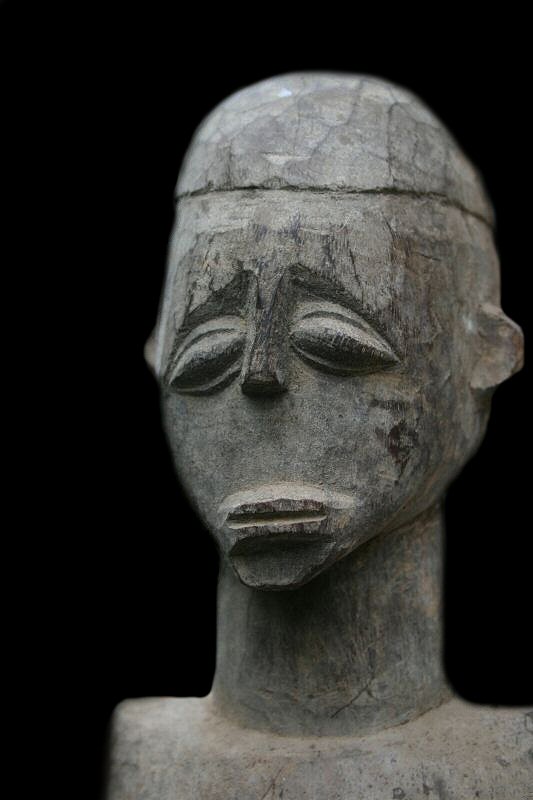
| Lobi Bateba yadewara or "sad" bateba 25.4 inches tall (65 cm) This piece is not in my collection, someone bought it before I could, I think it is wonderful and I love the expression so I decided to leave it on my website. If the person who bought this figure ever sees this page and wants to sell it I would LOVE to buy it from you... |
Other examples for reference purposes

| A group of late 19th/early 20th century Lobi figures Height: 17,3 to 53,5 cm Collection du Musée des Beaux-Arts d'Angoulême (Poitou-Charentes) |
| The 3 figures below are fantastic in my opinion. |

| Sotheby's - Paris Art Africain et Océanien, African and Oceanic Sale Auction Date : Dec 5, 2003 Lot 116 : ENSEMBLE COMPOSÉ DE TROIS STATUES, LOBI, BURKINA-FASO Dimensions haut. a. 53 cm, b. 27,5 cm et c. 25,5 cm Estimate:€ 1,500 - € 2,000 |


| Sotheby's - New York African, Oceanic and Pre-Columbian Art Auction Date : May 14, 2004 Lot 32 : A FINE LOBI HEAD Description the neck tapered and fragmentary and supporting the large head with finely worn and symmetric features, the pouting, oval mouth beneath large oval eyes bisected by a pointed nose, and wearing a single-crested, close-cropped coiffure with broad, incised striations; deep greyish brown patina. Dimensions height 19 1/2 in. 49.6cm Estimate:$ 18,000 - $ 22,000 Price Realized:$ 21,600 Provenance PROPERTY OF VARIOUS OWNERS André Schoeller, Paris Notes Cf. Kerchache (1974: 49) for a closely related head with similarly worn features. |
| Sotheby's - New York African & Oceanic Art - Auction Date : Nov 14, 2003 Lot 21 : A SUPERB LOBI HEAD Description DETAILED DESCRIPTION the elongated cylindrical neck supporting the head with a finely arching jawline leading to the pointed chin beneath the full, parted lips baring teeth, the naturalistic nose framed by large protruding almond-shaped eyes and a delicately curved browline, with demilune ears pierced for attachment and wearing a backswept, ridged coiffure with a pendant flange at the nape of the neck; exceptionally fine varied and weathered greyish brown patina with areas of white deposits. Dimensions height 13 1/4 in. 33.5cm Estimate:$ 18,000 - $ 22,000 Price Realized:$ 42,000 Provenance PROPERTY FROM AN AMERICAN PRIVATE COLLECTOR Jacques Kerchache, Paris, circa 1975 Published Leuzinger 1972: 57. Leuzinger 1977: 111, Kerchache 1974: 23, 57 and 61, Meyer 1981: 102 |

| Figure with two heads, bateba Dokpa Lobi Wood H. 58 cm Tomkins Collection In Lobi cosmogony, Thil Dokpa are spirits of the bush, above human beings and below Thila, invisible spirit creatures with human properties and characteristics. Thil Dokpa "are considered as living beings, active from the moment they are set upon an altar... They are then able to see, to communicate between themselves, and to protect and help humans in many ways and in various practical domains of daily life...once installed on the altars, [they] become active auxiliaries of the invisible spirits, the Thila, against witchcraft, evil spells and sickness and, on the other hand, to bring wealth, fertility, marriage, strength and happiness to whomever places them on his altar."(Giovanni Franco Scanzi 1987:31, 34) Provenance: Parcours des Mondes, Paris, September 2004 |
| The shrine photo and photo of figures below was taken from the book History of Art in Africa Shrine with Bateba figures of Wood, Clay and terracotta, Midebdo region, Lobi 1980 |
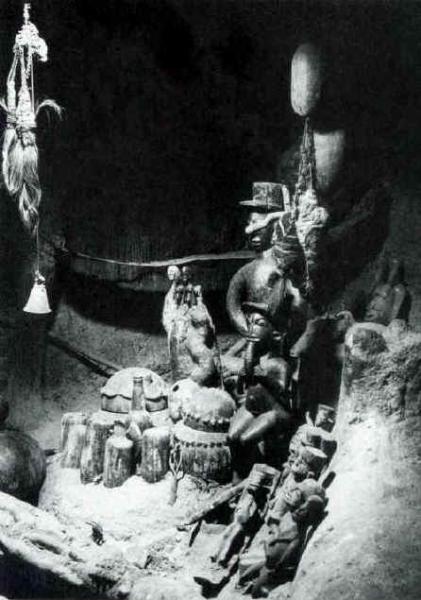
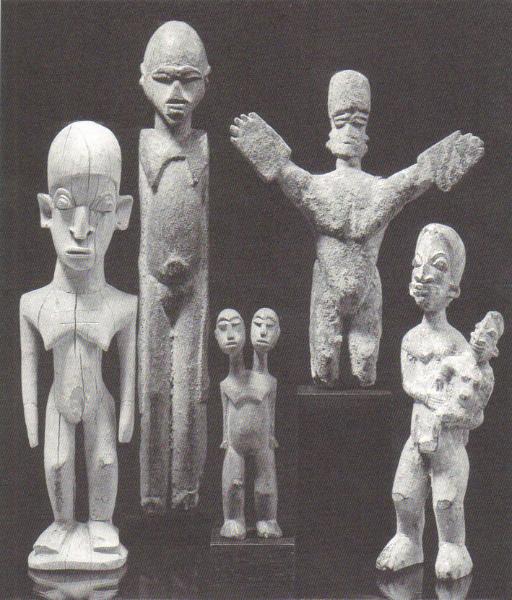
| Photos of the Lobi shrines from: http://www.dogon-lobi.ch/lobialbum.htm |


| Information and photos below from: Metropolitan Museum of Art |

| Shrine Figures: Couple (Bateba Phuwe) Lobi, Burkina Faso Wood; male: H. 57.2 cm (22 1/2 in.); female: H. 46.4 cm (18 1/4 in.) 20th century Thomas G. B. Wheelock Collection |
| The impetus for the creation of these works and the manner in which they should ideally appear came from spirits who conveyed the desired images through the medium of a diviner. Their subsequent realization fulfilled a prescription that resulted in curing an ailment or otherwise relieving some personal difficulty. According to Lobi conceptions of existence, God (thangba yu), the Creator of all life on earth, is an abstract and distant force. (1) More directly engaged in human experience are the thila, invisible and bodiless beings endowed with superhuman powers and abilities. Through the medium of diviners (buor), the thila issue injunctions against certain kinds of behavior; anyone who violates them will be punished with an ailment or some other misfortune. They also provide the means to reverse these conditions by prescribing cures and protective measures, also conveyed through buor. This dynamic was set in place by thangba yu in order to establish standards of political, social, and moral order in Lobi society, which humans had been incapable of managing by themselves. At the time of creation, according to oral traditions, humankind had enjoyed a carefree state in which thangba yu had provided for all its needs, a world where sickness and death were unknown, as were war or conflict of any kind. As a requirement of these idyllic conditions, thangba yu prohibited adultery and killing—commandments that were violated when the population grew out of control. Consequently, thangba yu retreated forever, leaving humanity to provide for itself and vulnerable to suffering and mortality. To mitigate this isolation, the Creator assigned to the thila the responsibility of responding to human needs and protecting people against witchcraft and sorcery. The directives (bonoo) given to individuals through buor are very exacting and must be fulfilled with precision. Failure to do so is thought to lead either to some form of punishment by the thila or to the persistence of the difficulties being experienced. Because they are amorphous beings, the thila depend on human mediums to communicate their instructions. Thila select individuals to fulfill this role by revealing themselves directly to them, or through notifying other diviners. Individuals usually resist this calling, as it is considered an onerous responsibility in view of the time commitment it represents and its lack of remuneration. Training is relatively informal and consists of observing consultations and rituals and learning the signs that the thila use to communicate.(2) Individuals consult diviners to gain insight into a broad range of situations that concern them. They enter into this relationship without describing the problem at hand. Instead, the diviner positions himself beside the client, grasps his hand, and, in order to determine independently the nature of the problem and which thila is involved in this particular situation, poses a series of questions that can be responded to with "yes" or "no" answers. Responses are indicated through specific movements of their joined hands.(3) A diagnosis ultimately reveals behavioral prohibitions that must be followed, sacrifices that are required, and instructions that may request the construction of a shrine or the commissioning of figural sculpture (bateba).(4) Small wood figurines are often part of the collection of paraphernalia owned by the buor, whereas works that are commissioned to fulfill prescriptions are larger in scale. The sculptor (bateba thel), who may himself have been directed toward his vocation by his thila, carefully follows the guidelines for such works, provided by the spirits through the diviner.(5) This couple represents a unified vision of the human form but displays subtle distinctions between the male and female figures. Although the female is slightly smaller in scale, she shares the same bold rectilinear cast, crisply rendered features, and gradually swelling torso with a pronounced navel. Both are depicted in a state of intense concentration, eyes closed and lips pursed, the male figure facing forward while his female counterpart turns her head in profile. This creates a dramatic shift between the orientation of their bodies and her gaze. Lobi figural sculptures commissioned as a result of a divination consultation represent tibila thil, people who help a spirit, and are designed to be placed in a residential or public shrine.(6) These two figures are thought to be bateba duntundara, a genre of bateba that serve to shield their owner against the witches that might attempt to enter his or her home.(7) Duntundara can be found in a broad range of representations, including figures that gesture dramatically or feature unusual physiological characteristics such as multiple heads or arms. Standing with their arms at their sides, this couple falls into a category of "plain" (phuwe) figures. Despite their tranquil stance, they embody an attitude of vigilance and acute awareness that surpasses ordinary reliance on sensory perception and intimidates potential malefactors. 1. Piet Meyer in Peek 1991, p. 92. 2. Ibid., p. 94. 3. Labouret 1931, p. 453; Piet Meyer in Peek 1991, p. 96. 4. Piet Meyer in Peek 1991, pp. 98–99. 5. Ibid. 6. Meyer 1981b. 7. Piet Meyer, Kunst und Religion der Lobi, exh. cat. (Zurich: Museum Rietberg, 1981), p. 56; Meyer 1981a, pp. 21–22. Source: Metropolitan Museum of Art |

| LOBI brass Chameleon in my collection |


| A Lobi figure from the Maurer Collection bateba Figure (Lobi) 6" http://www.amherst.edu/~afroart/14maurer.html |
| A Lobi figure from the Maurer Collection bateba Figure (Lobi) 7.2" http://www.amherst.edu/~afroart/14maurer.html |
This page
requires
JavaScript to
display
properly.
requires
JavaScript to
display
properly.