| Tellem headrest |
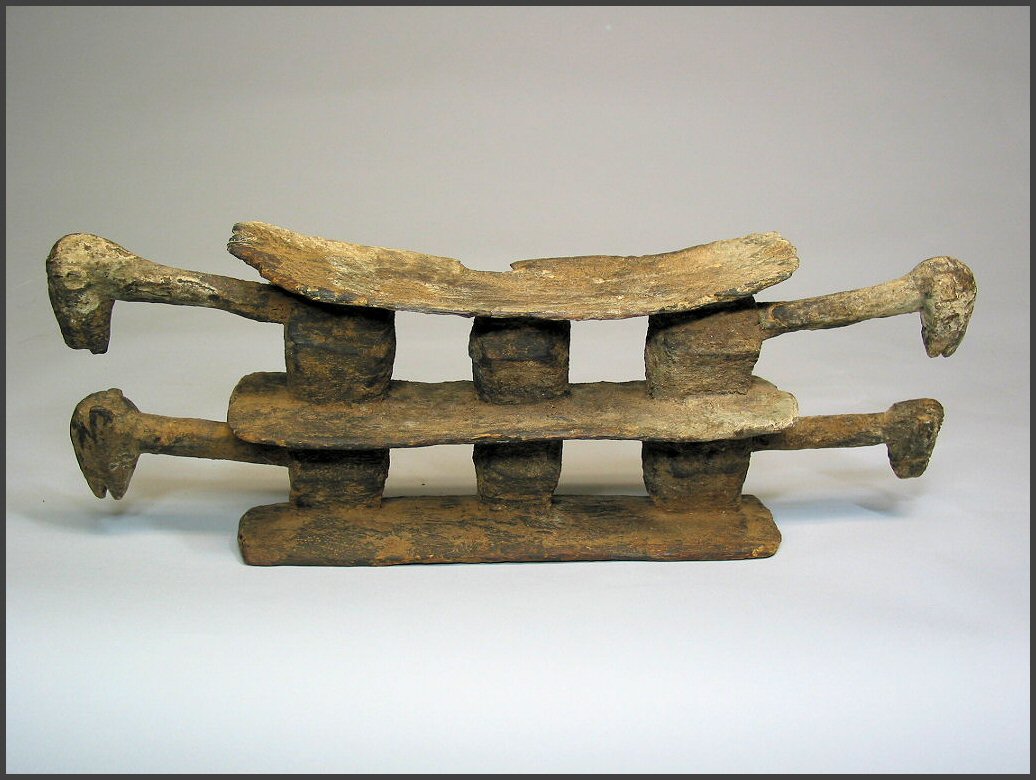
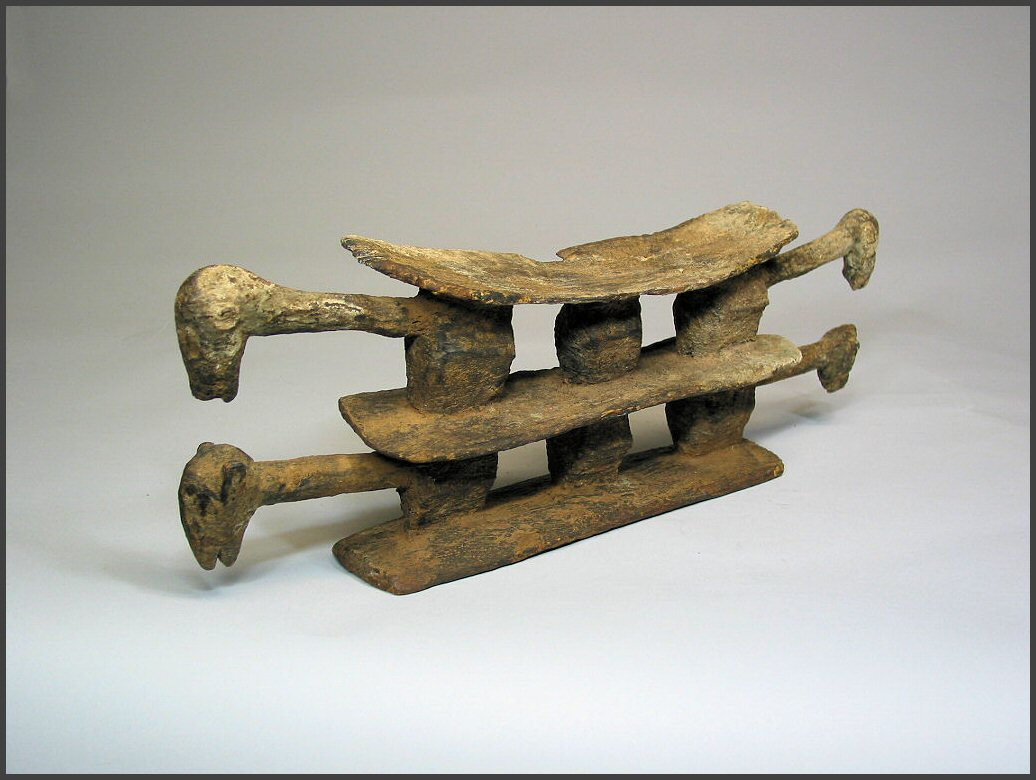
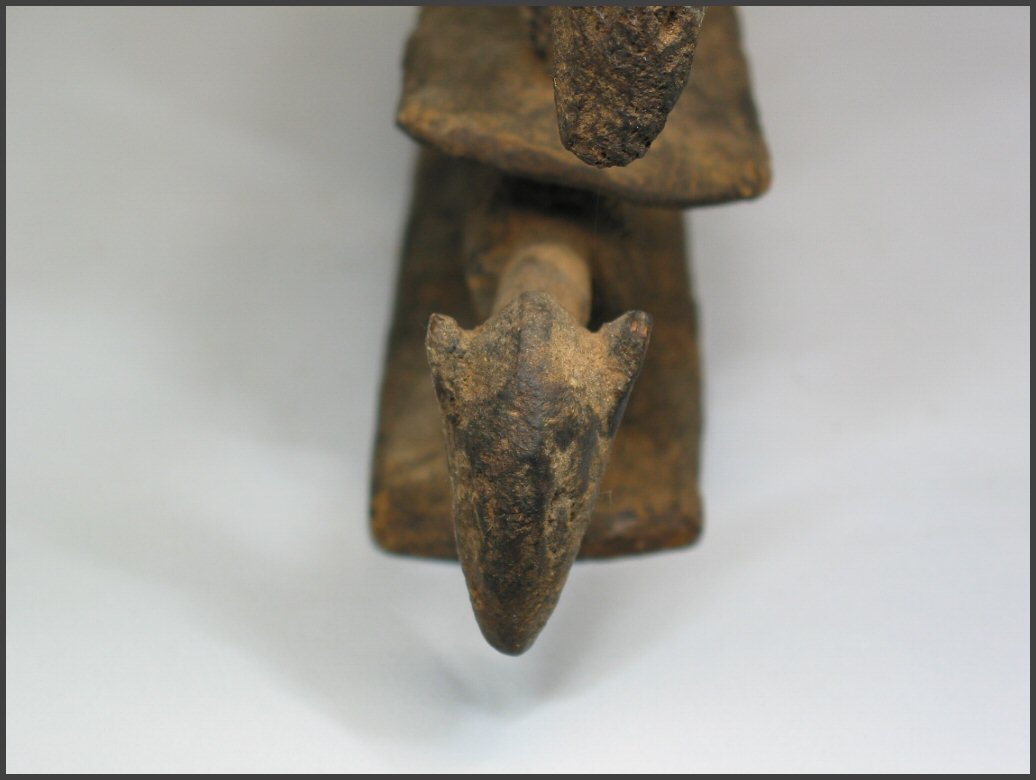
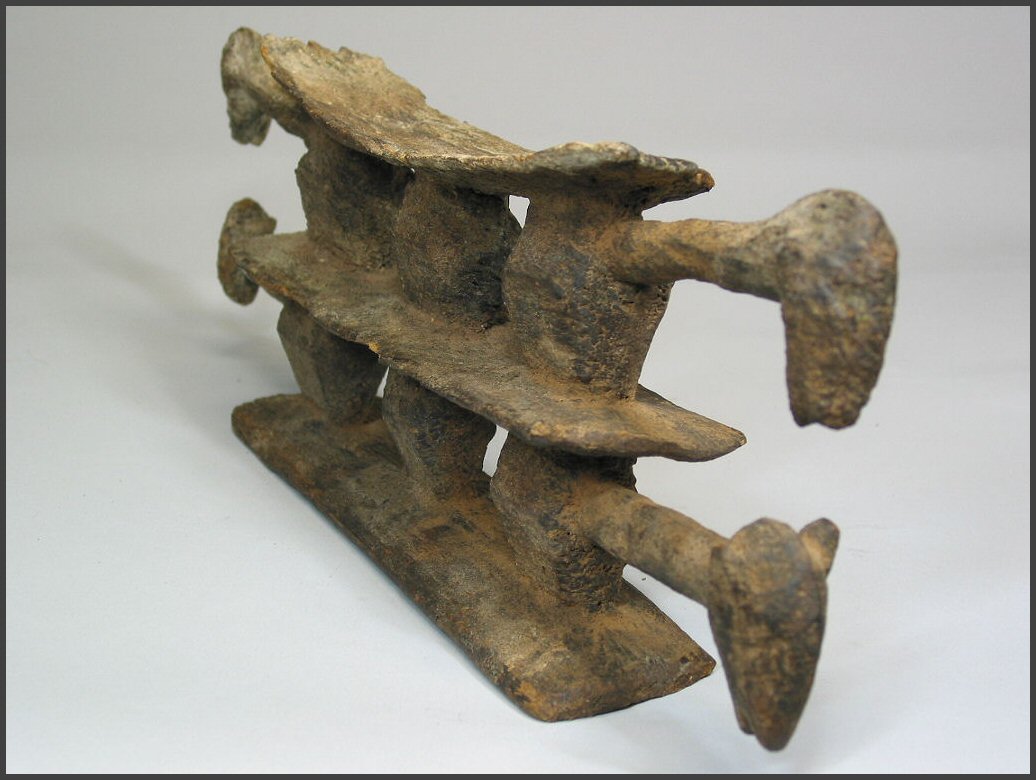
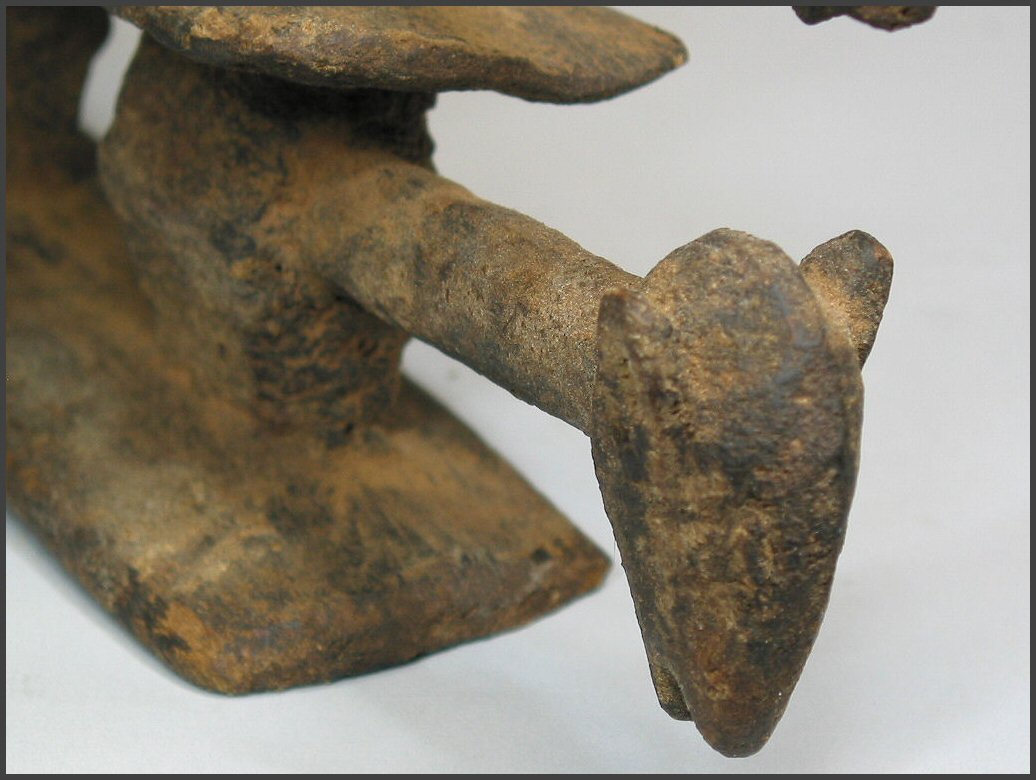
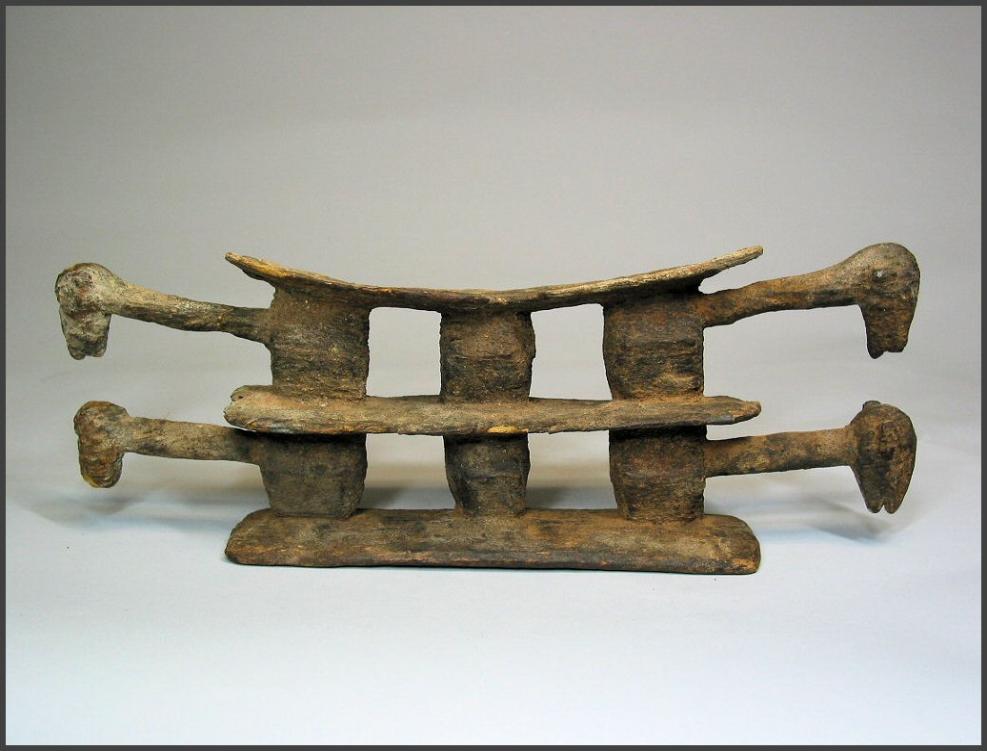
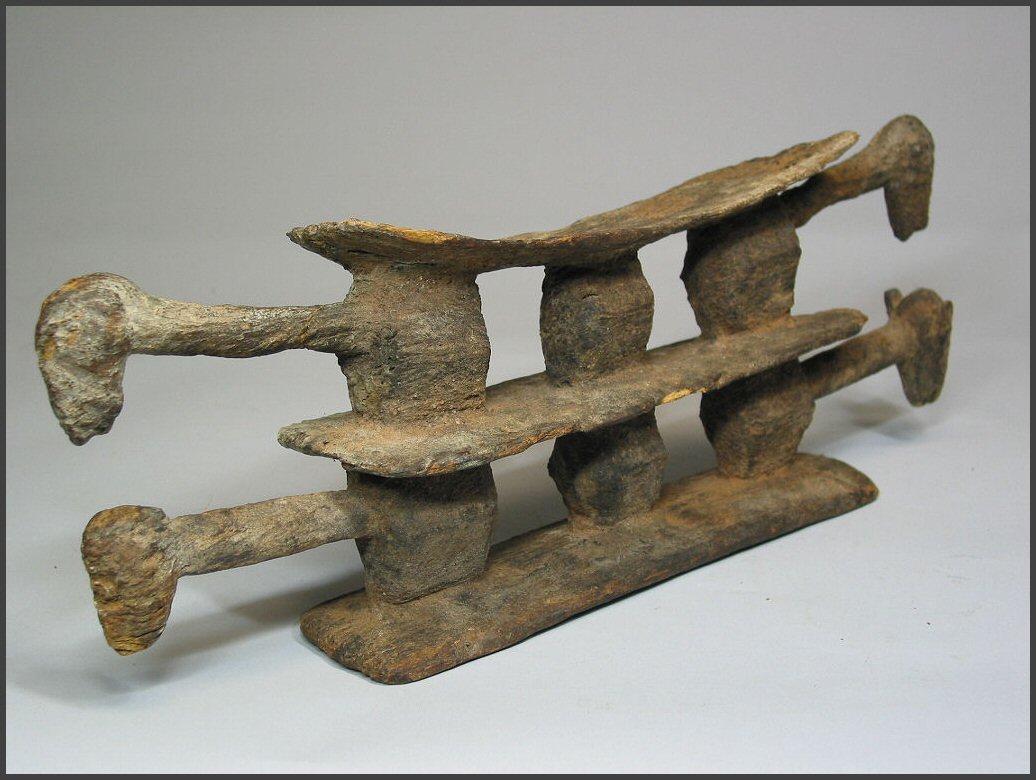
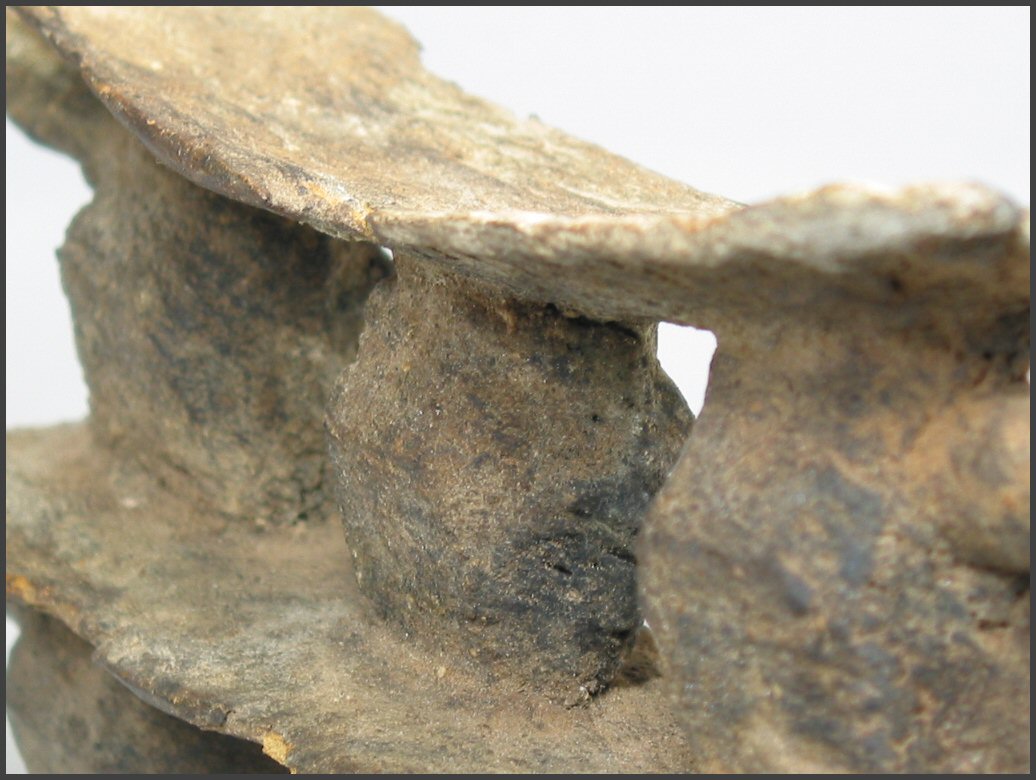
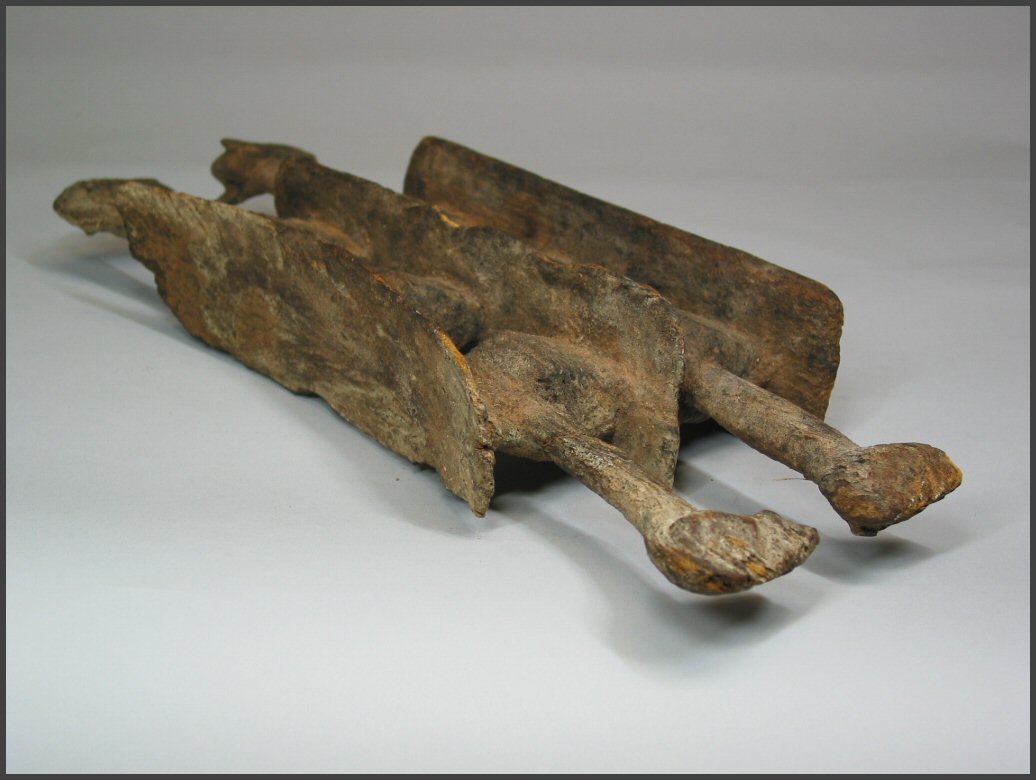
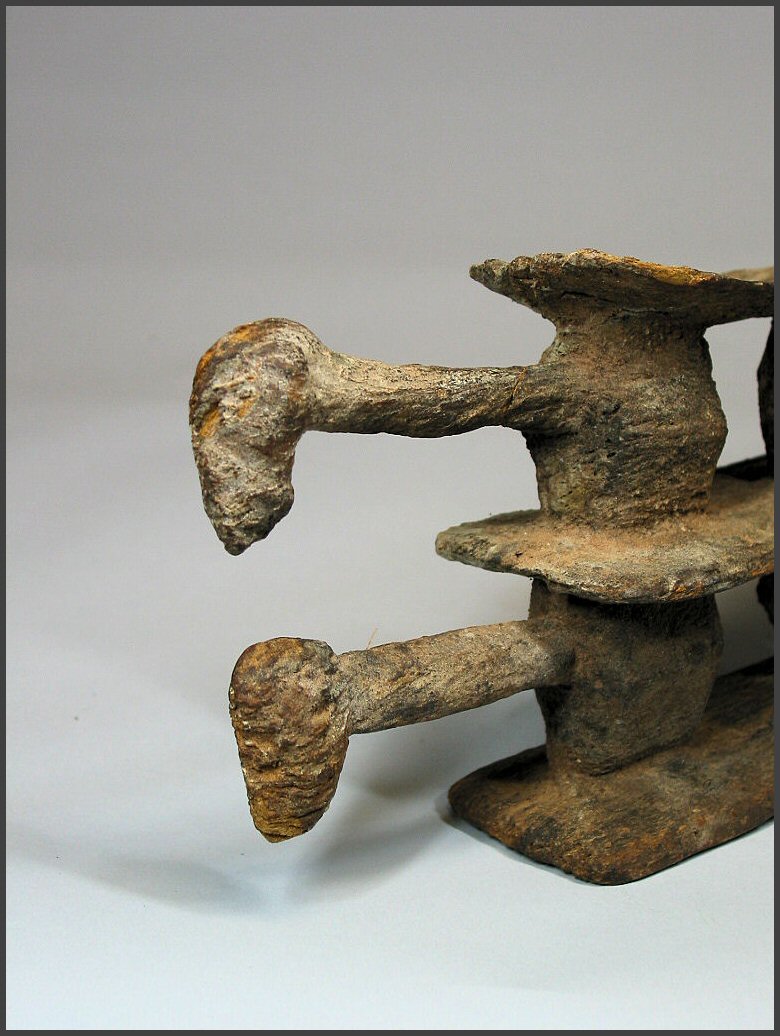
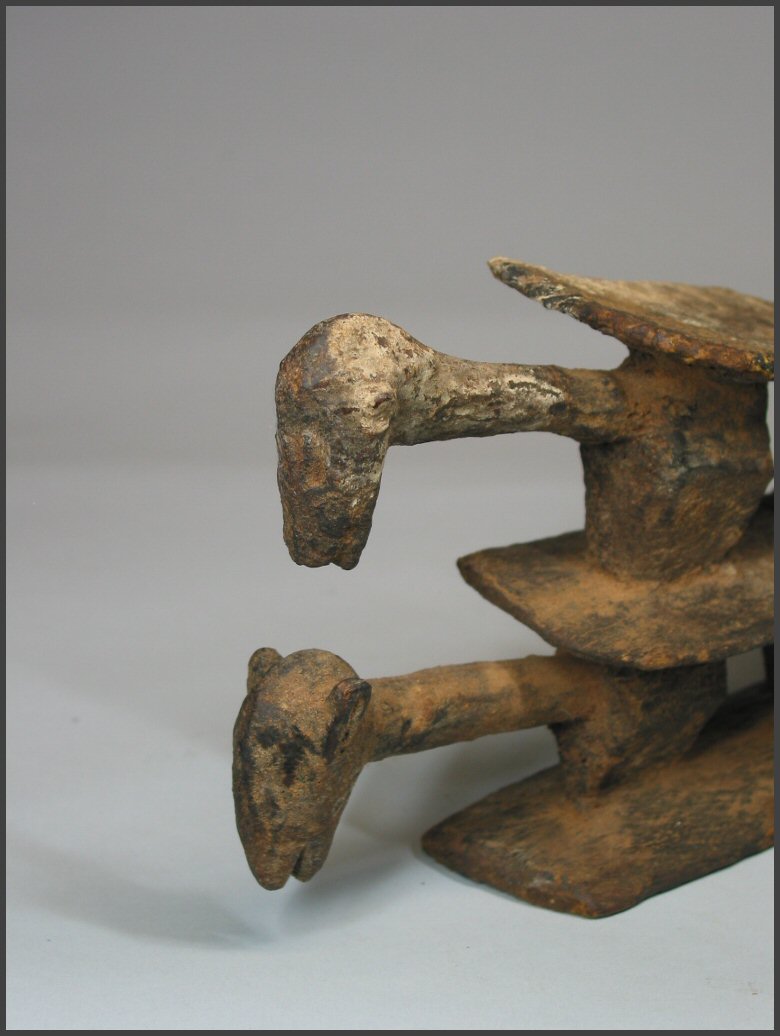
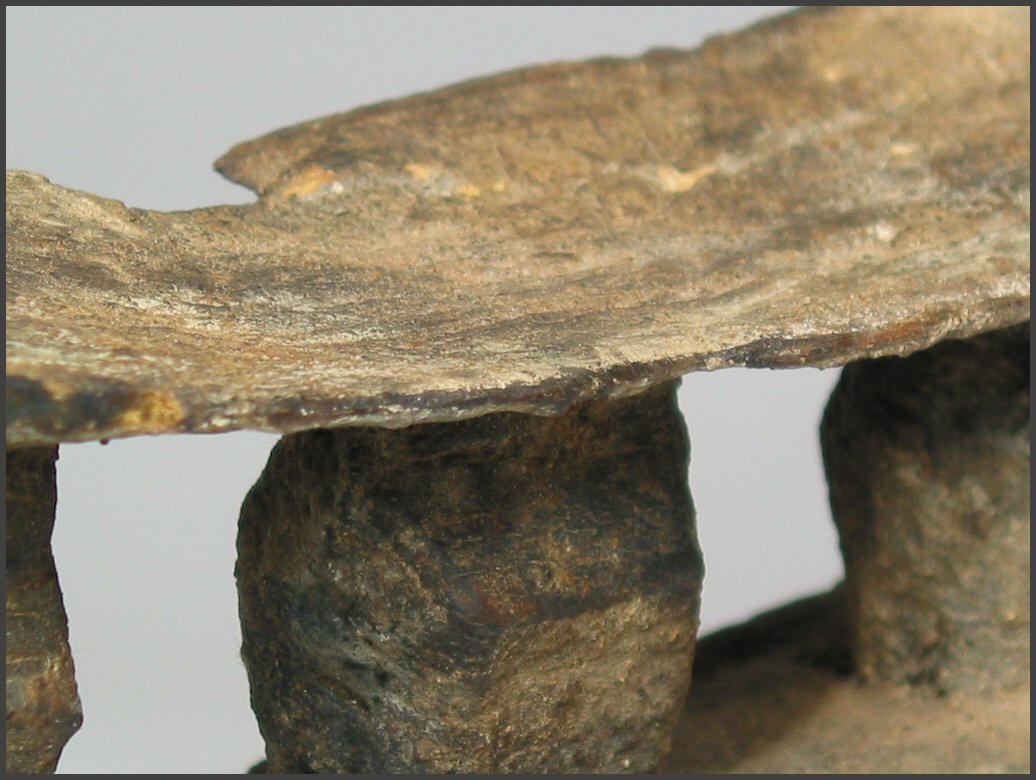
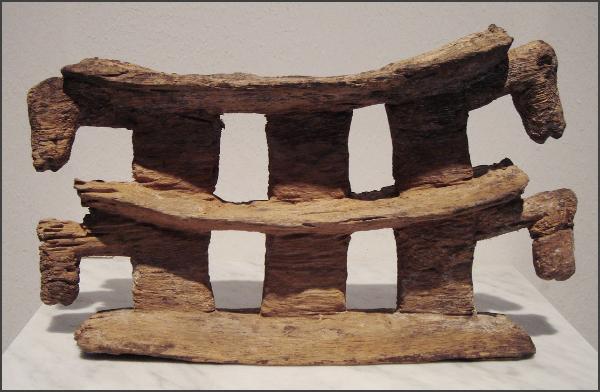
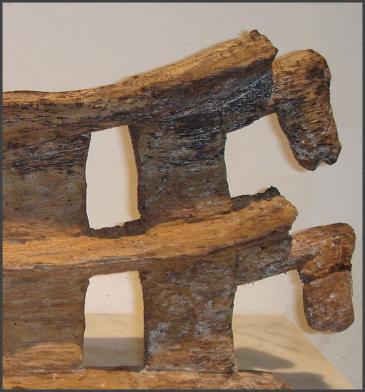
| 18" long x 2.5" wide x 5 1/4" tall An example made specifically for the collecting market which is no longer in my collection. "In the Bandiagara cliffs, above the villages now occupied by the Dogon people, carved wooden headrests have been found in burial caves. The Dogon, who do not now use headrests, attribute them to the Tellem, former inhabitants of the region from the 11th to the 16th centuries. Rogier Bedaux, who has excavated in the burial caves, asserts that headrests "do not occur in Dogon contexts." Tellem headrests that have been excavated from documented cave sites have elegant silhouettes but minimal decoration. Although unusual, some headrests have animal heads projecting from either end of the curved upper platform. The heads resemble those found on trough-like containers and benches of the contemporary Dogon." Source: National Museum of African Art In their original context, headrests such as this from the Tellem, as mentioned above, were used as burial gifts or quite possibly the headrests used by the deceased was buried with the deceased as it is done in some other parts of Africa. I don't know much about Tellem burial practices, but from what I have read, various substances were added to the bodies and the burial gifts that were buried with the deceased (not "buried" literally since they were placed in caves in the cliffs, photos of Tellem burial caves can be seen by clicking here). The addition of these substances may have given the objects found in these caves a very encrusted surface. Burial caves contained many objects that were offered as gifts for the dead : bowls, potteries, necklaces, bracelets, rings, and iron staffs. Headrests may have been objects of high status, because only a few caves contained them. On December 12th I posted a message to several African Art Discussion Groups inviting people from them, and people who visited my website, to take part in an interactive sort of exercise on this headrest and another one on my website. I simple asked people if they thought the headrests were authentic and to post comments as to why they thought they way they did. The results have been posted for this headrest underneath all of the photos. There is also a link to the results for the other headrest on this page as well. NOTE: YOU CAN CLICK ON ANY IMAGE TO SEE A HIGH RESOLUTION VERSION |
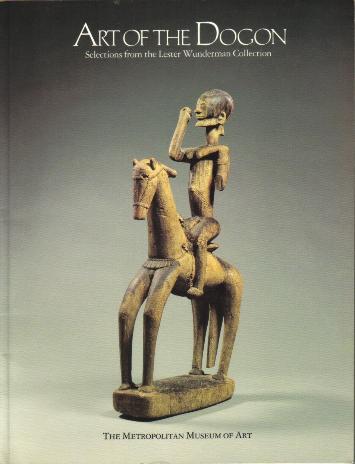
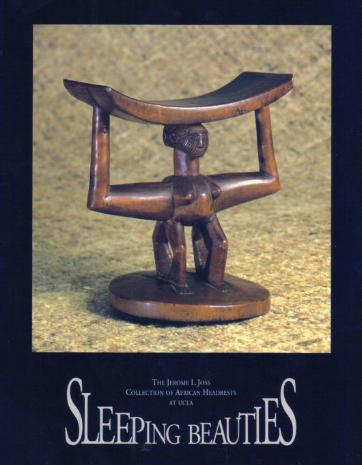
| A good resource on the Dogon A good resource on African headrests |

|
| THE RESULTS On December 15th I posted a message to several African Art Discussion Groups inviting people from them, along with people who visited my website, to take part in an interactive sort of exercise on this headrest and another one on my website. I simply asked people if they thought the headrests were authentic and to post comments as to why they thought they way they did. The purpose of this exercise is to show people how others look at the same type of object and see what other people's thoughts are. The choices for authenticity were - Authentic, Made to look old, and Unsure/Not enough data Then I asked people to comment as to why they felt the way they did, the comments were anonymous unless people wished to sign their name to them. I do this to encourage more people to participate since no one will be able to judge them for their thoughts. I think that lots of people have thoughts about things, but are unwilling to voice them in a public fashion with their name attached to their comments. The purpose of this exercise was to show people how other people look at the same object and it's perceived authenticity, and to show them what other people thought about the object. When I go to Tribal Art Fairs I enjoy walking around with people and looking at different objects and having the ability to share thoughts with each other about the objects. Sometimes you can learn from this and it's something I enjoy. Doing this sort of exercise on my website is the next best thing to walking around with someone and looking at the objects in person. There is one big drawback to this exercise, you don't get to look at the object in person... You don't get to hold it, smell it, feel the weight of it and you don't really get a good look at it like you would at a Tribal Art Fair or gallery. So many times though, people have to use the Internet to be able to have other people look at their objects from photographs to make judgements on them. Sometimes it is easy to tell if an object is made specifically for the collecting market from a photograph, but to make a definitive determination about the authenticity of an object from a photograph, at least in my opinion, is very challenging because you really need to have the object in your hand and get to smell it, feel the weight of it and get a really close look at different areas of the object to made a good determination on authenticity. Of course, if you collect objects that have not had tribal use and are objects that are representations of traditional objects (some refer to these as copies, and depending on how they are represented, they could be called fakes) then authenticity will not matter to you and the important thing will be the quality of the carving and how well the piece reflects the styles of known traditional and authentic examples. I collect authentic objects every chance I get, but I also have no problems collecting nice representations of traditional objects as well. Take for instance Tellem headrests, which happens to be the topic of this exercise. I am by no means an expert on the Tellem, I've only done some reading, but from what I have read the "the Tellem inhabited the Bandiagara escarpment from the 11th to the 15th centuries, prior to the arrival of the Dogon. They interred their dead in the grottoes, as do the Dogon today, with abundant funerary materials including textiles, votive neck supports made of wood and iron, ceramic materials and wooden figurines. The grottoes have been systematically looted and their contents illegally exported leading to unbridled depredation of the region. Pillage has left few archaeological sites intact resulting in the loss to science and history of an incalculable amount of information." (source) I'm not really sure what happened to the Tellem people, everything I have read just states that they mysteriously disappeared. The point is that this is a culture that pre-dated the Dogon, the Tellem is a culture that no longer inhabits the area, a culture that one could assume no longer made objects sometime after the 16th Century. This culture may have migrated to other parts of Africa? This culture may have disseminated and become part of other cultures along their migration paths. (I am assuming here, if anyone knows what happened to them I'd love to know). The thing is that objects that were produced by the Tellem culture were only found in the burial caves that, to the best of my knowledge, weren't excavated and researched until the 20th Century, I don't know when the looting of these caves started. "The rugged Bandiagara Cliffs where the animist Dogon tribe bury their dead in caves, also has been hammered by collectors. Virtually every one of the tribe's old, ornately carved granary doors has been bought up and carted away to African art galleries in Europe and the United States. Local elders have resorted to defacing what few original carvings remain in their villages to keep them from being stolen. Meanwhile, even more ancient art in the Dogon area--headrests and statuettes left in high, inaccessible caves by the Tellem, a people who vanished mysteriously in the 16th Century-- are being mined for money. Dogon youths hang from ropes to plunder the artifacts. "Little by little, it is all being taken away," said Mombalon dit Gol-fils Dolo, a Dogon tourist guide. "It is not our fault. We are poor. Our millet harvest failed this year." Indeed, aware of the irresistible lure of outsiders offering pocketfuls of cash in exchange for its dwindling art treasures, the Malian government has launched a unique education campaign to encourage villagers to protect their past. President Alpha Oumar Konare, a trained archaeologist, has ordered that cultural missions be established in all of Mali's smaller towns to promote a sense of pride and ownership in the country's artifacts." (source) It has been written by several scholars in several publications that headrests do not occur in Dogon contexts. It has also been written that Dogon people often times reused Tellem headrests. "Roy Sieber, noting that headrests may have a religious nature, quotes Igor de Garine's remarks (in Balandier and Maquet 1974:178) that "the heads of some individuals in high authority (for example the Hogon, who is the high priest of the Dogon of Mali) must not touch the ground" (1980:107). Until more definitive field work is done among the Dogon, the question will remain whether the Dogon really do make and use headrests or reuse Tellem ones." (Sleeping Beauties) So, how does this all apply to the headrest listed on this page that was part of this exercise? Well, when I originally came across this headrest I was very taken in by it's unique form. I couldn't recall if I had ever come across a 2 tiered headrest such as this from any African culture. I didn't really have much experience at all with Dogon or Tellem headrests, it was just an area that I hadn't explored much. I had one other headrest in my collection at one point that I sold earlier this year, and after I sold it I guess in the back of my head I had been keeping an eye out for other examples to collect. This example was very unusual to me and I liked that fact about it. The double tiered design with the heads on each end had great appeal to me but the surface was a bit confusing, and so was the smell. When I was originally looking at the headrests I had a friend of mine with me that has lived and worked in Africa for quite a number of years, and who has also been collecting for over 20 years. I showed him both headrests and asked his opinion on them. He brought out his magnifying glass and sat down and studied each of them very carefully. The 2 tiered headrest actually had one of the heads on the side broken off, so it gave us a chance to look more at the wood. The headrests aren't light, but they aren't made of a really heavy wood either and the wood is medium density. From my experience with most African headrests, a well used headrest will have a very worn, smooth surface, which is of course not the case with these headrests in this exercise. Both of these headrests have an interesting surface to them. Underneath that surface "could" be a worn wood surface, but without removing the material on top of the wood, I don't know. The friend that was with me commented about the surface and told me that traditionally when the Tellem placed the grave gifts in with the deceased that they applied various substances to the bodies and also to the grave gifts, and he thought that the surface on the headrests could be caused by libations placed on the bodies and the grave gifts. So I took this into account when looking at the surfaces and didn't look at them like I would look at the surfaces of any of my other headrests. He said if we were having this conversation 15 or 20 years ago there would be less doubt about the authenticity of the headrests. He found the surfaces to be very convincing if they were indeed used as burial gifts, and wasn't aware of any methods they could of used to get them to look how they did, and he thought the wood was genuinely old. The other thing was the smell of the headrests which confused both of us, they both had a very prominent sweetish smell to them, something neither of us could put our fingers on. He couldn't however definitively say if the headrests were authentic or not. So after all of this I decided that authentic or not, I enjoyed the headrests and bought them. I figured if they ended up being examples that were made to look like original Tellem burial headrests I would still enjoy them and they would be good educational tools to show people. If they ended up being authentic, then that would be great as well. Of course, what are the chances of an old authentic Tellem headrest coming into my hands that had not been in a collection for many, many years that I hadn't paid many thousands of dollars for? Could the headrests be Dogon? Or were they examples that had been crafted and made specifically for the collecting market? Originally I sought out the advice/opinions of Ben Hunter with Tribalhunter Antique Tribal Art who is a friend of mine with good experience with a lot of different headrests from different African cultures. He had some thoughts on them but referred the question to Jan Baptist Bedaux who he said had some expertise with these headrests. Jan Baptist Bedaux originally gave me a simple answer by stating: "Both are fakes, absolutely! They make them look very old these days. I bought one which looks just like the right one on this site, just to show people the difference between a real and a fake. How they do it, I do not know." I was then happy to get him to participate in this exercise and elaborate on his thoughts which you will see in the responses below. Then I thought to myself that using these headrests in an interactive exercise on my website might be a good thing to do. The headrests were unusual enough that they could probably get a lot of different answers from people regarding their authenticity. My thoughts: Well, if my headrests that were used for this exercise are supposed to be Tellem examples, that would mean they would have to most likely date back to the 16th Century or earlier and they would be representative of grave gifts. What are the chances of me coming across 2 examples like this, each very similar in surface appearance that were authentic examples? The likelihood isn't very good in my opinion, it would be like winning the lottery or being struck by lightning, right? Both of my headrests have very convincing features in my opinion, but I don't have the knowledge or experience to make a definitive judgement one way or another. I would have to lean towards the thought that both of my examples were made specifically for the collecting market, but I enjoy both of them very much regardless of that conclusion. I doubt that I'll ever get a C14 test done on them, that's expensive and probably not worth it to me. I'll just enjoy them along with the other headrests in my collection. Jan Babtist Bedaux sent me photographs of the headrest he bought to show people the difference between a real and a fake and they are directly below. When you compare the photos of that headrest to my headrest, which is shown directly below these 2 photos, there are similarities in general style, but I feel if you had the 2 examples in your hands there would be very noticeable differences in just about everything else. The lower and middle platforms on my headrest are straight across, while the upper platform is curved and also tilts to the front some. The platforms and supports are different as well and there is a large degree of difference in the quality of the carving. It is a fact that some objects made specifically for the collecting market that are made to look old are carved better than others, the difference in quality in these objects is the same as it can be for authentic objects. |
|
|
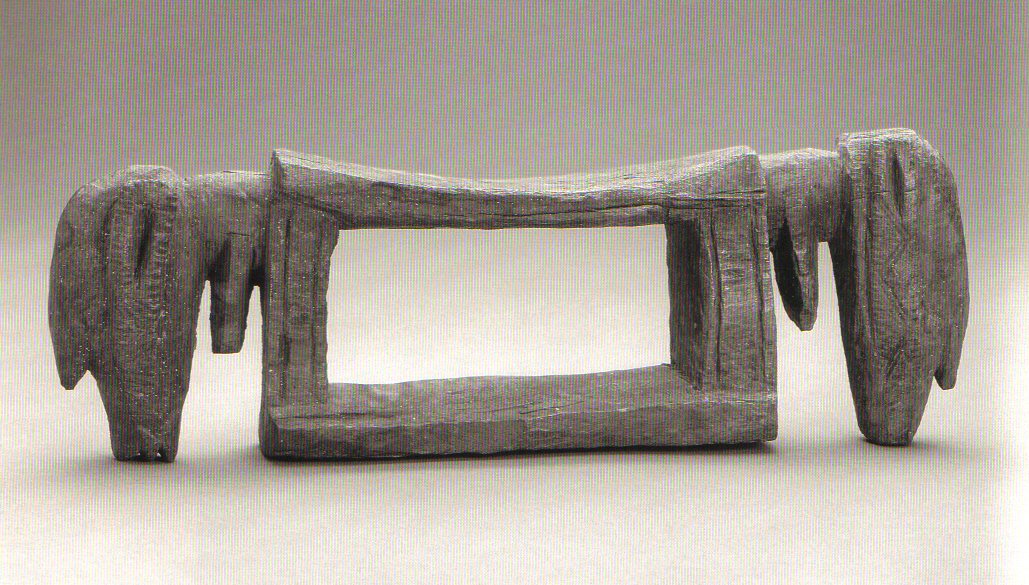
| Example from the book: Sleeping Beauties - The Jerome L. Joss Collection of African Headrests at UCLA Dogon (?) Mali Wood 31 x 11.6 x 10cm |
|
| Authentic = 4 Made to look old = 6 Not sure/Not enough data= 5 Below is the data that was submitted by the people that participated in this exercise. I wish to thank the people who took the time to participate in this, especially to Jan Baptist who took the time to provide very good detailed comments. The results give a good sampling on how different people look at and think about the same object. |
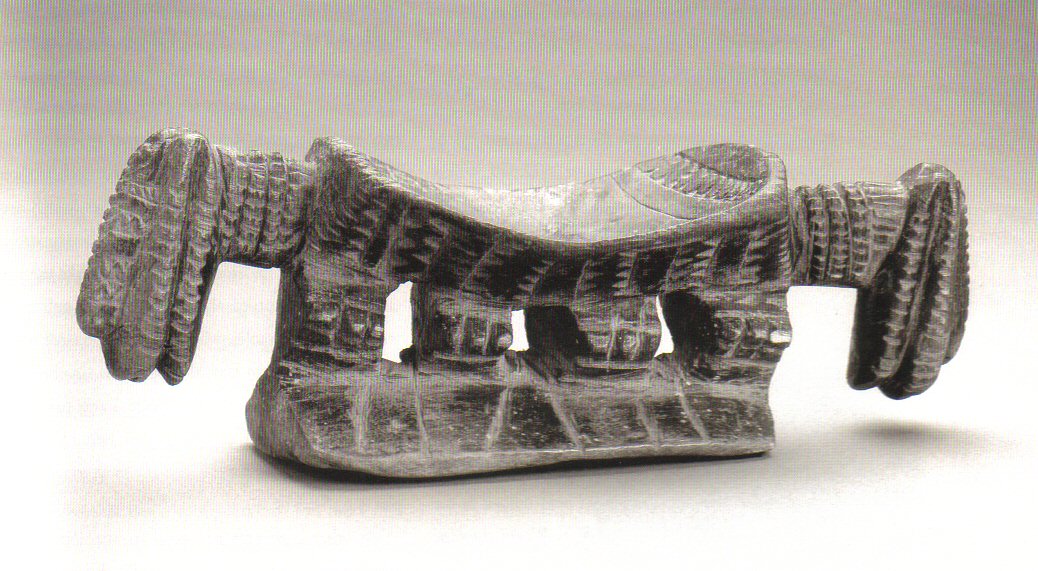
| Example from the book: Sleeping Beauties - The Jerome L. Joss Collection of African Headrests at UCLA Dogon (?) Mali Wood 34.5 x 11.5 x 4.5cm |
| Below are a couple of examples of "Dogon(?)" headrests published in the book "Sleeping Beauties" along with some additional information. |