
| Chokwe Angola, Democratic Republic of the Congo and Zambia |


| Chief Kauka, Lunda-Chokwe, Angola |
| Chokwe chief Chauto, Moxico, Angola. Photo Fonseca Cardoso, 1903 |
| Chokwe and Politics The fact that Chokwe territories are far inland helped them avoid Portuguese colonial influence until the 1600s or later. Their neighbors to the west (the Imbangala, the Mbundu, and the Ovimbundu) were closer to the coast and more under the influence of colonial rule. The relationship between the Chokwe and the Portuguese was complex. Sometimes the Chokwe fought the Portuguese; at other times they became allies. This is similar to the Chokwe relationship with the Lunda, and other neighboring (and related) groups. The Chokwe developed and maintained their cultural identity by adapting to outside influences. They created their own chiefly institutions based on the Lunda model. From the Portuguese they adopted new concepts of wealth and political power. As in the case of other African peoples, the Chokwe success and survival resulted from their cultural flexibility and ability to adapt to impending change. In recent times, however, the Chokwe have faced many new challenges. Since the early 1970s they have been living amidst civil wars in Angola and the Democratic Republic of the Congo. These political conflicts turned Chokwe territories into battlegrounds. Many displaced Chokwe still live in refugee camps where they wait until they can return safely to their homelands. Although Chokwe-related peoples have been greatly affected by modern conflicts, they continue to pursue their own ways. In militarized areas in Angola and Congo, as well as in Zambian refugee camps, they practice initiation, divination, and healing rites. Some Chokwe chiefs have been displaced by war, and their authority has been challenged by modern governments’ political goals. Nevertheless, Chokwe chiefs continue to represent traditional and sacred authority. Village Courts Most Chokwe-related territories have at least three types of legal organization: the village courts, the chiefs’ courts, and the district courts. Some districts have their own police forces and legal courts to settle legal cases, but in many rural areas the law is upheld in village and chiefs’ courts. In village courts, respected male elders oversee cases involving land ownership, family quarrels, theft, and other disputes. A village headman usually leads the village court. During a village court session, the male elders sit together on one side of the open yard. Female elders sit on the other side. The parties involved in the conflict sit in the middle, where they explain their situations one at a time. Usually an audience gathers to listen. The individuals and witnesses involved in the disputes are asked direct questions. A decision is made by court agreement. Guilty individuals are instructed to apologize and may have to pay fees of goods or money or to repair the damages they have caused. If a person is not happy with the village court’s decision, he or she may decide to go directly to a chief’ s court, where the decision of the village court may be reviewed. Senor chiefs and their court officers listen to disputes that could not be settled in the village. If necessary, a chief may send a delegation of court officials to a village to hear a particular case. The village chief will accept the judgment of the court officials. Criminal cases and serious financial disputes are usually taken to district courts. Hunting Hunting is a traditional Chokwe occupation, but modern laws against poaching have restricted most forms of hunting in some areas. All people are required to purchase hunting permits, which few rural people can afford. As a result, many feel that the (national) hunting laws are unjust and break with Chokwe traditions. The Chokwe and their neighbors often ignore the law and continue to hunt. The main catch is antelope, which they share with their families or sell or trade to other villages. Chokwe men hunt with guns or bows and arrows. They hunt alone or in groups. For the Chokwe, hunting is closely related to religious beliefs. They often build shrines to pay respect to ancestors who were successful hunters during their lifetimes. Information from: www.africans-art.com |
| I do not have a Chibinda Ilunga figure in my collection anymore |
| CHIBINDA ILUNGA FIGURES also sometimes known as Tshibinda Ilunga As Chokwe chiefs increased in wealth and influence, the arts associated with chiefdoms blossomed. Local peoples over whom they asserted their power had long traditions of wood-carving, and their artists produced utilitarian, leadership, and luxury objects in a powerful and refined style. With its swelling musculature and preponderance of curving elements, the figure of Chibinda Ilunga shown here is typical of Chokwe style from this time. Such idealized representations of ancestors and important historical personages were carved by professional artists and served to underscore the rank and position of chiefs. The legendary hunter and culture hero is portrayed in full hunting gear. His muscular body, huge hands and feet, and broad facial features give a sense of power, while the delicate details of toenails and fingernails and other minute details give a sense of refinement. The sweeping, ornate headdress identifies him as a chief, and the long plaited and bound beard of real hair alludes to his aristocratic position. His massive shoulders are thrown back and, from the rear, emphasize concave forms of his back. The objects he carries refer to his role as hunter. In his left hand he supports a staff used for holding a sack of power substances. In his right he carries a medicine horn full of substances that assist the hunter, alluding to the role of the supernatural in hunting. Large hands and feet further allude to qualities skill and fortitude that serve him during long ventures. |
| Some examples of Chokwe figures. I provide photos of the pieces below because they are old and authentic examples of these types of Chokwe figures. They are some of my favorite examples and I put them on this page to share them with others. |
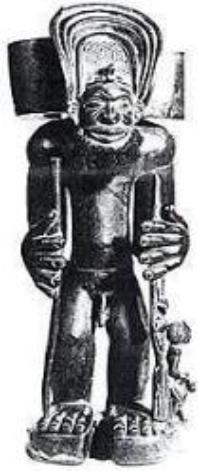
| Sculpture of ancestral hero, Tshibinda Ilunga, Luba prince and father of first Mwata Yamvo. Hard wood, brown, lightly covered with red clay. Museu do Instituto de Anthropologia, Porto. Height: 39 cm. |
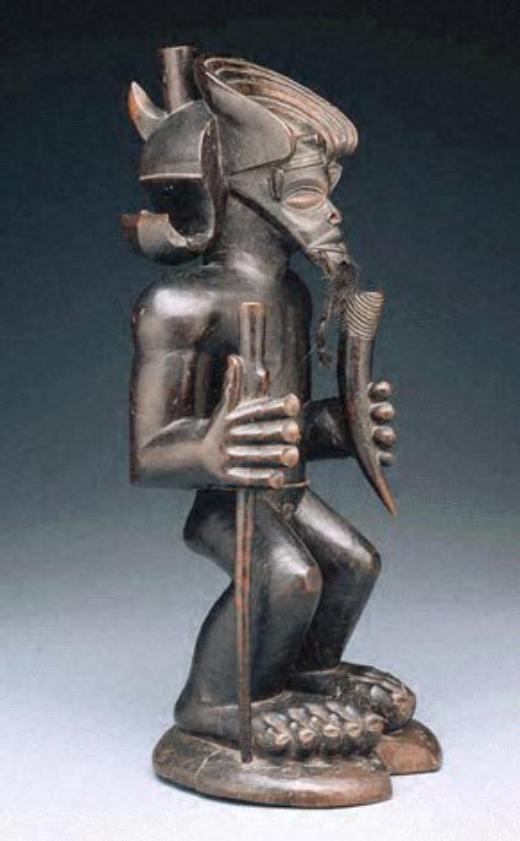
| This one is my favorite... |

| Same figure different angle |
| Chibinda Ilunga mid-19th century Africa, Northeastern Angola Chokwe peoples Wood, hair, and hide 16 x 6 x 6 in. (40.6 x 15.2 x 15.2 cm) Acquired in 1978 Kimbell Art Museum Fort Worth, TX |
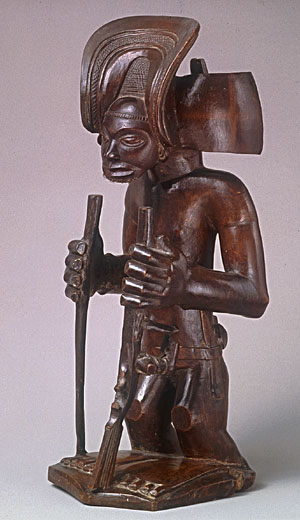
| Chibinda Ilunga Figure, 19th–20th century Angola; Chokwe peoples Wood; 15 5/8 x 6 in. (39.7 x 15.2 cm) Private collection Metropolitan Museum of Art |

| Chokwe-Skulptur: Chibinda Ilunga (Sammlung O. Schütt 1878; SMB, Ethnologisches Museum, Berlin) |
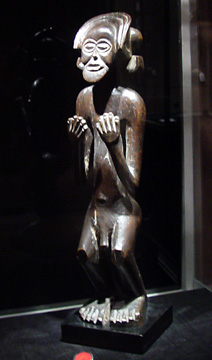
| Sotheby's Lot 79, Tschokwe male figure, 19 3/4 inches high A very stylized and evocative work is Lot 79, a "fine" Tshokwe male figure that is 19 ¾ inches high. It has a modest estimate of $40,000 to $60,000 and has been consigned by a European private collection. It sold for $51,000. |
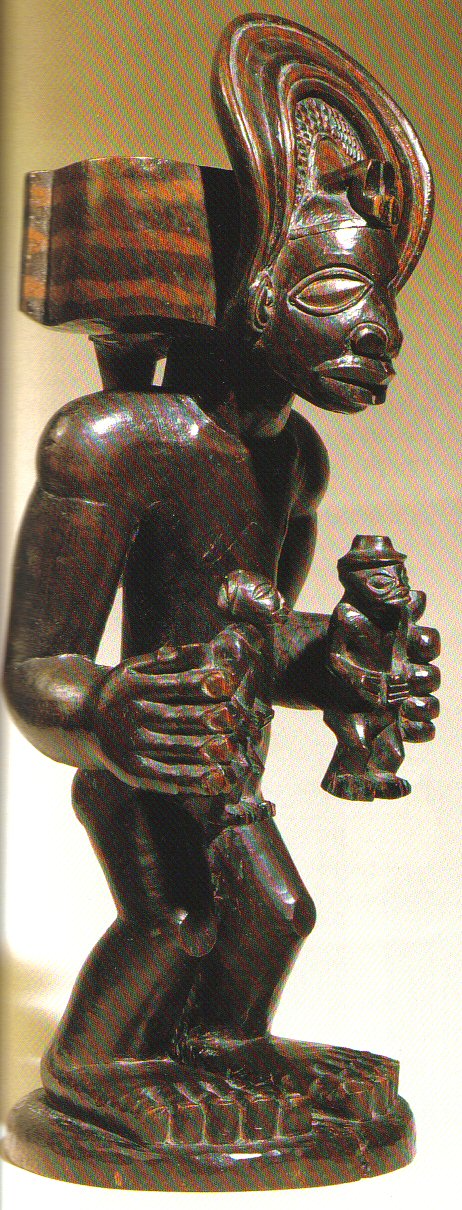
| A Moxio-style Tshibinda Ilunga figure Height 14.5" Provenance: Collected c. 1895 by Captain Artur de Paiva in Angola This figure depicts Tshibinda Ilunga, the Luba ancestor of the Chokwe, with a welcoming gesture. The two smaller figures clasped in his hands symbolize the protection he offers the entire tribe. |
| Below is the figure that got me interested in these types of figures. It's a figure of a chief and is a great example. |
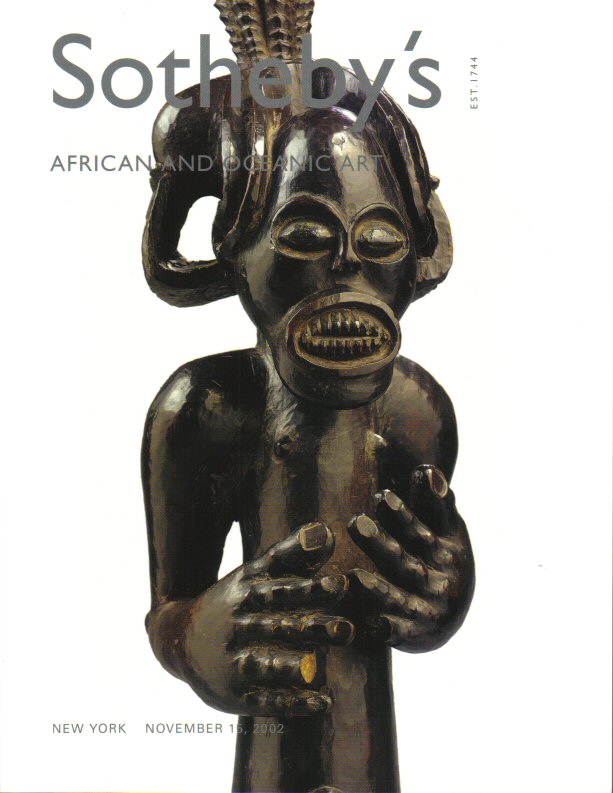


| Property from a South American Collection A RARE AND IMPORTANT TSHOKWE MALE CHIEF FIGURE mwanangana, the chief standing with large feet and lengthy articulated toes and ankles beneath bent legs and an elongated cylindrical torso, the muscular shoulders turned to the right leading to bent arms with enormous fan-like hands to the front, the large head with stylized facial features, the large oval mouth with defined lips baring filed teeth, and a small nose framed by protruding eyes encircled by oval lids, wearing an elaborate coiffure, mutwe wa kayanda, of multiple undulating bands and carved horns at the crown; exceptionally fine smooth and slightly glossy black patina. height 24V2in. 62.2cm This rare chief figure, mwanangana, or 'lord of the land', was carved in the Muzamba school, near the Kwango river in Angola. The very distinctive Muzamba style is expressed in the mask-like face and aggressive mouth in which the pointed teeth protrude slightly and are outlined by a defined, oval mouth. The Muzamba features contrast with the more naturalistic styles of the Muchiku or Mexico regions. See Bastin (1982: 120-121, figure 62) fora chief figure from the Mexico region, in the Museu de Etnologica, Lisboa. The offered, large-scale chief figure is the third Muzamba figure known of this proportion and particularly expressive quality, particularly in the mouth. See another formerly in the collection of Josef Mueller (Christie's 1979: lot 163) and a third published by Bastin (ibid: 117, figure 60). Of the latter two neither compares to the dynamism demonstrated in the offered figure's expressive features and turned, flexed gesture. In addition, the sculptor of the offered lot has placed great emphasis on the elaborate headdress. According to Bastin (ibid.: 112), the ceremonial headdress, mutwe wa kayanda, 'is one of the most pertinent indications of a prince's rank, and a figure that lacks this never bears any other sign which could identify it as portraying a chief. ...A chief may [at times be depicted] holding his hands in front of his chest in the fad gesture, a sign of power and strength.' Likewise, the winged headdress metaphorically evokes the black stork, khumbi, who is thought to embody the chief and his ancestors 'because the stork is the swamp-dwelling master of the water—the source of life and fecundity' (Bastin 1998: 18). $150,000-250,000 |

| Museum of Fine Arts, Boston From the Teel Collection Published in "Art of the Senses - African Masterpieces from the Teel Collection" Height 15” Brought from Angola to Portugal by M. Fereira at the end of the nineteenth century. Formerly in a Portuguese and then in a Chilean collection Acquired in 2003 Bibliography: Bastin 1989 Befitting their vigorous political expansion in the nineteenth century that supplanted the Lunda kingdom, Chokwe leaders commissioned bold sculptural figures and masks evoking the memories of their founders and cultural heroes. This idealized image of a chief (or mwanangana, "lord of the land") is among the masterpieces created by Chokwe artists of the Moxico region, which flourished in the nineteenth century. The figure's composed stance, with flexed legs and arms in front of the abdomen, and its serene facial expression allude to the wisdom and fortitude of Chokwe leaders, who assured the well-being of their communities. The large hands with elegantly carved fingers suggest the gesture of tad, a sign of strength and potency. The winged headdress decorated with brass tacks imported from Europe is called mutwe wa kayanda, part of the ceremonial regalia of Chokwe chiefs. |
| Chokwe Angola, Democratic Republic of the Congo and Zambia |
| One million Chokwe (at least 30 different spellings -- all based upon the name these people call themselves, Kocokwe, in plural Tucokwe) have spread out over a wide area in the eastern Angola, southern DRC and Zambia. Their history dated back to the 15th century, when a Lunda queen married a Luba prince Chibinda Ilunga. A significant member of the Lunda aristocracy so disapproved of the marriage that they migrated south to present- day Angola. Once settled, they founded several kingdoms, each headed by a god-king. Around 1860, following a major famine, the Chokwe people migrated back towards the south and settled in Angola, at the source of the Kwangi, Kasai and Lungwe rivers. The Chokwe are governed by a king called Mwana Ngana, who distributes hunting and cultivation areas. The male Mugonge and female Ukule societies regulate their social life. They are vigorous and courageous hunters and agriculturists, who used formerly to engage in the slave trade. Their dynamic spirit is also reflected in their art. Chokwe sculptors were the most famous of the region; there were two types. The songi made jinga charms, the small mahamba figures for the family shrines, and all objects used for hunting, love, magic, and fertility. In addition to the folk art, somewhat rigid and giving no illusion of depth, there existed also the ancient refined culture of the court, expressed with conviction by professional artists the fuli. They were hired by the great chieftainries and worked exclusively for the court. They sculpted scepters, thrones with figurines, fans, tobacco boxes, pipes, flyswats, cups, and figures of chiefs or ancestors – all demonstrating a great deal of refinement. They were famous for their large statues of deified ancestors, exalting strength and dignity. The best-known representation of a chief is of Chibinda Ilunga. He was a wandering hunter, youngest son of the great Luba chief Kalala Ilunga. He got married a Lunda queen Lueji. Chibinda Ilunga was the start of the sacred dynasty of the Mwata Yamvo of the Lunda and became the model of the hunting and civilizing hero, sometimes represented seated on a throne, sometimes as standing naked or dressed as a hunter. As statues of him were sculpted after the introduction of firearms, generally the standing figure is holding a stone rifle in his left hand and a stick, called cisokolu, in his right. Chibinda Ilunga’s body is stocky, with legs bent, shoulder blades clearly drawn, the neck wide and powerful, the navel protruding. He wears an enormous hairdo, the sign of princely rank. The social organization, founded upon matrilineal lineages, has an equally large number of female statues, whether these be identified as the queen mother or a chief’s wife. The most powerful and important Chokwe mask is known as chikunga. Highly charged with power and considered sacred, chikunga is used during investiture ceremonies of a chief and sacrifices to the ancestors. These masks are made of barkcloth stretched over an armature of wickerwork, covered over with black resin and painted with red and white designs. Chikunga is worn only by the current chief of a group. The mukanda masks play a role in male initiation. The mukanda is an initiatory institution through which religion, art, and social organization are transmitted from one generation to the next. Mukanda training lasts from one to two years. Boys between the ages of about eight and twelve are secluded in a camp in the wilderness, away from the village. There they are circumcised and spend several months in a special lodge where they are instructed in their anticipated roles as men. As part of their instruction, the boys are taught the history and traditions of the group and the secrets associated with the wearing and making of masks. Mukanda masks are also made of barkcloth over an armature of wicker. They are covered with a layer of black resin, which can be modeled before it is ornamented with pieces of colored cloth. While in former times they probably played important roles in religious beliefs and institutional practices, many other Chokwe masks have come to be used primarily for entertainment. Itinerant actors wearing these masks travel from village to village, living on gifts received at performances. Most masks are carved of wood. The most popular and best-known entertainment masks are chihongo, spirit of wealth, and pwo, his consort. Gaunt features, sunken cheeks, and jutting beard of an elder characterize a chihongo mask. Chihongo was formerly worn only by a chief or by one of his sons as they traveled through their realm exacting tribute in exchange for the protection that the spirit masks gave. While chihongo brings prosperity, his female counterpart, pwo, is an archetype of womanhood, an ancestral female personage who encourages fertility. As an ancestor, she is envisioned as an elderly woman. The eyes closed to narrow slits evoke those of a deceased person. The facial decoration on the surface are considered female. Recently pwo has become known as mwana pwo, a young woman. It represents young women who undergone initiation and are ready for marriage. During the 17th century many Chokwe chiefs were introduced to chairs imported by Portuguese officials and adopted the foreign style for their thrones. However, Chokwe style and decoration were saved. The figures on the back, stretchers, and legs were typical Chokwe carving. The Chokwe have influenced the art of many neighboring peoples, including the Lunda, Mbunda, Luvale, and Mbangani. Source: www.zyama.com |