| BAULE Blolo bian figure (spirit husband) Blolo Bla = spirit wife Among the Baule peoples of Côte d'Ivoire, human experience evolves out of and remains inextricably linked to the ancestral spirit world, or blolo (roughly, "the village of truth"), which controls and determines the fate of the living. Divination figures such as these serve as links to the spirit world and are a critical element in a Baule diviner's professional practice. Baule diviners are individuals who have been selected by spirits, or asye usu, as mediums through which to communicate important insights into the human condition. The sculptures are often described as the asye usu's "stool," a figurative resting point for the spirits. Divination figures represent idealized male or female figures in their prime, which are considered by the asye usu as desirable forms to inhabit, and so are used to draw the unruly spirits out of their home in the bush and into the village. This male figure most likely represents a sculpture made for a spirit husband, Blolo bian. According to Vogel, 'these figures represent an ideal of man or womanhood, embodying not only physical perfection, but social, moral and intellectual achievement. Spirit spouse sculptures can be seen as a kind of opposite sex alter ego and are a fascinating case of the use of art in Africa for individual psychological relief. The Baule are one of a number of African groups who believe that before birth, human beings all had Blolo bla (spirit wife) and Blolo bian (spirit husband) spouses in the other world who can influence their lives. Baule artists and their nearby neighbors, the Yaure, however, seem to be the only artists in Africa who traditionally carved figural representations of spirit spouses' The more elaborate the ornamental and decorative features of an individual work, the more time has been invested in its execution by the sculptor, and the greater the expense to its owner. The culmination of such efforts hopefully results in the creation of a sculpture that is most attractive to the asye usu. When used by Baule diviners, such works not only flatter the asye usu but also add to the theatrical spectacle of a public pronouncement of a divinatory revelation. Their aesthetic quality dazzles potential clients with the caliber and sophistication of the instruments associated with a diviner. The beauty of a figure advertises its owner's success as an intermediary with the spirit world. Consequently, diviners prosper by commissioning superlative figures as divinatory instruments. Ownership of extraordinary objects thus directly affects a diviner's professional standing and enhances public perception of his or her efficacy. |

| Measurements: 19" tall x 4.5" wide x 4" deep Click on any image to see full size version |


| Other examples and additional information |
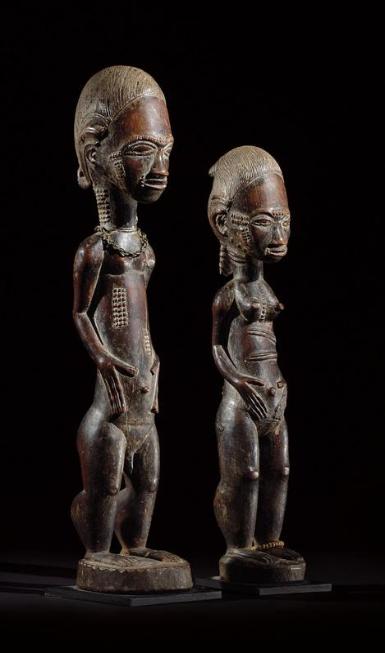
| Sotheby's May 2004 LOT 51 PROPERTY FROM A NEW YORK PRIVATE COLLECTION A FINE BAULE MALE AND FEMALE PAIR Estimate 7,000—10,000 USD Lot Sold. Hammer Price with Buyer's Premium: 16,800 USD MEASUREMENTS heights 16 1/2 in. and 14in. 42cm and 35.5cm DESCRIPTION each of similar form, the elongated gently tapered torsos with raised scarification, framed by arms to the sides with elegant, long hands resting on the abdomen, the faces jutting forward with distinctive sensitively carved features including pouting mouths and large almond-shaped eyes, each wearing back-swept striated coiffures pendant at the back; medium brown patina with areas of kaolin. PROVENANCE Pace Gallery, New York, 1976 LITERATURE AND REFERENCES Siroto, African Spirit Images and Identities, 1976: 77, figure 158 and 159, catalogue for the exhibition, Pace Gallery, New York, April 24-May 29, 1976 CATALOGUE NOTE According to Vogel, in her description of another Baule male and female pair created for trance diviners: they depict 'physical and moral ideals [within Baule society]: they are upstanding, composed and their eyes show an intelligent and respectful presence in society. ...Their refined scarifications demonstrate their desire to please; their clean, healthy skin and rounded muscles show that they can work successfully, producing food and crafting the things needed in society' (1997: 236). |
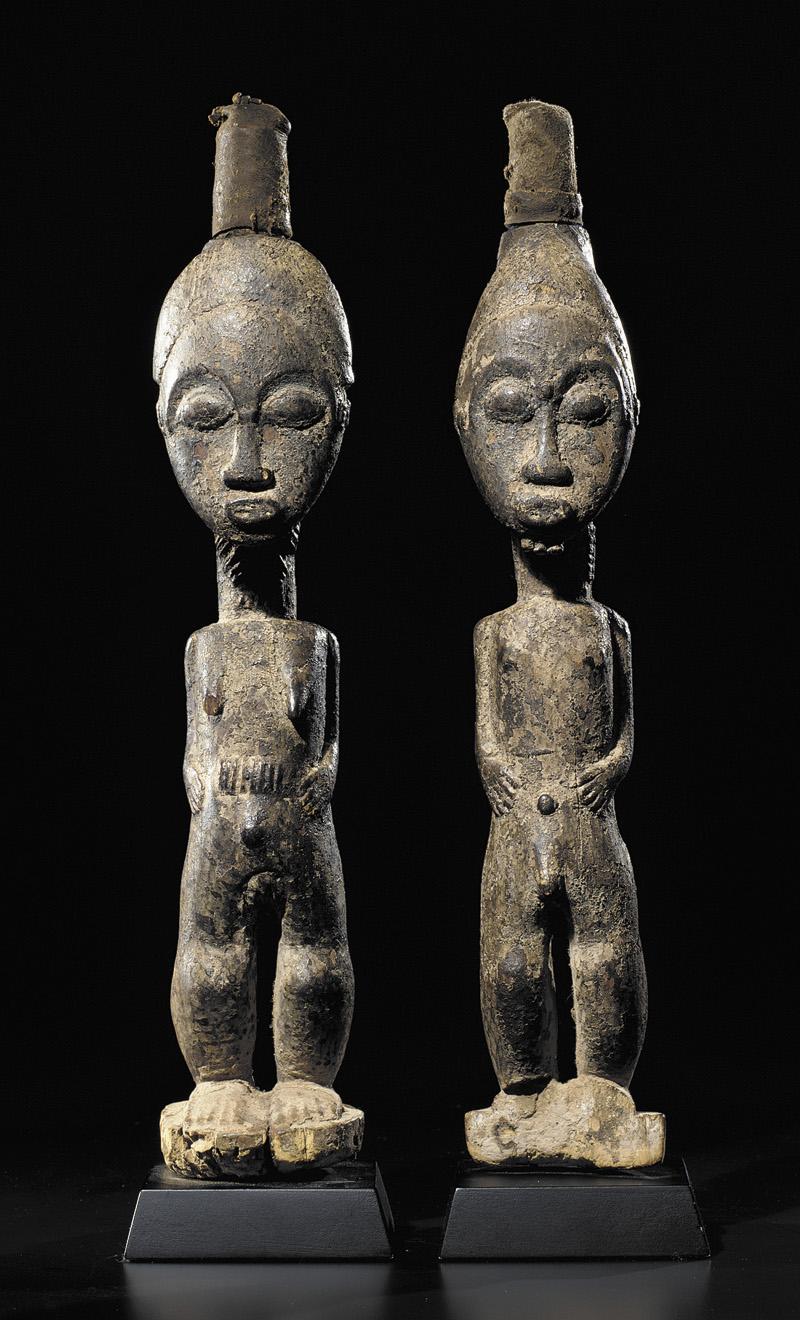
Sotheby's November 2002 LOT 23 Property from an English Collector A FINE BAULE PAIR, PROBABLY SAKASSOU REGION Estimate 10,000—15,000 USD Lot Sold. Hammer Price with Buyer's Premium: 7,170 USD MEASUREMENTS height 14 1/4in. 36.2cm DESCRIPTION the standing male and female, each of similar form, with muscular legs and full hips leading to a cylindrical torso with hands resting to the sides, the elongated necks decorated with elaborate raised scarification, the protruding oval mask-like facial planes with stylized features, and wearing backswept coiffures with pendant braids, finials at the crown covered with cloth; varied and highly encrusted greyish brown patina. Probably made for a trance diviner, as indicated by the layered and encrusted patina as well as the power bundles at the crown, these figures represent klo sran, or civilized people of the village (as opposed to the wild bush spirits). Opposite sex doubling is a theme within Baule art. Therefore, this pair could represent one person with manifestations of both male and female characteristics as opposed to a complementary individual (Vogel 1997: 168). |
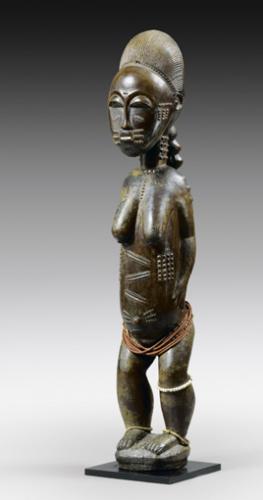
| Sotheby's Paris 2004 LOT 117 TRÈS BELLE STATUE FÉMININE, BAULÉ, CÔTE D'IVOIRE A FINE BAULE FEMALE FIGURE, IVORY COAST 35,000—45,000 EUR Lot Sold. Hammer Price with Buyer's Premium: 55,200 EUR |

| Baule peoples; Côte d'Ivoire Wood, pigment, beads, iron; H. 21 13/16 in. (male), 20 2/3 in. (female) The Michael C. Rockefeller Memorial Collection, Purchase, Nelson A. Rockefeller Gift, 1969 (1978.412.390-.391) Among the Baule peoples of Côte d'Ivoire, human experience evolves out of and remains inextricably linked to the ancestral spirit world, or blolo (roughly, "the village of truth"), which controls and determines the fate of the living. Divination figures such as these serve as links to the spirit world and are a critical element in a Baule diviner's professional practice. Baule diviners are individuals who have been selected by spirits, or asye usu, as mediums through which to communicate important insights into the human condition. The sculptures are often described as the asye usu's "stool," a figurative resting point for the spirits. Divination figures represent idealized male or female figures in their prime, which are considered by the asye usu as desirable forms to inhabit, and so are used to draw the unruly spirits out of their home in the bush and into the village. The elegant and refined couple shown here is especially successful in capturing such an ideal. The figures are slender, with long torsos and muscular legs that are slightly flexed. With their eyes closed and hands resting on their abdomens, both figures reflect the same tranquil meditative attitude of contemplation. They are symmetrical and fluid in design, and their facial features are described with precision and great attention to detail. The recessed eye sockets are accentuated with a layer of white kaolin, reflecting the practice of diviners who analogously apply kaolin to their own eyes and lips, enabling them to see and hear the spirits while in a trance state. Bodily adornments on both figures include beaded strands around the neck, hips, and ankles, and are particularly significant because they function to confer the culturally desirable attributes of civilization on the wild and disruptive asye usu. The female figure is slightly smaller in size, a characteristic accentuated by the male's conical coiffure. Both figures' feet rest on circular bases and are covered with an encrustation of sacrificial matter. Great care has been exercised to apply the sacrificial offerings to the feet of the figure only, so that its overall aesthetic refinement is not marred. The more elaborate the ornamental and decorative features of an individual work, the more time has been invested in its execution by the sculptor, and the greater the expense to its owner. The culmination of such efforts hopefully results in the creation of a sculpture that is most attractive to the asye usu. When used by Baule diviners, such works not only flatter the asye usu but also add to the theatrical spectacle of a public pronouncement of a divinatory revelation. Their aesthetic quality dazzles potential clients with the caliber and sophistication of the instruments associated with a diviner. The beauty of a figure advertises its owner's success as an intermediary with the spirit world. Consequently, diviners prosper by commissioning superlative figures as divinatory instruments. Ownership of extraordinary objects thus directly affects a diviner's professional standing and enhances public perception of his or her efficacy. |
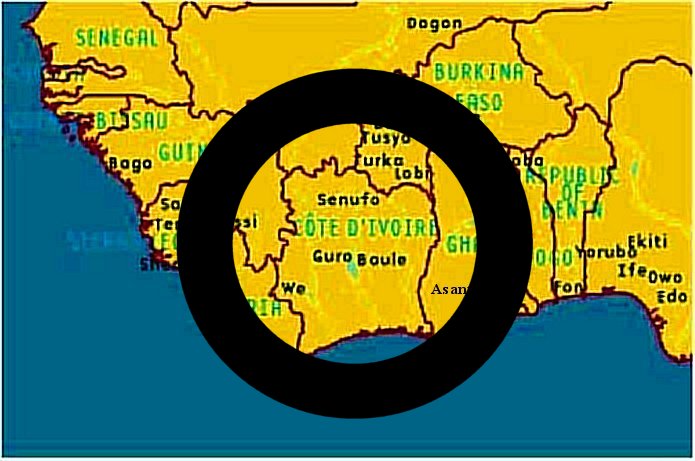
| BAULE The Baule people, known as one of the largest ethnic group in the country, have played a central role in twentieth- century Ivorian history. They waged the longest war of resistance to French colonization of any West African people, and maintained their traditional objects and beliefs longer than many groups in such constant contact with European administrators, traders, and missionaries. According to a legend, during the eighteenth century, the queen, Abla Poku, had to lead her people west to the shores of the Comoe, the land of Senufo. In order to cross the river, she sacrificed her own son. This sacrifice was the origin of the name Baule, for baouli means “the child has died.” Now about one million Baule occupy a part of the eastern Côte d'Ivoire between the Komoé and Bandama rivers that is both forest and savanna land. Baule society was characterized by extreme individualism, great tolerance, a deep aversion toward rigid political structures, and a lack of age classes, initiation, circumcision, priests, secret societies, or associations with hierarchical levels. Each village was independent from the others and made its own decisions under the presiding presence of a council of elders. Everyone participated in discussions, including slaves. It was an egalitarian society. The Baule compact villages are divided into wards, or quarters, and subdivided into family compounds of rectangular dwellings arranged around a courtyard; the compounds are usually aligned on either side of the main village street. The Baule are agriculturists; yams are the staple, supplemented by fish and game; coffee and cocoa are major cash crops. The importance of the yam is demonstrated in an annual harvest festival in which the first yam is symbolically offered to the ancestors, whose worship is a prominent aspect of Baule religion. The foundation of Baule social and political institutions is the matrilineal lineage; each lineage has ceremonial stools that embody ancestral spirits. Paternal descent is recognized, however, and certain spiritual and personal qualities are believed to be inherited through it. The Baule believe in an intangible and inaccessible creator god, Nyamien. Asie, the god of the earth, controls humans and animals. The spirits, or amuen, are enrowed with supernatural powers. Religion is founded upon the idea of death and the immortality of the soul. Ancestors are the object of worship but are not depicted. Baule art is sophisticated and stylistically diverse. Non inherited, the sculptor’s profession is the result of a personal choice. The Baule have types of sculpture that none of the other Akan peoples possess. Wooden sculptures and masks allow a closer contact with the supernatural world. Baule statues are usually standing on a base with legs slightly bent, with their hands resting on their abdomen in a gesture of peace, and their elongated necks supporting a face with typically raised scarification and bulging eyes. The coiffure is always very detailed and is usually divided into plaits. Baule figures answer to two types of devotion: one depicts the “spiritual” spouse who, in order to be appeased, requires the creation of a shrine in the personal hut of the individual. A man will own his spouse, the blolo bian, and a woman her spouse, the blolo bla, which they carry around everywhere they go. The Baule are also noted for their fine wooden sculpture, particularly for their ritual figures representing spirits; these are associated with the ancestor cult. The Baule have also created monkey figures gbekre that more or less resemble each other. Endowed with prognathic jaw and sharp teeth and a granular patina resulting from sacrifices, the monkey holds a bowl or a pestle in its paws. Sources differ on its role or function: some say it intervenes in the ritual of divination, others that it is a protection against sorcerers, or a protective divinity of agrarian rites, or a bush spirit. The figures and human masks are elegant -- well polished, with elaborate hairdressings and scarification. Masks correspond to three types of dances: the gba gba, the bonu amuen, and the goli. They never represent the ancestors and are always worn by men. The gba gba is used at the funerals of women during the harvest season. It celebrates beauty and age, hence its refined features. The double mask represents the marriage of the sun and the moon or twins, whose birth is always a good sign. The bonu amuen protects the village from external threats; it obliges the woman to a certain discipline; and it appears at the commemorations of death of notables. When they intervene in the life of the community, they take the shape of a wooden helmet that represents a buffalo or antelope and which is worn with a raffia costume and metal ankle bracelets; the muzzle has teeth which incarnate the fierce animal that is to defend the group. The very characteristic, round-shaped “lunar” goli is surmounted by two horns. It was borrowed from the Wan for a celebration adopted by the Baule after 1900. Celebrating peace and joy, they would sing, dance, and drink palm wine. In the procession, the goli preceded the four groups of dancers, representing young adolescents. The goli would be used on the occasion of the new harvest, the visit of dignitaries, or at the funerals of notables. Boxes for the mouse oracle (in which sticks are disturbed by a live mouse, to give the augury) are unique to the Baule, whose carvers also produce heddle pulleys, combs, hairpins, and gong mallets. Source: www.zyama.com |