
| Tsesah Batcham-style mask/headdress also known as a Bakom headdress or head Grasslands tribes - Bandjoun region From the book "A History of Art in Africa" it refers to it as "Perhaps the most famous of all masks from the Cameroon grasslands is a sculpture so formally compelling that many scholars consider it to be one of the masterpieces of African Art. This style of forcefully abstracted mask probably dates at least to the eighteenth century. While similar masks have been found in several grassland kingdoms, the historical center of production seems to have been the kingdom of Bandjoun. There the mask, called Tsesah, are instruments of a closed association known as Msop. They were brought out to participate in the enthronement of a king or to act in the mourning festivities of great personages. They also came out to perform the tso dance at the palace, accompanied by ritual flutes. The tso dance symbolizes the sovereignty of the kingdom and took place at the funeral of a king or queen, at annual agricultural rituals that marked the end of the harvest and the new year, at special rituals that had to do with transcendent power, and at certain meetings of the Msop." |
| Examples below for reference purposes |
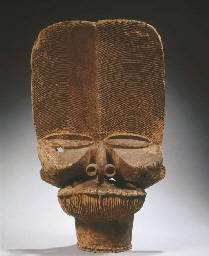
| Christie's - Amsterdam TRIBAL ART FROM THE ESTATE OF THE LATE BARON FREDDY ROLIN Auction Date : Jul 2, 2002 Lot 227 : AN IMPORTANT CAMEROON MASK Description Mkem, probably from Bandjoun Of massive form with the lenticular eyes carved on the fat curved cheeks, slender nose with almost spherical nostrils, the wide mouth with vertical grooves between the thin lips, the tall panel above with carved grooves forming a series of shallow chevrons, a double bands of carved cowries at the neck aperture, light laterite reddish patina 88.5cm. high PROVENANCE Count Baudouin de Grunne Pierre Dartevelle LITERATURE Harter, P., 'les masques dits 'Batcham'', Arts d'Afrique Noire, No.3, 1972, p.31, no.21 Notu‚e, J.P., Batcham - Sculptures du Cameroun, Marseilles, 1993, p.104,no.2 EXHIBITION Batcham - Sculptures du Cameroun, Marseilles, 1993/4, no.2 NOTES The first mask of this original design, which pushes visual conceptions of a facial image to a limit not duplicated elsewhere in the entire world, was collected in Batcham, one of the kingdoms of the Cameroon grasslands, in 1904 and brought to Europe by the German officer Von Wuthenow. It was deposited in the museum in Leipzig and apparently destroyed by bombs in 1943. 'Batcham' was used as the title for a definitive catalogue when nineteen masks of this form were exhibited in Marseilles in 1993-4. The catalogue describes how these rare masks were jealously guarded in the treasuries of the Fons of the small kingdoms, used only in the most exclusive rituals by the societies whose power balanced that of the Fon, and were usually danced at night, worn above a costume of cloth or fibre. The sculptor Arman, in a discussion at the end of the catalogue (Notu‚, J.P., op.cit., pp.185-193), observed that the dramatic outlines, large size and pale reddish patina would all enhance the effect of the mask when it was danced by firelight or with torches. Pierre Harter had previously published fifteen of these masks in Arts d'Afrique Noire (1972,No.3, pp.18- 45). He wrote that the three earliest known masks were collected in Batcham (Leipzig) and Bamendjo (Rietberg before 1937 and UCLA photographed by Christol in 1925). These are all hollowed out in a distinctive manner. To them he added a mask collected in Bafounda before 1972 (J. Last collection, Los Angeles) which has seven carved rectangular apertures at the back. A mask in the Mestach collection, collected in Batoufam, has a wide, curved rim at the back, but the remainder have a relatively flat plank above the level of the eyes. Harter deduced that the masks were carved and used by various groups in the grasslands around Bandjoun and the names they were given and the functions they performed varied from village to village. In Bandjoun he discovered that an enterprising sculptor was carving imitations of the style that had been used by his father and may have been devised by his grandfather or even earlier. The photograph of Paul Tahbu with six of his masks taken by Harter in 1981 is illustrated in Notu‚, op.cit. p. 88. Most of the masks have the carved furrows on the upper flanges, but one has the more decorative lenticular motif found on some of the masks - e.g.the Franklin mask now in the M.N.A.A.O., Paris (p.102, no.1), and they all have the distinctive double row of carved cowries about the neck aparture. Otherwise these copies are hard to distinguish from some of the masks from other villages in the area carved by various sculptors, some of which remain in the treasuries of the local Fon. Estimate:$ 39,600 - $ 59,400 Price Realized:$ 0 |