| Bamileke Elephant masks Cameroon |
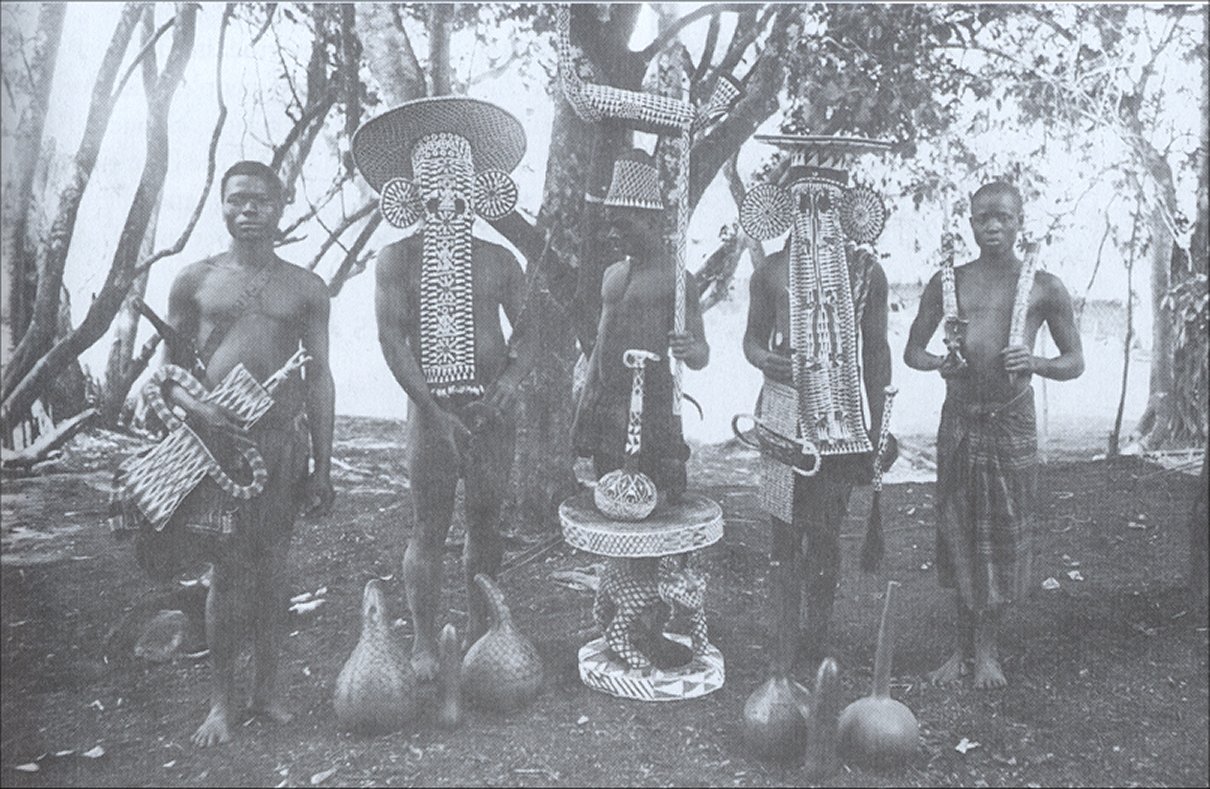
The king and Kuosi society members in Bandjoun 1930

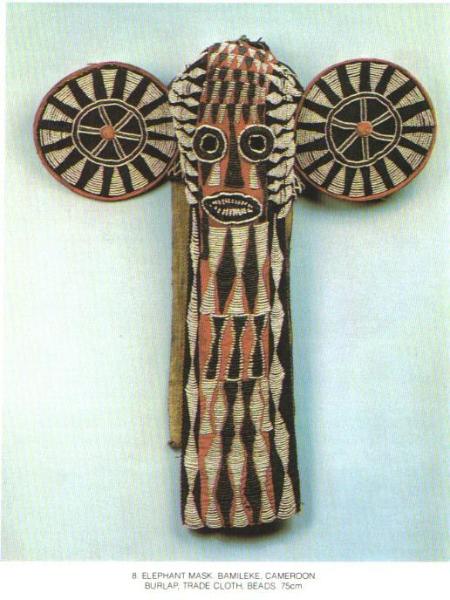
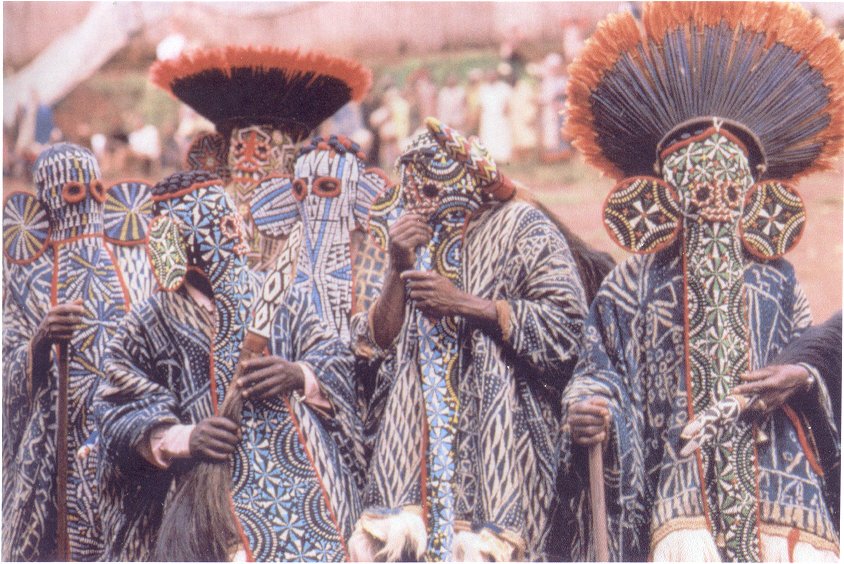
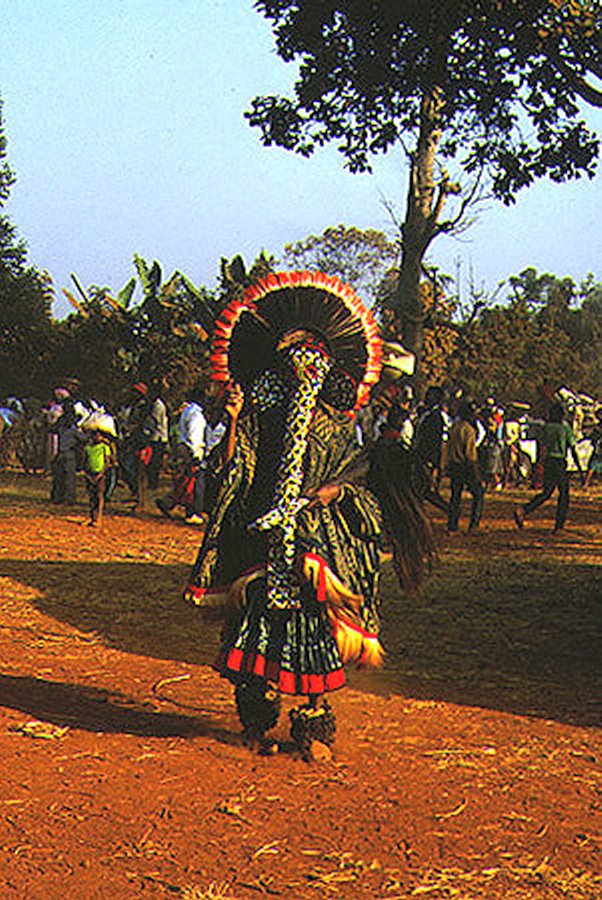
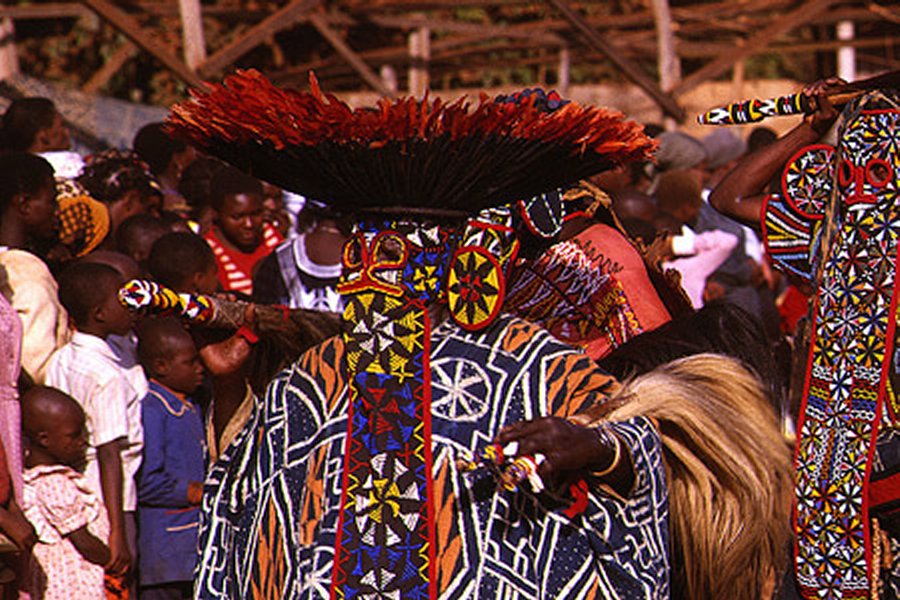
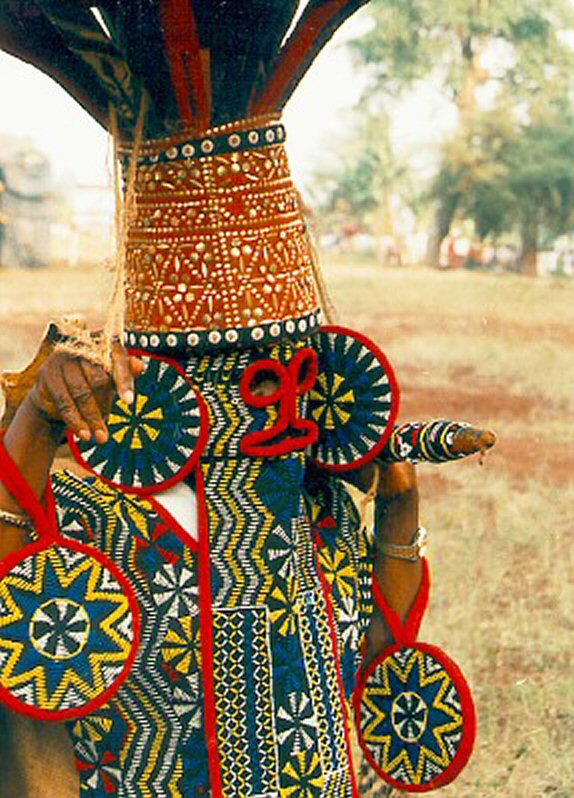
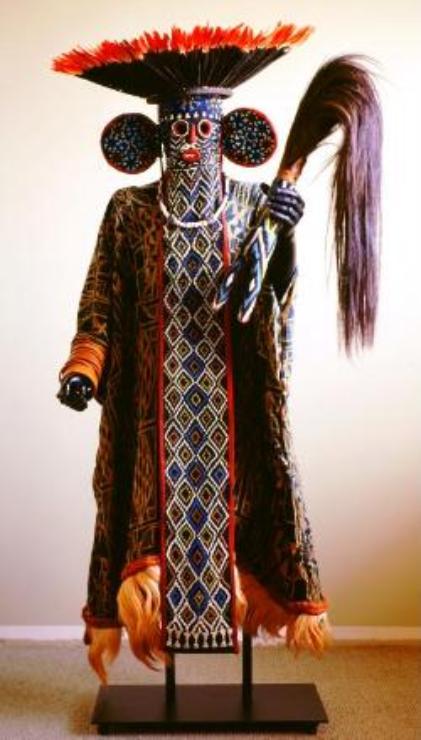
| Bamileke elephant masks Elephants are the world's most commanding land creatures, unsurpassed in grandeur and power. Thus elephant masks, while rare in Africa, are fully appropriate symbols of important leaders or, at least, their respected deputies or messengers. The societies that use these masks in fact act as agents of chiefs' control and as formal royal emissaries. Elephant societies that originated in Bamileke and spread elsewhere in the Grasslands consist of three graded ranks attained by wealth. These elephant masks, signifying kingship and wealth, were worn by the powerful members of the Kuosi regulatory society, which included members of royalty, wealthy title holders, and ranking warriors of the Bandjoun kingdom of western Cameroon. In the past, payment of a slave or a leopard pelt to the chief who owns the society was necessary for entrance to the highest rank. The glass beads used on earlier masks were nineteenth-century trade beads of Venetian or Czechoslovakian manufacture, used as well in exchange for slaves. Elephant mask costumes were thus called "things of money" since their beads were both objects and symbols of wealth (Brain and Pollock 1971:100; Northern 1975:17-21). Elephant masks comprise cloth panels and hoods woven from plantain fiber over raffia. On this background multicolored beads are stitched in geometric patterns. The basic form depicts salient features of the elephant—a long trunk and large ears. The hood fits tightly over the masker's head, and two hanging panels, one behind and one in front, partially conceal the body. The front panel is the elephant trunk, and the two large, stiff circles hinged to either side of the head are its ears, which flap as the masker dances. While the mask symbolizes an elephant, the face is human. Eyeholes provide visibility, and a nose and mouth with teeth are normally present. Such masks are often worn with robes of dark woven fiber covered with small fiber knobs or indigo and white tie-dyed "royal" cloth. The robes contrast greatly with the maskers' bright red legs, dyed with camwood. Costumes also include beaded vests with broad belts and leopard pelts attached at the back. Since a chief owns or controls the masking society, both leopards and elephants are apt metaphors for symbolic impersonation. Maskers dance barefoot in these colorful costumes to a drum and gong, moving slowly as they wave poles with blue and white beaded tips trimmed with horsehair. They whistle "mysteriously and tunelessly," brandishing spears and horsetails. Maskers are later joined by chiefs and princesses, parading by an elaborate tent in which high-ranking men sit to observe. A masker hurls his horsetail to the chief, the crowd cheers, and the celebration continues with various feats performed primarily by younger maskers. When the festivities end, the favorites are rewarded with kola nuts and wine (Brain and Pollock 1971:100-104; Northern 1975:17). The beauty of these masks is largely in their colorful beaded patterns. Dark blue or red backgrounds provide foundations for basic geometric designs laid out in white, creating a striking contrast. As Tamara Northern indicates, the masks show varied degrees of order and complexity (1975:116).33 Masks may be sparsely or densely beaded. The mask's lavish use of colored beads and cowrie shells displayed the wealth of the members of the Kuosi society; and its colors and patterns expressed the society's cosmic and political functions. Cowrie shells are also symbols of wealth and power and were used in the some examples of these masks. Black denotes the relationship between the living and the dead. White refers to the ancestors and potent medicines. Red symbolizes life, women, and the institution of kingship. The dominant triangle designs on both masks represent leopard spots, the leopard being a royal symbol of power and mastery like the elephant. The members of the Kuosi regulatory society belonged to the royal court and enforced the laws of the kingdom in all spheres of life. The society gathered together during funeral ceremonies of its members and for public celebrations of kingship to display the Bandjoun kingdom's power and wealth. |
| Bamileke beaded elephant mask Length is 61 in. and the diameter at the top is 21 in. Some Bamileke elephant masks had a structure on the top as this one does. This one is supported by a row of what I believe to be animals representing the leopard. The leopard was also considered a royal animal and was often used on top of the elephant masks and on headcrests used in conjunction with the elephant masks. This mask is no longer in my collection Click on any image to see full size version |


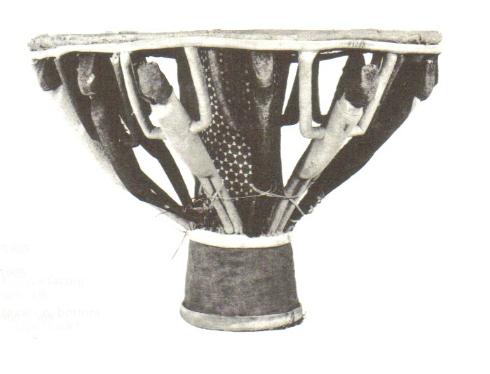
| The black and white image above is taken from the book: The sign of the Leopard - Beaded Art from Cameroon It is listed as a head piece in the book because the example was worn on top of the head and may or may not have been worn on the top of an elephant mask. I included it on this page because it is similar in form to the structure that is on top of my elephant mask. HEAD PIECE Collected by V. Knobloch in Bagango, 1905 43083, H. 18 in. (46cm) Alternating red (faded) and dark blue figures facing in- and outward Centre column covered with blue/white calico; bottom edge: remnants of bark cloth |


| Other examples for reference purposes |
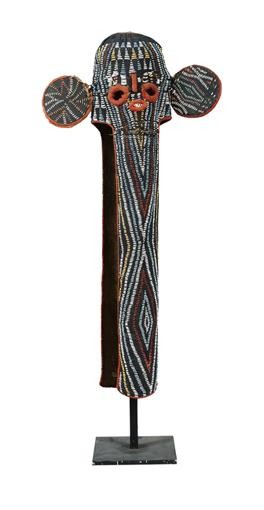
| Sotheby's - Paris Paolo Morigi collection : Important African Art Auction Date : Jun 6, 2005 Lot 155 : f - MASQUE-CAGOULE ÉLÉPHANT, BAMILÉKÉ, CAMEROUN [A BAMILEKE BEADED ELEPHANT MASK, CAMEROON] Description tou-poum, fait d'une toile de fibres de raphia doublée à l'extérieur d'un tissu noir orné de perles de verre colorées. Les traits anthropomorphes sont ourlés d'une feutrine indigo, les yeux sont ronds, percés. De chaque coté sont cousues de larges oreilles plates, circulaires, rigidifiées par une structure interne. La cagoule se prolonge à l'avant et à l'arrière par un long rabat décoré de motifs de losanges et de triangles formés par des perles multicolores. Dimensions haut. 86 cm 33 2/3 in Estimate:€ 1,500 - € 2,000 Price Realized:€ 3,600 $ 4,337 |

| Sotheby's - New York Arts of Africa, Oceania & The Americas Auction Date : May 17, 2002 Lot 44 : Bamileke elephant mask Description fashioned from cloth in the form of an abstract elephant framed by large flat circular ears, with a panel at the front and back composed of indigo resist dyed cloth and a burlap lining; elaborately beaded overall with yellow, green, white and blue glass beads in geometric patterns. Estimate: $ 6,000 - $ 9,000 Price Realized: $ 0 Provenance Pace Primitive and Ancient Art, New York According to Ross (1992: 246-253), this type of Bamileke mask is associated with men's societies found in most Bamileke chiefdoms: the Kuosi, Nekang and Kem-ndze. The societies perform regulatory functions, with the elephant as their symbol. See Ross (ibid.) for further discussion and related examples in situ. |

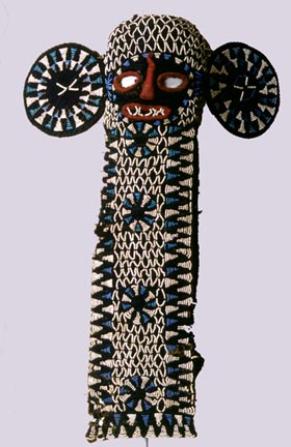
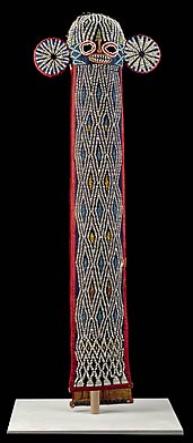
| Bamileke, Cameroon Elephant Society Mask, late 19th century Raffia, canvas embroidered with beads 62 3/4" x 18 1/2" x 8 1/4" Gift of the Director's Council 97.2.1 Memphis Brooks Museum of art |
| Elephant Helmet Mask, about 1950 1970 Bamileke people textile, beads Ball State University Museum of Art |
| Bamileke Title: Elephant Mask Date: c.1900 Medium: Indigo-dyed cotton, glass beads, natural fibers Dimensions: 54 x 8 1/2 in. (137.2 x 21.59 cm) Credit Line:The Christina N. and Swan J. Turnblad Memorial Fund The Minneapolis Institute of Arts |

| Cameroon Grasslands, 20th Century, Colonial Period This mask represents the elephant and the leopard, royal symbols of the king's power and wealth. According to Bamileke legend, the king can transform himself into either of these animals at will. Such a mask would have been worn in a biannual dance by the king and members of the Kuosi association, an elite group of Bamileke men. Dance costumes often included luxury items such as elaborate beaded garments, feathered and sculpted headdresses, indigo-dyed royal cloths and leopard pelts. The large ears and hanging trunk of the mask are indicative of an elephant. Kings are said to have accomplished legendary deeds while in the form of an elephant, such as moving giant trees blocking their way. The king faces similar obstacles as the leader of his people. Not only does the elephant evoke a sense of might and majesty, but their ivory tusks were a source of wealth, exchanged for beads and other goods. The spots of the leopard are reflected in the beadwork patterns. The strength, power, speed, and cunning of the leopard are also characteristics equated with kingship. This mask was generously donated by Richard and Barbara Faletti and is part of the Richard and Barbara Faletti Family Collection of West African Cultural Artifacts. Spurlock Museum, University of Illinois |
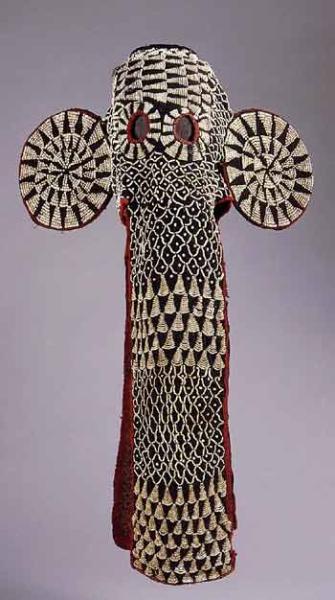
| Denver Art Museum from the collection of Frederick Wolff, Vienna -collected ca. 1880 |
| Museum for African Art |
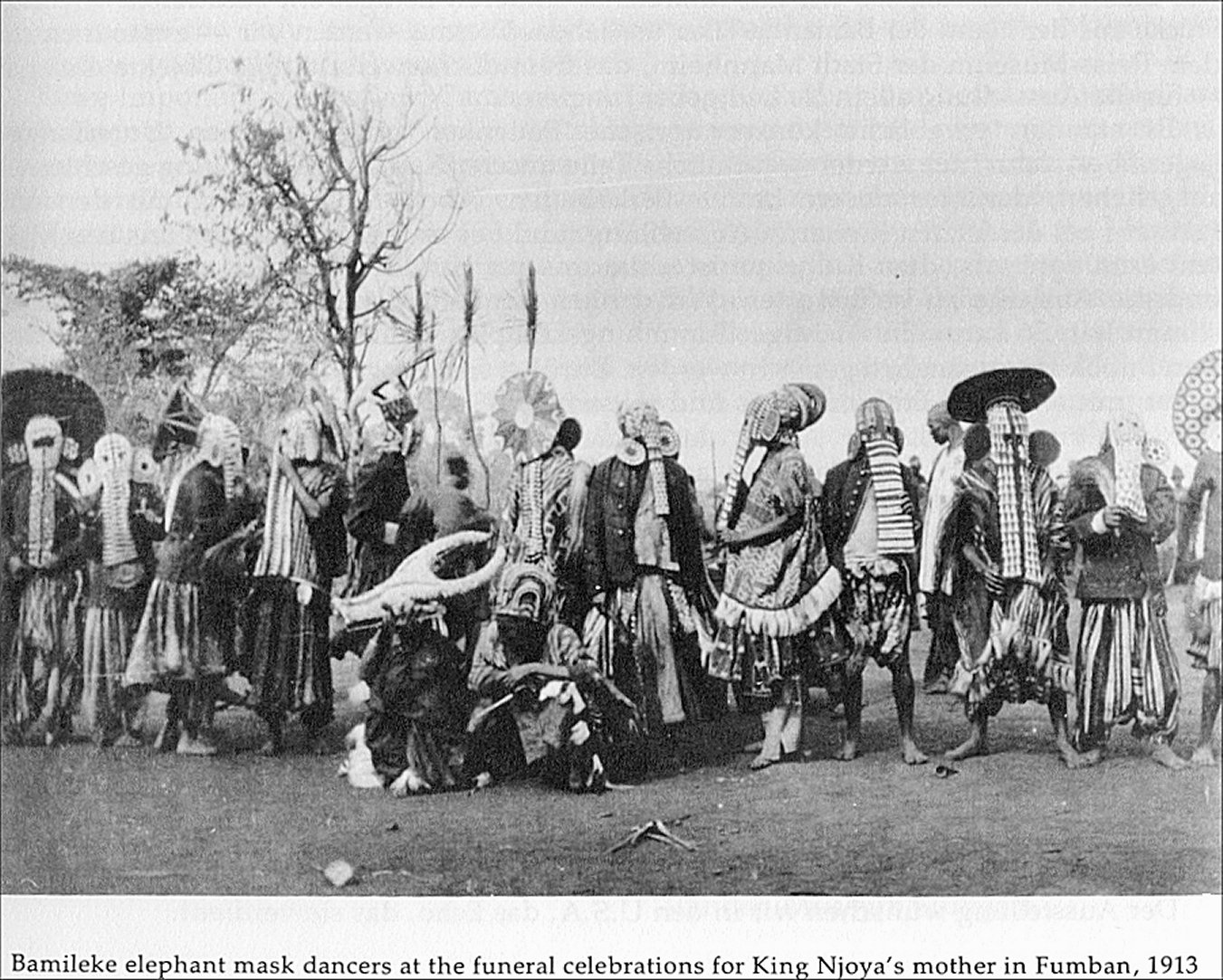
The king and Kuosi society members in Bandjoun 1930
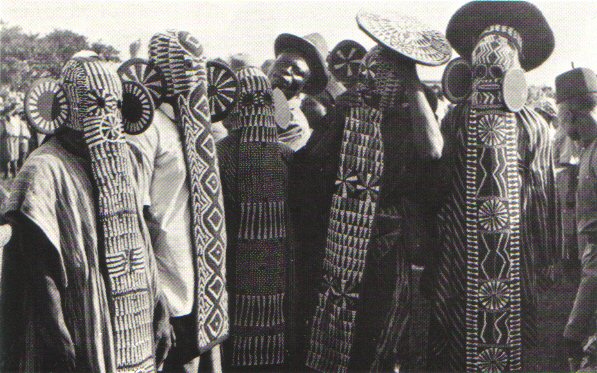
| Cameroon elephant maskers in the Bamenda highlands (Nsaw group). Photo: Paul Gebauer, 1930s |

| Bamileke Kuosi elephant masqueraders in full costume |
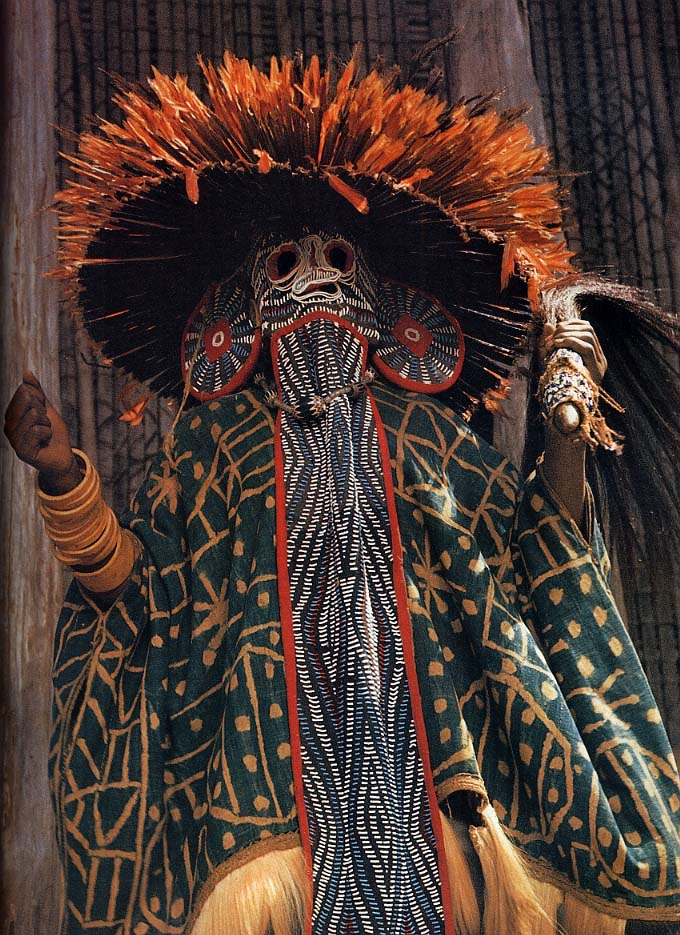


| GRASSLAND, Cameroon The northern part of Cameroon has been Islamized and has no sculpture; on the other hand, the savannas of the west, the Grassland, are composed of three ethnic groups with ancestors in common. There are the one million Bamileke spread over the southwestern plateaus, in communities that have from 50,000 to 100,000 people; the 500,000 Bamenda-Tikar in the north; and, finally, the Bamum in the northwest, with a population of 80,000. The Bamileke resisting slave raids with suicide or rebellion, contributed very little to the Black population of the New World. The artistic production of the people living in the Grassland of Cameroon is closely associated with royal and societal ceremonies. Large figures, thrones and prestige paraphernalia are used by the king to assert his power. The Grassland was divided into ninety kingdoms governed by a king, the fon, supported by non-secret societies. In the past, he was believed to be endowed with supernatural powers that allowed him to change into an animal – an elephant, leopard, or buffalo. He ensured the protection of his people and guaranteed the fertility of the fields and the fecundity of the women. The fon was responsible for rituals of planting and harvesting, for the annual festival of the dry season, for the opening of the collective royal hunt, and for expeditions of war. The fon was appointed by his predecessor, who chose him from among his direct heirs, excluding the eldest. Art objects were symbols of position in the hierarchy; their number, the materials from which they were made, and their iconography changed progressively as one descended or ascended the social ladder. Competition among sculptors was often great, for the artist’s “office” was not hereditary. Sculpture’s goal was to commemorate and celebrate the royal ancestors of the present fon. In the fon’s palace, next to the ancestral figures and the masks, one would also find headdresses, beaded thrones, bracelets, necklaces, pipes, leopard skins, elephant tusks, swords, commanders’ sticks, fans, dishware, horns, and terracotta bowls. In Bamileke territories, the fon entrusted the guardianship of the sculptures to certain members, for to spread around portions of the treasury was an insurance against the frequent fires. Masks that elicit fear and apprehension are the work of societies responsible for repression. In spite of the ethnic and stylistic variations found in the Grassland area, similar types of mask have been produced. All young boys belong to associations based on age classes, covering periods of five years each, focusing on military and technical apprenticeship. The various societies also had their masks; some of them, according the tradition, had been created and consecrated by the ancestors themselves, others inspired great fear, there were masks decorated with beads, copper, and cowrie shells. Most of the kingdoms used the buffalo, stag, elephant, birds masks, and masks presenting male and female human heads. They are usually worn during state ceremonies such as the funeral of an important dignitary, or during annual festivities. During these ceremonies, the leading dancer wears a n’kang mask which bears a false beard, a coiffure split in two symmetrical parts and is often covered in royal paraphernalia such as cowrie shells and beads. The n’kang mask is followed by other masks representing a woman, a man or an animal. The buffalo and elephant masks represented strength and power, and the spider mask, intelligence, but most of the meanings are now lost. Bamum social life was oriented toward the conquest of surrounding chieftainries, and forays were made into neighboring lands: from this stems a warrior mythology and an abundance of material symbols of strength. The Bamum produced large figures encrusted with beads and cowries. Noteworthy elephant heads cast in bronze. There are also: dance masks in the form of a long head and a high neck, also in animal-head form; footstools and thrones decorated and supported by animal or human figures. In the small kingdom of Bangwa, the heads of statues and masks feature puffed-out cheeks. The very characteristic sculpture in the round attains its apogee in a depiction of a horn-player who wears traditional headgear in the shape of a tiara; the thick double arc of his eyebrows overhang, and the mouth is treated in parallelepipedal relief under a heavy nose featuring well-shaped nostrils. The wood used for masks is not always completely hollowed out, for the mask does not cover the face of the wearer but rather tops a kind of bamboo cage surrounded by a tufted collar of palm fibers, which conceals the head. These masks, instruments of societies with political, administrative, judicial, or theatrical functions, were kept in special storage houses; they were brought out at the first rainfall. Then, the king himself would appear masked and dancing. The buffalo joins the leopard, elephant, and two-headed python as an image of royal power is frequently found in the decoration of works from the region. A large number of prestigious items of paraphernalia were produced within the Grassland area, including large house- posts, door and window frames carved with human and animal figures, thrones, stools and tables decorated with small heads and figures, large bowls, carved horns for royal feasts, anthropomorphic terracotta and bronze pipes. Musical instruments such as anthropomorphic and zoomorphic drums, as well as metal gongs, were played during royal and state ceremonies. Source: www.zyama.com |
| Go to the Bamileke cowrie shelled elephant mask page Go to the Bamileke elephant/leopard headcrest page |