| African maternity figures Various African cultures |

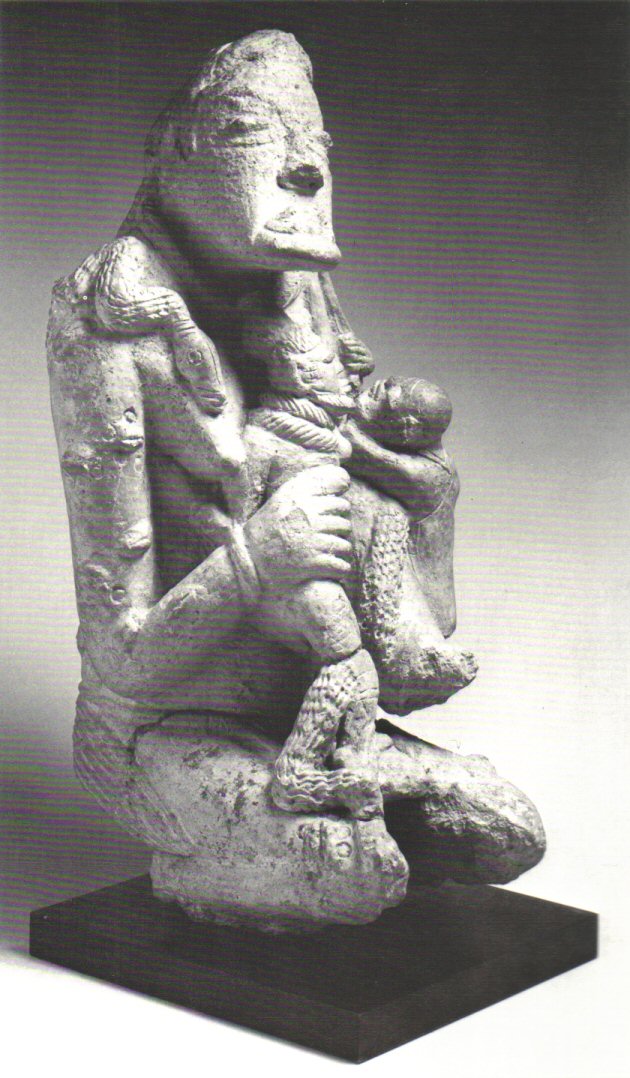
| MATERNITY FIGURE Inland delta region of the Niger River, Mali late12th-late 14th century Terra-cotta H. 15 1/8 in. (38.4 cm) Collection of Count Baudouin de Grunne, Belgium Since the 19405, the excavations in the inland delta region of the Niger River near Djenne in Mali have yielded numerous sculptured terra-cotta, cast copper-alloy, and gold figures representing humans and animals. These sculptures originated in advanced, flourishing cultures that may have existed as early as the eighth century A.D. or as late as the seventeenth century. Figures representing a mother and child seem to occur less frequently than other subjects, such as chiefs or warriors on horseback, reclining or kneeling females, or animals, especially snakes. The meaning of these ancient maternity figures is unknown. In this example and in other instances, the "children" are obviously mature adults, as indicated by the beard on one of the males in this figure. Perhaps such figures served as symbols of the primordial mother or another mythical figure in the history of a clan in which the sculpture originated. Regrettably, the stratigraphic context in which most of these objects have been discovered and other pertinent data are unknown. Even so, it is possible to date the objects. In 1979 this figure was dated by the thermolumines-cence method to 690 ± 105 years earlier (de Grunne 1980, 2.7, fig. 1.15). The proliferation of decorative details on the figure includes serpents, which are depicted as zigzags. Snakes commonly occur in the visual arts as well as in the oral traditions of numerous peoples of the inland delta region. Snakes play an important role in the cosmology and mythical origins of the clan. For example, snakes are king makers, designating the successful candidate by touching him with the nose (ibid., 17-35). Snakes are often considered to be symbols of immortality throughout sub-Saharan Africa because they "renew" themselves by shedding their skin (Parrinder 1954, 51). |

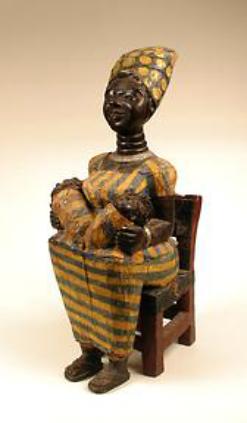
| Akan peoples - Ghana Mid-late 20th century Papier mache, wood, paint, fiber H x W x D: 74 x 21.8 x 35.1 cm (29 1/8 x 8 9/16 x 13 13/16 in.) Gift of Dr. and Mrs. Robert Kuhn National Museum of African Art |
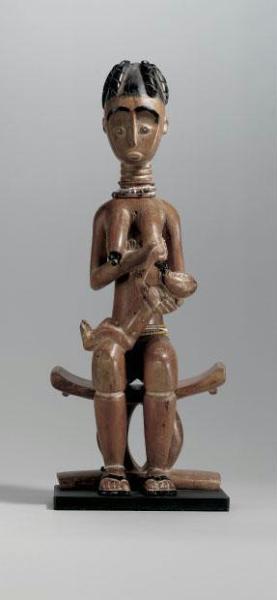
| A FANTI MATERNITY FIGURE From a Sotheby's auction May 2002 |
| MATERNITY FIGURE Asante group, Akan peoples, Ghana, 19th-20th century Wood H. 20 in. (50.8 cm) Collection of Gustave and Franyo Schindler |
| Fertility and children are the most frequent themes in the wooden sculptures of the Asante. Thus the most numerous works are akua'ba fertility figures and mother-and-child figures. In traditional Asante society, in which inheritance was through the maternal line, a woman's essential role was to bear children, preferably girls to continue the matrilineage (McLeod i98ia, 164). Sculptured mother-and-child figures show the mother nursing or holding her breast, as exemplified by this figure. Such gestures express Asante ideas about nurturing, the family, and the continuity of a matrilineage through a daughter or of a state through a son. This figure does not depict an ordinary mother. Rather, as indicated by her elevated sandaled feet, the figure represents a queen mother as she would sit in state on formal occasions. Such royal maternity figures were kept with the venerated seats of ancestral chiefs in special rooms, or they were housed in the shrines of powerful deities that were particularly concerned with the well-being of a royal person, perhaps a queen mother (Cole and Ross 1977, in). |
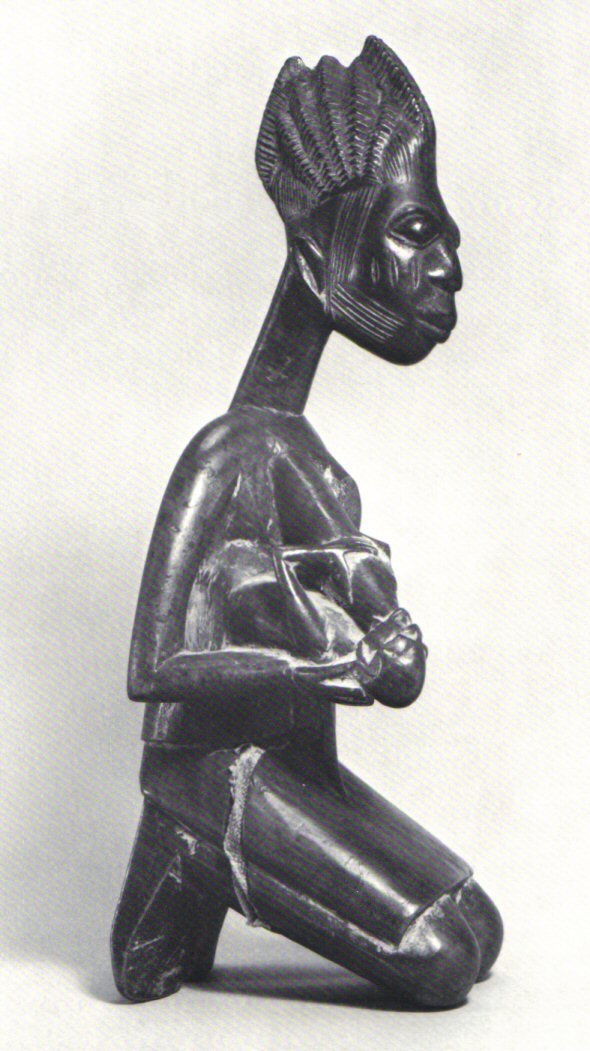
| MATERNITY FIGURE Yoruba peoples, Nigeria, 19th—20th century Wood H. 16 3/4 in. (42. 5 cm) Collection of Rita and John Grunwald According to Yoruba belief, children are blessings from the gods. Before the advent of modern medicine, women petitioned certain deities for fertility and the birth of a healthy infant. The shrines to these deities—Erinle, Yemoja, Shango, Ogun, and others— were adorned with sculptured figures representing a mother and child, as exemplified by this figure. The absence of cult attributes makes specific identification of this figure impossible. The kneeling position is a gesture of respect, devotion, and submission. Thus the figure represented in the carving is probably a petitioner rather than a deity. The sculpture may have been a votive offering from a woman who had successfully petitioned for a child, a priest or priestess of a cult, or even the entire body of worshipers (Bascom 1969b 107; Cole 1985). |

| MATERNITY GROUP FIGURE Afo peoples, Nigeria, 19th century Wood H. 27 3/4 in. (70.5 cm) Horniman Museum, London - 31.42 Afo maternity figures are thought to represent an ancestral mother (Fagg 1963, fig. i43b) and are owned by individual villages. These figures are brought out of their shrines once a year for the Aya ceremony. At this time, men pray for increased fertility in their wives and make gifts of food and money to the ancestor (Tschudi 1969-70, 93; Leuzinger 1972, 208; Kasfir in Vogel 1981, 163). Extant maternity figures from the Afo are usually monoxylous, that is, carved from one piece, and are usually shown with only one child. This female figure is carved from one piece of wood; however, the child on her lap, the arms of that child, and the head of the child clinging to her back are carved separately. The separate pieces are fitted on with wooden pegs. The Horniman Museum acquired this maternity figure in 1931 from Major Fitz Herbert Ruxton, a British colonial officer in Nigeria. The figure is believed to date from before 1900 (Fagg 1963, fig. 143b). |

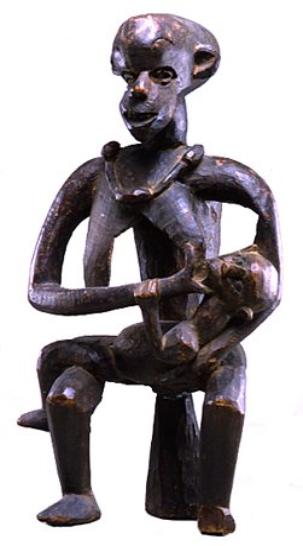
| 1850-1950; Cameroon, Bamileke; Wood; height 59 cm (23 in.) Founders Society Purchase, Eleanor Clay Ford Fund for African Art; 79.22 Detroit Institute of Art |
| MATERNITY FIGURE Artist: Mbeudjang, Batufam Kingdom, Bamileke peoples, Cameroon, c. 1912 Wood, pigment H. 39 7/8 in. (101.3 cm) Collection of Murray and Barbara Frum |
| It was customary in the grasslands Batufam Kingdom to have portrait statues carved of the new fon (king) and the wife who bore his first child. According to royal custom, the heir to the throne could not rule until he proved his fertility. The sculptures were executed within two years of the beginning of the reign and were used in the rites of installation of the successor. The female figure shown here is a portrait of Queen Nana, the wife of Metang, who was installed between 1912 and 1914, and their first child. Mother-and-child figures and those of kings were erected outside the palace, where they were on permanent display, protected by the roof of the verandah (Harter in Fry 1978, 118-22.; Harter 1986, 54). |

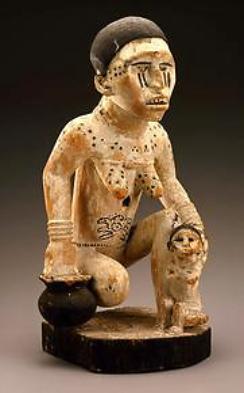
| Female figure with child Kongo peoples Congo, Cabinda Province, Angola, Mayombe region, Democratic Republic of the Congo Late 19th-early 20th century Wood, pigment, mirror glass H x W x D: 54.0 x 27.9 x 26.4 cm (21 1/4 x 11 x 10 3/8 in.) Gift of the Eugene and Agnes E. Meyer Foundation National Museum of African Art |
| SCEPTER (Mvuala) FINIAL Yombe group, Kongo peoples, Zaire probably 18th century Ivory, metal H. 8 1/4 in. (21 cm) Collection of Count Baudouin de Grunne, Belgium |
| The Kongo Kingdom flourished from c. 1300 to the mid-seventeenth century. The Kongo were the first people of Central Africa to make contact with the Portuguese navigators, who first arrived in 1482 and brought with them Catholic missionaries, merchants, and artisans. The Kongo aristocracy embraced Christianity and Western culture, and trade with Portugal resulted in increased wealth and military power. From the capital at Sao Salvador in present-day Angola, Kongo rule extended into portions of Zaire, Congo, Cabinda, and numerous small coastal and inland chiefdoms in Angola. Around the mid- seventeenth century, the once-powerful kingdom began to founder and shrink. Finally, it collapsed and became decentralized. Among the symbols of rank belonging to Kongo kings and chiefs were scepters (mvuala) made of hardwood and usually topped by an ancestor figure carved of precious ivory. Very often the ancestor so represented was a female (Cornet 1971, 48). Because power was transmitted through the female line, rulers were selected from among the matrilineage. The king's mother was titled the "queen mother," and although she did not share rule with her son, she held a position of respect and privilege (Murdock 1959, 2.97). Although the precise meaning of this Yombe mother-and-child figure is not known, it probably symbolizes woman as the source of human fertility and the bearer of healthy children—in this case, healthy future rulers. Clearly this mother belongs to the ruling class, as indicated by her cap ("chief's hat") and carefully coiffed hair, filed teeth, and jewelry. A similar cap is worn by the infant, who, as real babies do, holds his mother's breast with one hand and tugs on her hair with the other. Despite the submissive pose, Kongo women were powerful, and images like this are a reminder of their importance. |
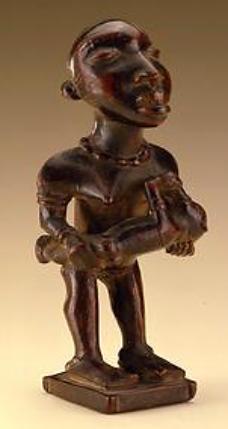
| Female figure (pfemba) Kongo peoples Congo, Democratic Republic of the Congo Late 19th-early 20th century Wood H x W x D: 17.1 x 7.9 x 5.4 cm (6 3/4 x 3 1/8 x 2 1/8 in.) National Museum of African Art While this figure holding a child to her breast has obvious associations with maternity and fertility, there are indications of use as a nkisi (see 91-22-1 for an explanation of nkisi). The faint incised marks on the back of the standing woman are all that remain of a missing container for special empowering materials. The hole atop the head also once held a medicine horn or streamers. Feathers, strips of cloth or leather are used because they flutter when the nkisi is danced; this movement suggests the presence of the "spirit." An important nkisi had many components and accessories. A male and female pair of carved figures would be a male nkisi and his wife. They exemplified the types of power controlled and unleashed by the nkisi. The woman softens the retributive violence of the male and links these forces with fertility. Indeed a nkisi nkondi, an aggressive nkisi, could be used to treat a woman during childbirth and to end her seclusion afterward. The woman depicted in this diminutive carving is high in status. The child indicates that she is married, and she may have been the founding mother of a clan, for her head is covered by an mpu, a chief's hat. The concentric circles of its design can be interpreted as a sign that she holds the clan together. Certainly her pose suggests confidence and control--feet and legs firmly planted, while shoulders, neck and head lean forward almost aggressively. The overall impression is meant to be one of beauty, because that is the nature of a woman, especially a woman with a child. A sculptor who could convey this Kongo belief was respected and his work sought after. |
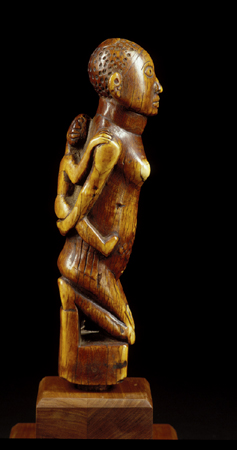
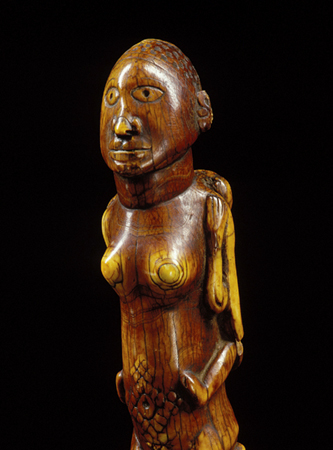
| Maternity figure, Bakongo/Sundi; D.R.C. Congo Ivory; H. 8 3/4" Remnants of Ritual - Gelbard Collection This large and impressive maternity figure probably once graced the top of a piece of royal furniture or served as a decoration for a processional or funerary bier. Dr. Albert Maesen believed that it was one of the largest of its type known and dated to the sixteenth century. However, the soft stylistic qualities of the Sundi subgroup are easily mistaken for archaic Bakongo traits, and it is much more likely that the piece is of slightly later manufacture. Aside from a number of small restorations, this object bears a fine, worn patina. The sculpture is noteworthy in that it displays an overall balance between the mother and child as well as an inventive handling of the compression in the mother's bent knees and leaning body. In a general sense, all sculpture that presents a female and child personifies womanhood, fertility, and continuity of life. What is represented is the primordial woman/ mother rather than an actual person or recently dead matron. Serenity and dignity are apparent in the sculptured image of the female. Her solid body is able to support and nourish not only the child she is carrying but, by inference, all others she hopes to bear. Shown at the height of her child-bearing years, her body is full and breasts powerfully emphasized. The mother's head is never bent but sits firmly erect, eyes aimed directly forward, as if on guard for her child. |
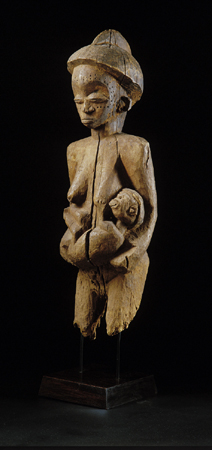
| Maternity figure, Pende (Kasai); D.R.C. Congo Wood, remains of pigment; H. 31 1/2" Remnants of Ritual - Gelbard Collection Decorating a Great Chief's kibulu ritual house, roof finials as well as figural carvings in the courtyard featuring a woman marked the high rank of the house's owner and his role as defender and protector of his people. This example, rotted below the knees from having been inserted in the ground in a chief's courtyard, would represent either the chief's mother or wife. Executed in a soft, naturalistic style, it certainly pre-dates the eastern Pende large-scale manufacture of such objects in the 1950s. The serene and beautifully rendered expression of the mother's face is in stark contrast to her roughly blocked hands and may indicate the work of more than one carver. Another example, published in a Sotheby's (Sotheby's: 1997) catalogue, has a body virtually identical to this yet a face rendered in a completely different style of carving (though still within the eastern Pende tradition). |
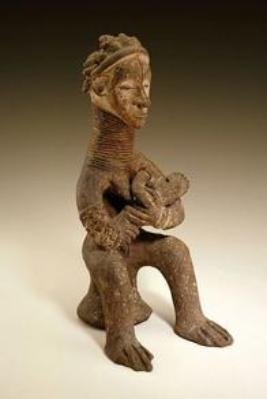
| Igbo peoples Nigeria Early-mid 20th century Ceramic, pigment, kaolin H x W x D: 34 x 14 x 18 cm (13 3/8 x 5 1/2 x 7 1/16 in.) National Museum of African Art Woman-and-child figures are placed in shrines and used by diviners in northeastern Igboland, Nigeria. The woman's coiffure, facial expression, striated neck and bracelets with cowrie shells express traditional notions of beauty. |
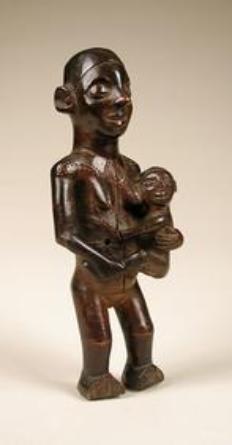
| Yaka peoples Democratic Republic of the Congo Late 19th-early 20th century Wood H x W x D: 27 x 9.5 x 7.6 cm (10 5/8 x 3 3/4 x 3 in.) Gift of Ruth Lippman in memory of Abbott Lippman National Museum of African Art This figure's naturalism and smooth surface are traits found in the sculpture from the Kwango River region. Among the Yaka, maternity figures are rare. They may appear, however, as figures surmounting masks worn by officials at boys initiation ceremonies. |
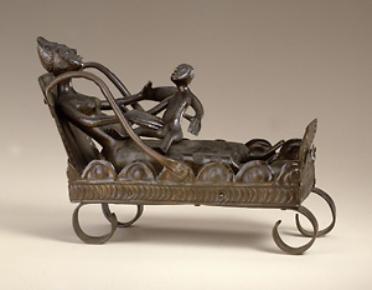
| Fon peoples Abomey, Benin Early-mid 20th century Copper alloy H x W x D: 10.5 x 15.5 x 7.5 cm (4 1/8 x 6 1/8 x 2 15/16 in.) Gift of Ernst Anspach National Museum of African Art This figure appears to be in the style of the Hontondji lineage--the somewhat elongated figures, their relatively large hands and feet and the abundance of tooled detail. According to oral tradition, this style was introduced by a smith named Gnassounou. He was part of the 1906 Colonial Exposition in Marseille and remained in France to study for three years. The style was well established by 1922 when the Merwart Collection was exhibited and continues to the present day. (Emile Merwart was the colonial governor of Dahomey in 1911-12.) These figures were purchased by European curiosity seekers originally. According to anthropologist Melville Herskovits, well-to-do Fon were also buying genre scenes as signs of prestige by 1930. Preliminary stylistic analysis suggests that this figure dates from the 1930s or earlier. |
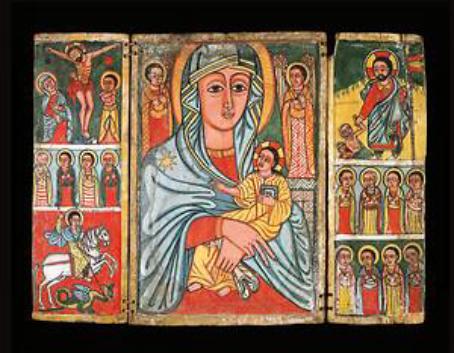
| Ethiopian Orthodox Ethiopia ca. 1750-1855 Distemper, gesso and cloth on wood H x W x D: 34.2 x 47 x 17 cm (13 7/16 x 18 1/2 x 6 11/16 in.) Gift of Ciro R. Taddeo National Museum of African Art The rich colors, especially the green and deep blue, are typical of this time period in Ethiopian icon painting. The emphasis on Mary's hand gesture, the Christ child's book and the shawl's decorative folds and star and cross ornaments derive from a Jesuit copy of an Italian engraving of a Santa Maria Maggiore icon. Mary's handkerchief, however, is an Ethiopian status symbol. Left panel top: "St. Mary," "Our God is crucified," and "St. John" the Evangelist middle: Four apostles or saints bottom: "St. George" and the dragon Center panel "St. Mary with Her Beloved Son" flanked by the archangels "St. Michael" (left) and "St. Gabriel" (right) Right panel top: "Painting of Resurrection" (the Descent into Limbo), "Adam and Eve" middle: Four apostles or saints bottom: Four apostles or saints |

| GRAVE STELE WITH MOTHER AND CHILD Musurongo group, Kongo peoples, Angola, 19th century Steatite, H. 46 1/2 in. (118.1 cm) Rijksmuseum voor Volkenkunde, Leiden, Netherlands - 449/3 Among the Kongo peoples, large families were desirable. A mother who had many children and grandchildren was honored like a great chief (Laman 1957, 16-18). In Musurongo society, expectant mothers who died before or during delivery were believed to be victims of malevolent or unhappy spirits. Stelae bearing low-relief images of a mother and child were carved from soft steatite and erected in the vicinity of the graves of such women. These stelae were considered to be receptacles for the spirits of dead mothers, from whom protection against the same fate was solicited (Verly 1955, 52.3-2.4). The mother represented on this stele probably belonged to the Kongo aristocracy, as indicated by several symbols of prestige: a pineapple leaf fiber cap ("chief's hat"), a necklace probably made from precious glass beads and metal, a pectoral cord, and metal anklets. Most extant stelae from the Musurongo were collected before 1916 from the coastal town of Ambrizete and its vicinity on the northern coast of Angola. This stele was acquired by the Rijksmuseum voor Volkenkunde in 1884. |

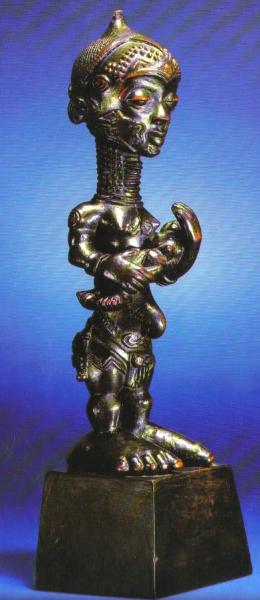
| Bena Lulua maternity Sotheby's Nov. 1980 cover photo |
| Bena Lulua maternity in the Metropolitan Museum of Art, NY |
| MATERNITY FIGURE Lulua peoples, Zaire, 19th—20th century Wood Among the Lulua, the Buanga Bua Cibola, a fertility cult, addresses the plight of mothers whose babies were stillborn or died in infancy. The cult ensures that the soul of the deceased infant returns to its mother's womb to be reborn. Figures representing a pregnant woman or a mother and child, carved as a complete figure or ending in a point like this one, are used in the cult. During pregnancy a woman is isolated for a specified period of time as imposed by the cult and commissions a figure from a sculptor. Upon the delivery of the sculpture, the period of isolation ends. Once it is in her possession, she keeps the figure in a basket near her bed and regularly rubs it with oil and tukula, a paste made from a hardwood. The figure is brought out on nights when there is a full moon, a symbol of fertility (Maesen 1982., 55). Characteristic of Lulua statuary and people, this maternity figure has elaborately coiffed hair and a gleaming skin that is covered with detailed scarification. These are more than expressions of the Lulua aesthetic; rather, buimpe (beauty) is simultaneously a moral and a physical quality, which is manifested in the quality of one's skin. Without a beautiful skin, one is considered evil. Thus the "healthy skin" of the figure must be achieved by the woman to ensure the moral and physical integrity of her newborn child, the reborn ancestor. |

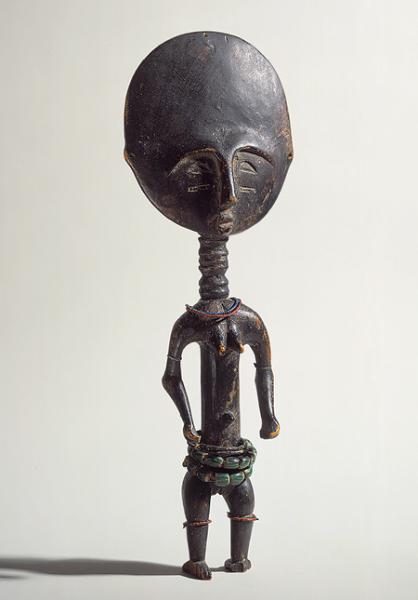
| Akuaba Figure, 19th–20th century Akan peoples; Ghana Wood, beads, string; H. 10 2/3 in. The Michael C. Rockefeller Memorial Collection, Bequest of Nelson A. Rockefeller, 1979 (1979.206.75) Metropolitan Museum of Art, NY Akua'maa (sing., akua'ba) are sculptured wooden figures that are believed to induce pregnancy and ensure a safe delivery and a beautiful, healthy infant. After the akua'ba is blessed by the fertility deity in rites conducted by a priest, the woman carries it and treats it like a real child; she adorns it with beads and earrings, "nurses" it, and puts it to bed. After a successful birth, a mother may give the akua'ba to a daughter to play with or use it to teach child care (Cole and Ross 1977, 103—7; McLeod 1981a, 161-65). Females are, with rare exceptions, the only sex represented in akua'maa. There are several reasons for this, but the essential one is that Asante society is matrilineal and the family line is passed from the mother to the daughters, not from the father to the sons (McLeod 19813, 19, 164). Thus it is essential that a woman have daughters to perpetuate the family line, and it is desirable to have daughters to help with household chores and take care of younger siblings. Akua'maa illustrate Asante concepts of beauty: a high oval, flattened forehead that in reality is achieved by massaging an infant's soft skull; a small mouth; and a neck ringed to depict creases caused by subcutaneous fat, indicating the good health of the infant. In contrast to typical akua'maa, which have truncated bodies, this akua'ba has naturalistic arms and legs. It has been estimated that such figures constitute less than 1 percent of the total number of akua'maa and may be a twentieth-century innovation (Cole and Ross 1977, 105). |

| Dogon maternity figure from Sotheby's May 2005 Description the fragmentary base leading to exaggerated, shelf-like hips, with slender arms, the right one fragmentary, framing the torso with pendant breasts and a baby at the back, the pointed shoulders beneath a helmet-shaped head with worn features, terminating in a flat crown; highly encrusted, slightly resinous ritual surface. PROVENANCE Acquired from Erica Brausen, Hanover Gallery, London, 1959 |
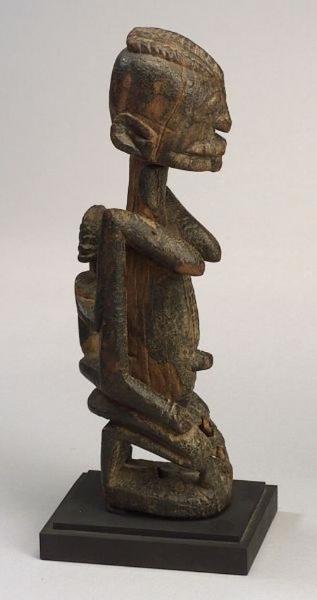
| Dogon maternity from an auction at Skinner Provenance: The Gilbert Graham collection. |

| TABWA MATERNITY FIGURE From a Sotheby's auction, Nov 2003 Ujiji region, standing on a circular base, the flat feet and bent legs leading to rounded hips encircled by a fiber skirt, the narrow torso with incised, dentil scarification supporting a baby at the back, the shelf-like shoulders leading to hands held to the sides beneath the elongated neck and head with jutting chin, demilune ears and wearing a close-cropped elaborately incised coiffure, '135.9A.Ex', '1924.431.' in white pigment at the base and 'NA.bcl-19-xix-140' and 'EA 1470' on the underside; fine dark brown patina. Dimensions height 20 1/4 in. 51.5cm Provenance PROPERTY FROM THE COLLECTION OF DEBORAH STOKES HAMMER, CHICAGO Collected in the Ujiji region circa 1880 Gifted by Victor Wright to the Royal Scottish Museum in 1924 Denver Art Museum, 1949 Peter Natan, Denver, 1963 Ernst Anspach, New York Exhibited The Museum of Primitive Art, New York, African Tribal Sculpture from the Collection of Ruth and Ernst Anspach, November 1967-February 1968, number 97 Brainerd Hall Art Gallery, State University College at Potsdam, New York, African Sculpture: Rare and Familiar Forms from the Anspach Collection, October 1974, number 64 Published Walker, African Women/African Art, 1976: 28, catalogue for the exhibition at The African-American Institute, New York, September 13-December 31, 1976 Maurer and Roberts, Tabwa: The Rising of a New Moon, 1985: 246, figure 173, catalogue for the exhibition at The National Museum of African Art, Smithsonian Institution, Washington D.C., January-March 1986 (see bibliography for additional venues) Cole, Mother and Child in African Sculpture, 1985: plate 47 catalogue for the exhibition at the Los Angeles County Museum of Art, Los Angeles, December 5, 1985-July 6, 1986 Notes The records of the Royal Scottish Museum (NMS) state the following: 'A.1924.431, Figure of a woman carrying a child on her back, carved in pale soft wood and blackened, standing, naked except for loin cloth of woven grass; grotesquely long neck; incised patterns on body suggesting cicatrices. On circular base. Tanganyika District, East Africa, H. 20 inches. Brought home about forty years ago by the brother of the donor who was stationed at Ujiji, Kawimbi, and Kambole, where the specimens were probably obtained. Given by Mr. Victor Wright.' Tabwa figures from the Ujiji region are rare. Rarer still are maternity figures from this region. See Maurer and Roberts (1985) for further discussion, and the catalogue raisonné (219-278) in which this is the only documented maternity figure. |

| From the collection of the American Museum of Natural History, NY FIGURE, FEMALE/CHILD [90.0/ 5230] AFRICAN ETHNOGRAPHIC COLLECTION Culture: MBALA?(S.BAMBALA?) Locale: KWANGO REGION?, KASAI Country: CONGO FREESTATE Material: WOOD,PIGMENT,COATING Dimensions: L:47 W:17.4 [in CM] Donor: BELGIAN GOVERNMENT Acquisition Year: 1907 |
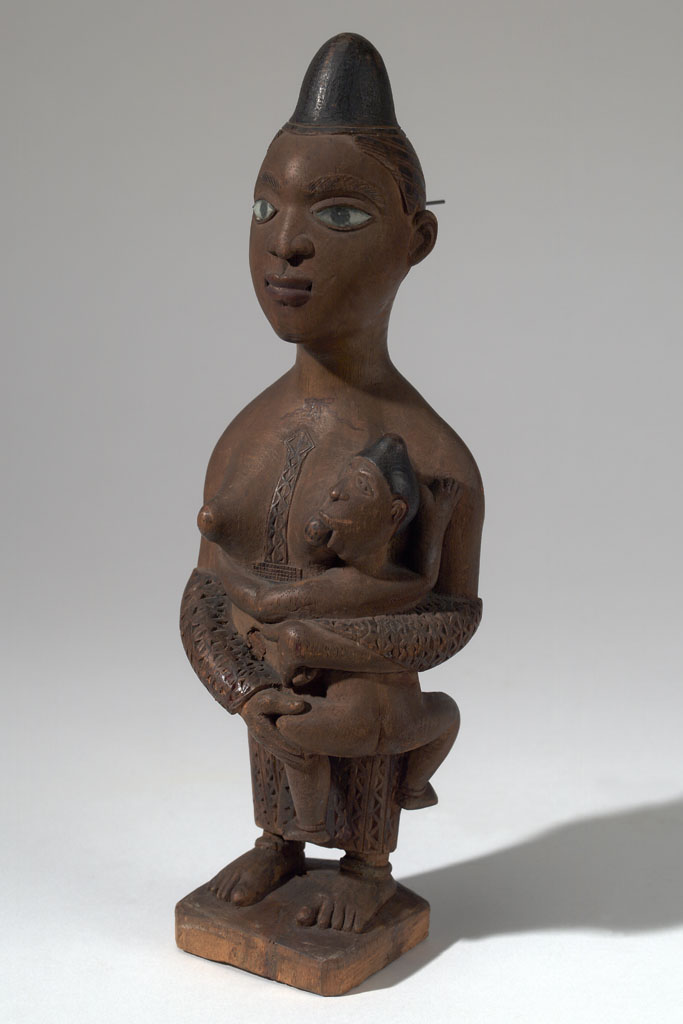
| From the collection of the American Museum of Natural History, NY FIGURES, FEMALE/CHILD [AFE/00821] AFRICAN ETHNOGRAPHIC COLLECTION Culture: KONGO? Country: ANGOLA? |

| From the collection of the American Museum of Natural History, NY FIGURES, WOMAN+CHILD [90.1/ 3320] AFRICAN ETHNOGRAPHIC COLLECTION Culture: ZANDE Locale: NALA Country: BELGIAN CONGO Material: WOOD,COATING Dimensions: L:60.2 W:23.5 H:16 [in CM] Donor: LANG Acquisition Year: 1915 Published in: AFRICA: THE ART OF A CONTINENT. ( by PHILLIPS, TOM EXHIBITION CATALOG, 1966) AFRICAN REFLECTIONS: ART FROM NORTHEASTERN ZAIRE. ( by SCHILDKROUT, ENID AND CURTIS KEIM EXHIBITION CATALOG, 1990) Exhibition History: AFRICA: THE ART OF A CONTINENT (ROYAL ACADEMY OF ARTS, LONDON , LONDON, 1995) AFRICAN REFLECTIONS: ART FROM NORTHEASTERN ZAIRE (AMNH , NEW YORK, NY, 1990) MOTHER AND CHILD (AFRICAN AMERICAN INSTITUTE , NEW YORK, NY, 1986) |

| From the collection of the American Museum of Natural History, NY FIGURE, FEMALE/CHILD [90.1/ 4645] AFRICAN ETHNOGRAPHIC COLLECTION Culture: MANGBETU, ZANDE Locale: NIANGARA? Country: BELGIAN CONGO Material: WOOD,PLANT FIBER,PIGMENT Dimensions: L:47 W:22.3 H:11.3 [in CM] Donor: LANG Acquisition Year: 1915 |

| From the collection of the American Museum of Natural History, NY FIGURES, WOMAN/CHILD [90.1/ 8901] AFRICAN ETHNOGRAPHIC COLLECTION Culture: ZARAMO(WASARAMO) Country: TANGANYIKA Material: WOOD,COATING Dimensions: W:9.4 H:27.7 [in CM] Donor: LERNER Acquisition Year: 1949 |
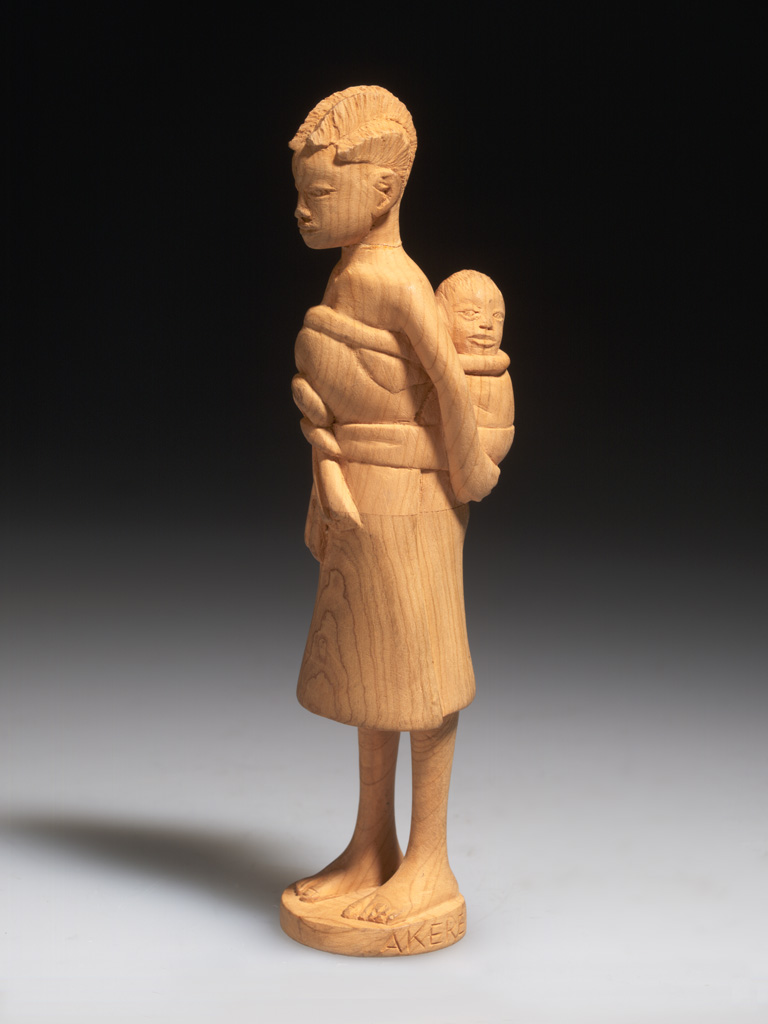
| From the collection of the American Museum of Natural History, NY FIGURE, FEMALE/CHILD [90.1/ 8691] AFRICAN ETHNOGRAPHIC COLLECTION Culture: YORUBA? Locale: LAGOS Country: NIGERIA Material: THORNWOOD Dimensions: W:2.4 H:10 [in CM] Donor: WASSON Acquisition Year: 1948 Exhibition History: TOYS OF AFRICA (SAN FRANCISCO AIRPORT , SAN FRANCISCO, CA, 1992) |

| From the collection of the American Museum of Natural History, NY FIGURES, FEMALE/CHILD [90.2/ 3781] AFRICAN ETHNOGRAPHIC COLLECTION Culture: MAHAFALY Country: MADAGASCAR Material: WOOD,COATING Dimensions: L:36.9 W:9.4 [in CM] Donor: GERDEAU Acquisition Year: 1961 |

| From the collection of the American Museum of Natural History, NY MARIONETTE, MOTHER & CHILD [90.2/ 8603] AFRICAN ETHNOGRAPHIC COLLECTION Culture: BAMBARA Country: MALI Material: WOOD, CLOTH (COTTON), METAL EARRING Dimensions: H:92 W:84 (ARMS) [in CM] Donor: SIMMONS Acquisition Year: 1992 |

| From the collection of the American Museum of Natural History, NY GOLDWEIGHT, WOMAN,CHILD [90.2/ 8069] AFRICAN ETHNOGRAPHIC COLLECTION Culture: ASHANTI Country: GHANA Material: METAL (BRASS) Dimensions: H:5 W:2.5 [in CM] Donor: WILLIAMS Acquisition Year: 1990 |
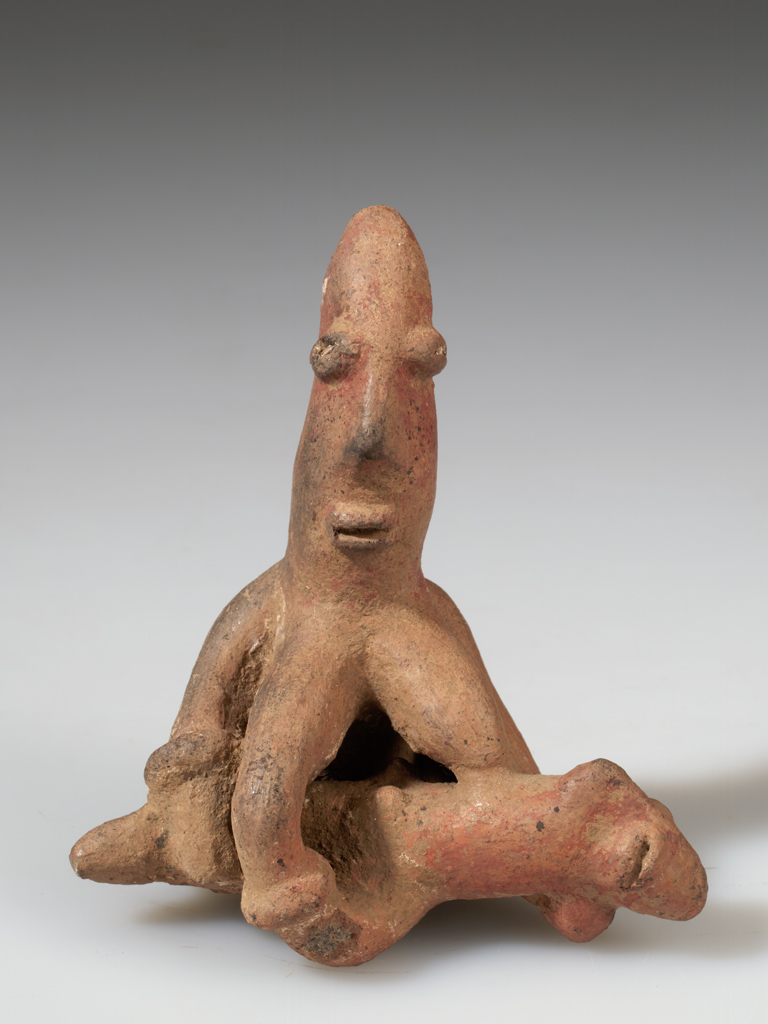
| From the collection of the American Museum of Natural History, NY FIGURE, FEMALE/CHILD [90.2/ 57] AFRICAN ETHNOGRAPHIC COLLECTION Culture: YORUBA, NAGO Locale: MEKO Country: NIGERIA Material: CERAMIC Dimensions: W:11 H:12.3 [in CM] Donor: BASCOM Acquisition Year: 1951 |
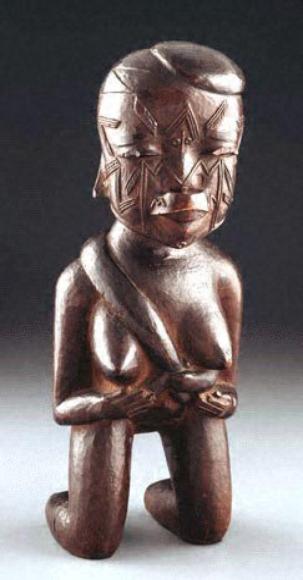
| Kneeling Mother and Child late 19th century Africa, Tanzania-Mozambique border area Makonde peoples Wood 14-1/2 x 5-3/8 x 4-3/4 in. (36.8 x 13.6 x 12.0 cm) Acquired in 1979 Kimbell Art Museum Among the few East African peoples who made sculptures in any quantity, the Makonde are notable for their unusually naturalistic figures. Most African mother and child sculptures are intended to ensure fertility, but this piece indicates the high status of the female in that matriarchal society. It is thought to represent the primeval matriarch who founded the Makonde tribe. Details of the vigorously carved sculpture are sensitively articulated, including the mother's hooded eyes and her fingers holding the sling in which the baby straddles her back, its tiny feet and hands extended. The sculpture displays Makonde signs of feminine beauty, such as facial scarification, prominent breasts, and an upper lip distended by a lip plug. Provenance History Pitt Rivers collection, England. Armand P. Arman (born 1928), Paris and New York, to c. 1977; purchased by (Ben Heller, Inc., New York), 1977; purchased by Kimbell Art Foundation, Fort Worth, 1979. |
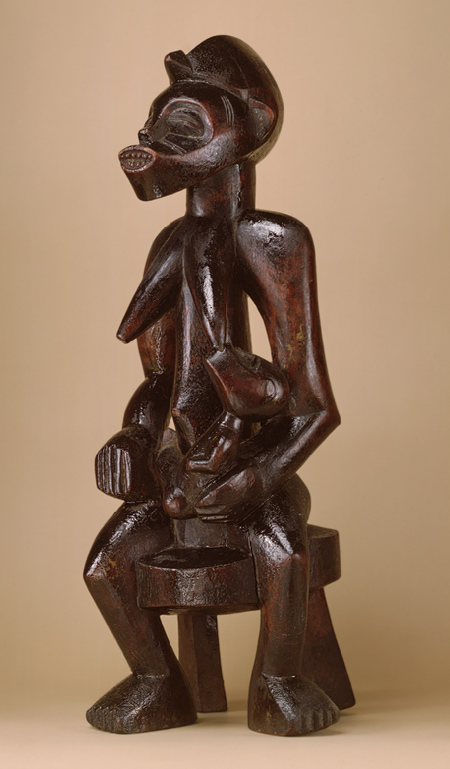
| Maternity Figure, 19th–20th century Senufo peoples; Côte d'Ivoire Wood, oil patina; H. 21 1/4 in. (54 cm) Gift of Lawrence Gussman, 1981 (1981.397) Metropolitan Museum of Art, NY This impressive representation depicts a mother nursing an infant. The sculpture is used to honor women and their maternal role in ceremonies and festivals of the tyekpa society, a social association among the Senufo peoples. The delicate infant strains at his mother's breast intently focused on its vital nourishment, while his mother remains stoic, steadying the baby in her left arm. The head of the mother is rendered in a rather expressionistic fashion, with pronounced mouth, large eyes, and crestlike coiffure. Her slit eyes suggest a sense of introspection and serenity as she fulfills her maternal obligations. The mother's face is further adorned with fine linear incising on the temples and cheeks, marks that are analogous to those made on Senufo women after having reached puberty. The surface of the figure is finished in a lustrous sticky patina, indicating the frequent application of oils as spiritual libations, but also to preserve the piece. The tyekpa association functions in Senufo culture primarily as a funerary society. This sculpture is but one element of complex funerary celebrations that also include music, song, and dance. These elements come together to pay homage to and honor the memory of an elder tyekpa "mother." During the ceremonies, tyekpa members dance with various figurative sculptures such as this mother-child pairing raised high above their head. Due to its prominent visual display in the funerary proceedings, tyekpa figurative sculptures are rather large, some measuring three to four feet in height; this piece is nearly two feet tall. The Senufo peoples form a complex network comprising more than thirty subgroups with many local variations of language and custom. They occupy a large area of West Africa that spans the national boundaries of Côte d'Ivoire, Mali, and Burkina Faso. Senufo society is patriarchal; inheritance, however, is traced through the matrilineal line. Consequently, the primacy placed on women and their essential maternal role is often reflected in Senufo artistic traditions like this sculpture. The tyekpa association is part of a larger social organization among the Senufo known as Sandogo. Membership in Sandogo is limited to female members of the Senufo community. Senufo life revolves around the Sandogo society and its counterpart, the all-male Poro society. These institutions cut across kinship lines and household ties, creating a social cohesiveness that extends throughout the community. Source: Metropolitan Museum of Art |
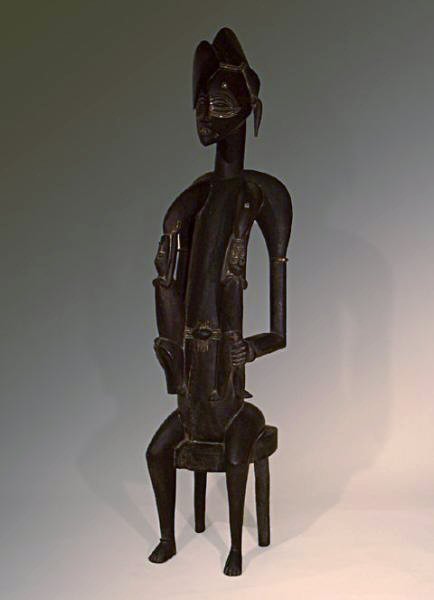
| FIGURE OF ANCIENT MOTHER. KULEBELE CARVER FOR SENUFO PATRONS. 2OTH CENTURY OR EARLIER. WOOD, HEIGHT 36 3/4 (93.5 CM). THE WALT DISNEY-TISHMAN AFRICAN ART COLLECTION |
| 43" x 9.5" x 9.25 - LA Gallery |

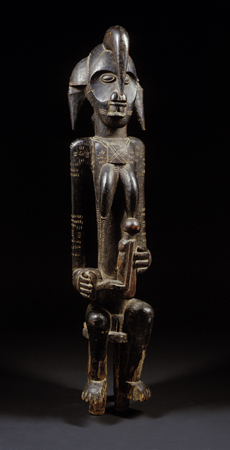
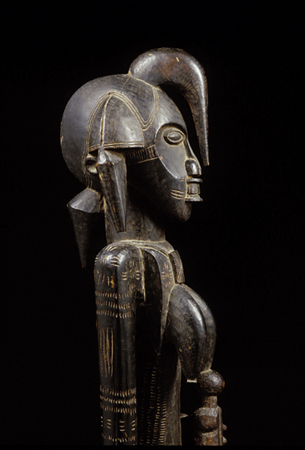
| Senufo maternity from a Sotheby's auction |
| Maternity figure, Senufo; Ivory Coast Wood, traces of pigment; H. 401/2 Remnants of Ritual book |
| Senufo maternity figures The importance of women is explicitly acknowledged in statues of a personage known as Ancient Mother who is typically depicted holding a small child on her lap. Ancient Mother is considered the head of Poro, as exemplified by the saying "Poro is a woman." The sacred grove considered to be her ward, or compound. She represents the female aspect of creation and is the founder and guardian of the matrilineage. She is the spiritual mother of all Senufo males who pass through Poro, and, metaphorically, the mother of the community itself. According to some scholars, carvings of Ancient Mother are deliberately non-naturalistic so as to emphasize her symbolic rather than her biological roles in Senufo culture. A statue of Ancient Mother is shown to novices during the Poro learning process, in part as an indication that beyond the obvious lies the hidden, an idea also exemplified by the secret language learned by novices. Initiation begins with boys being taken from their biological mothers to enter a period of dislocation in the compound of Ancient Mother and under her care. Ancient Mother absorbs the young novices, who are not yet seen as human. She will symbolically give birth to them many years later, after their initiation is complete. New initiates undergo a symbolic death through such rituals as crawling through a muddy tunnel. They are reduced to a kind of emptiness, a liminal or in-between status. Over the long course of their initiation, they confess their breaches of acceptable behavior, and undergo intensive instruction in the male arts of living and in the Poro language and other lore. They submit to numerous ordeals and tests, including small cuts inflicted by Ancient Mother's "leopard." At one point, they pass through a narrow opening called "the old woman's vagina" to enter a symbolic womb. At the end of the process, tutors lead graduating initiates out through an actual door, signaling their rebirth as issues of Ancient Mother. Now fully socialized men and complete human beings, they have been nourished by the "milk of knowledge" at their Mother's breast, as is keyed in the carving's iconography. Only superficially a biological nursing mother, then, an image of Ancient Mother is a veiled and rather abstract sign of the systematic body of knowledge acquired by Poro initiates. Source - A History of Art in Africa |
| Most of the images and information on this page are from the WONDERFUL book "African Art in the Cycle of Life" and The National Museum of African Art except where noted |
| African maternity figures main page Rand African Art home page |