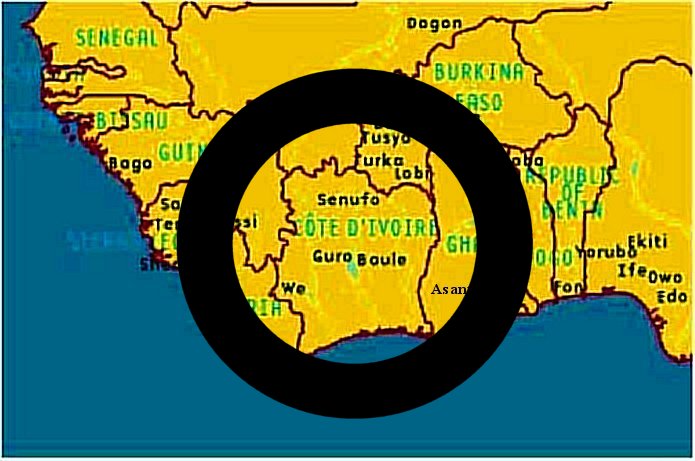
| SENUFO Burkina Faso, Côte d'Ivoire, Ghana and Mali |
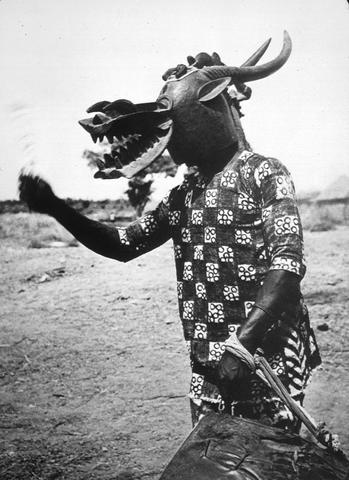
| Kponyungo Ethnic group: Kufulo Vernacular name and meaning: Kponyungo is the semi-public name (nyun-go means "head"; kpoo wii, high mid-tone, means "the dead one" or "corpse" and kpoo, high tone, means "to kill".) Thus, a broad translation of Kponyungo is "funeral head mask". Material components: Mask- carved, wooden, zoomorphic helmet mask; same dome shaped helmet and antelope horns as on the Gbon masks. The Senambele see the masks as basically an antelope head that is given additional selective features for both symbolic and decorative purposes. The antelope represent specific species, a fact that accounts for some important 'style' differences to be observed in collections. Kponyungo masks tend to be more elaborate then the austere forms of the Gbon and after 1950 were painted with lavish polychrome decorations. Whereas the Gbon usually has only the chameleon figure on the crest, the Kponyungo frequently has a group of figures, which may vary slightly from one mask to another. A Common grouping is a bird (fish eagle, long crested helmet shrike, or hornbill) biting a chameleon attached to a cup form, the latter a reference to a container for magical herbs and leaves. Another element can be a female figure added to the muzzle of the mask. Occasionally a magic bundle of porcupine quills and feathers is inserted into holes on the head and muzzle, but is not a consistent feature, as it is with the artisan helmet masks. The most critical features are the warthog tusks and the antelope horns. Costume: Jump suit with drawstring neck and straight-cut legs and sleeves (hands and feet allowed to show in contrast to the conservative Gbon raffia costume) painted in deep red dyes or sienna brown with geometric and figurative patterns. Each suit has a unique design. Other attributes: The masker carries a large, double-membrane, cylindrical drum beaten with a flexible, bludgeonlike stick. The Kponyungo is accompanied by an age mate playing the most sacred of the Kufulo Poro society drums, a long narrow cylindrical one played with a bent stick. Performance context(s): Ancestor rites in the commemorative funeral for graduates of the Poro society. The Kponyungo masks, one for each participating Poro organization, drum by the side of the carved wooden bed used in Central Senufo funeral ritual. This ritual always takes place by the small kpaala (a long wooden shelter with stacked layers of wood poles placed at alternating angles, serving both as domestic courtyard furniture and as a visual reference to the ancestral lineage of the katiolo chief) of the lineage group to which the dead man belonged. Source: Art and Death in a Senufo Village The complexity of the Senufo funeral rites derives both from the importance of the event and from the danger incurred by the whole group. The spirit of the dead man roams around the village and lingers in the spots he used to frequent. If this force is allowed to roam freely around, it could bring back the original chaos. It is therefore essential that it should be captured. The initiates alone have the power and energy to overcome the dead man's spirit. The Tyolobele blow on great horns made out of a single piece of wood. These are the nanaa, and they evoke the roar of a lion. The Poro dignitaries beat on thin, high-pitched drums called tyepingdaana. They are accompanied by the laladyogo, an enigmatic character muffled up in a cotton cloth which reveals only the eyes. On his head he wears a large plaited straw hat decorated with the white and black feathers of a fishing eagle. Finally, the Poro masks join the procession. Among them are the kponyungo masks with their tyobige drums. The strange procession follows the tracks of the dead man's soul through the village and up to the bed on which his body lies. One of the kponyungo masqueradors then takes a small armpit drum, jumps up on the bed and stands astride the corpse, all the time beating a rapid beat on the instrument with his fingers. He is assisted by an initiate who shakes iron bells to the same rhythm. The function of this ritual is to stress, with the help of the music, the power of the Poro society, and also to chase the dead man's soul right away from the village and the cultivated fields and into the region of the dead. The Dance, Art and Ritual of Africa, by Michel Huet (This page contains a lot of images) |

| From: Art and Death in a Senufo Village |

| Senufo Kponyungo mask 31" long It's probably not a terribly old mask, but I think it is a wonderful mask in nice style and form in my opinion. I have a weakness for these masks, I love them! I originally sought out the non painted versions, but I have come to enjoy the painted versions even more. *This example is no longer in my collection |
|

|

|


|

|

| Kponyungo masquerades and tyolobele Senior intiates from five seperate Kufulo sinzangas appear together at a funeral for a Kufulo elder ( May 1970). From: Art and Death in a Senufo Village |
|
|

|

|