
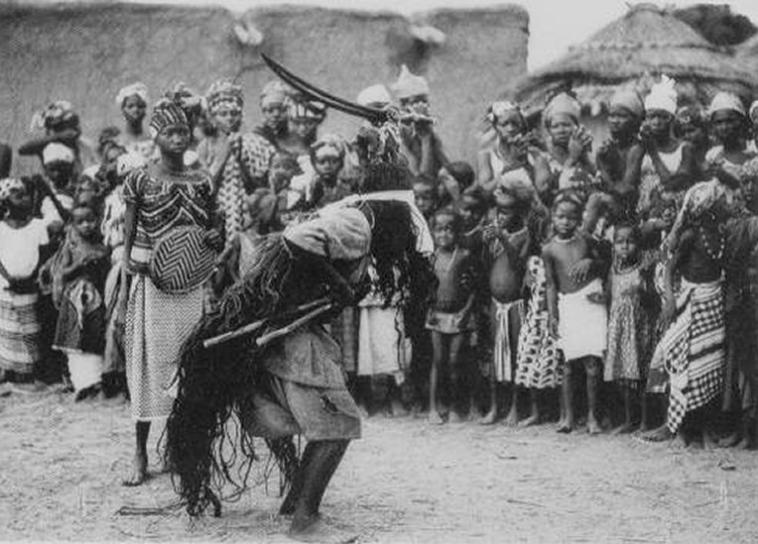
| Horizontal style Few objects are so generally identified with African art as the Bamana "antelope" headdress. It is actually a complex object, with tremendous variations in style and technique, but share the same symbolism. The differences are usually attributed to the regional styles set forth in 1960 by Robert Goldwater, whose work relied on museum- based research and the 1934-35 field data of F. H. Lem. Most African sculptures are carved from one piece of wood, but the horizontal style of antelope mask uses two: one for the head and neck, and one for the body. The tji wara society members use a headdress representing, in the form of an antelope, the mythical being who taught men how to farm. The word tji means “work” and wara means “animal,” thus “working animal.” There are antelopes with vertical or horizontal direction of the horns. In the past the purpose of the tji wara association was to encourage cooperation among all members of the community to ensure a successful crop. In recent time, however, the Bambara concept of tji wara has become associated with the notion of good farmer, and the tji wara masqueraders are regarded as a farming beast. The Bambara sponsor farming contests where the tji wara masqueraders perform. Always performing together in a male and female pair, the coupling of the antelope masqueraders speaks of fertility and agricultural abundance. According to one interpretation, the male antelope represents the sun and the female the earth. The antelope imagery of the carved headdress was inspired by a Bambara myth that recounts the story of a mythical beast (half antelope and half human) who introduced agriculture to the Bambara people. The dance performed by the masqueraders mimes the movements of the antelope. Antelope headdress in the vertical style, found in eastern Bambara territory, have a pair of upright horns while in the Southern regions they are generally found with horizontal horns like the example below. The dancers appeared holding two sticks in their hands, their leaps imitating the jumps of the antelopes. |